Quality Standards
American Owned
Mixed, bottled, and tested in the USA
Third-Party Tested
Independently tested for purity and quality
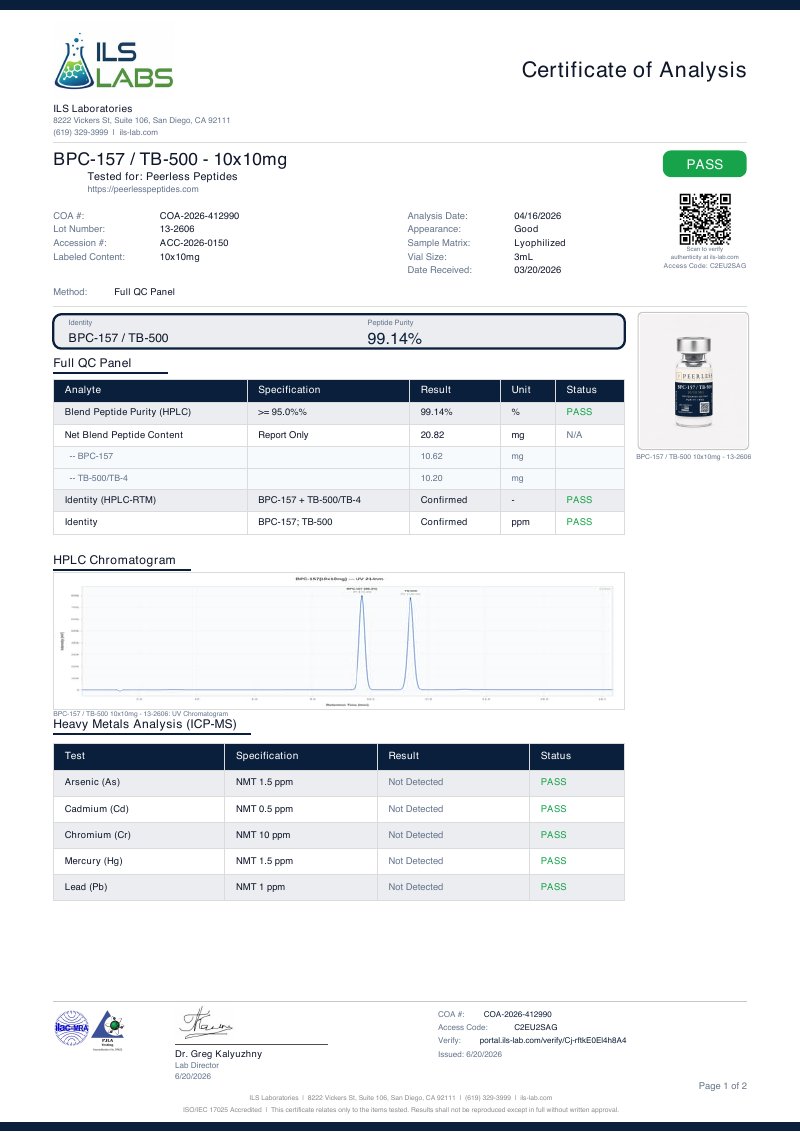
>99% Purity
Exceptional purity you can trust
Also Screened For
Endotoxins + Heavy Metals
Beyond the identity, purity & sterility panel.
BPC-157 + TB-500 Blend
Contents: BPC-157 (10mg) · TB-500 (10mg)
Dual research peptide preparation: BPC-157 pentadecapeptide + TB-500 LKKTETQ heptapeptide more info
Available for laboratory research use only.
Quality Standards
American Owned
Mixed, bottled, and tested in the USA
Third-Party Tested
Independently tested for purity and quality
>99% Purity
Exceptional purity you can trust
Also Screened For
Endotoxins + Heavy Metals
Beyond the identity, purity & sterility panel.
Vial size
Choose your supply
3 vials· 30mg-10mg total
Save $18.75 (5% off)
Total
$356.25
Volume pricing applies to your total vials, not just this product. Mix or match any vials in your cart to reach the next tier.
Independent Lab Results
The most comprehensive testing panel in research peptide commerce. Every batch is independently verified by ILS Laboratories — an ISO/IEC 17025 and PJLA-accredited facility in San Diego, CA.
- Identity
- Purity (HPLC)
- Endotoxin (USP <85>)
- Sterility screen (PCR)
- Heavy metals (ICP-MS per USP <233>)
Biochemical Profile
- CAS Number
- 137525-51-0 (BPC-157) / 885340-08-9 (TB-500)
- Molecular Formula
- C62H98N16O22 (BPC-157) / C38H68N10O14 (TB-500)
- Molecular Weight
- 1419.54 g/mol (BPC-157) / 889.02 g/mol (TB-500)
- Purity
- >99% (each component) (HPLC-UV (214-220 nm), each component)
- Amino Acid Sequence
- BPC-157: Gly-Glu-Pro-Pro-Pro-Gly-Lys-Pro-Ala-Asp-Asp-Ala-Gly-Leu-Val | TB-500 (7-mer): Ac-Leu-Lys-Lys-Thr-Glu-Thr-Gln
Mechanism Context: Two Independent Molecular Pathways
BPC-157 has been investigated as a modulator of nitric oxide (NO) signaling and as an upstream effector in the VEGFR2-Akt-eNOS angiogenesis pathway across rodent models[1]. The mechanism work mapping the VEGFR2 pathway was reported by the Chang research group at Chang Gung University, Taiwan, the only non-Zagreb laboratory to have published substantive original mechanism research on BPC-157[2]. No specific high-affinity BPC-157 receptor has been identified in the published peer-reviewed literature, and current mechanism proposals are drawn from observed effects in preclinical models rather than direct receptor pharmacology.
TB-500 (the Ac-LKKTETQ 7-mer) corresponds to residues 17-23 of the parent protein thymosin beta-4 (Tβ4). The strongest mechanistic finding in the broader Tβ4 literature is 1:1 binding of monomeric ATP-G-actin via the LKKTET motif at residues 17-22, with affinity in the sub-micromolar range; X-ray crystallography has shown that essentially the entire 43-residue parent chain wraps the actin monomer in solution[3][4]. The commercial 7-mer reproduces the actin-binding contact but lacks N-terminal and C-terminal flanking regions present in the full Tβ4 parent protein. The 7-mer (MW ~889 Da) and full Tβ4 (MW ~4921 Da) differ by more than 5x in mass; every RegeneRx-sponsored human clinical trial of thymosin beta-4 used the full 43-mer, not the LKKTETQ 7-mer[5].
No peer-reviewed mechanism study has investigated the combined administration of BPC-157 and TB-500. The two molecules have been studied within distinct preclinical research streams (BPC-157 in gastric mucosal, tendon, and vascular preparations; the TB-500 7-mer and full Tβ4 in actin-sequestration, dermal wound, and endothelial-migration preparations), and no published peer-reviewed study has examined a shared molecular pathway, a co-administration pharmacokinetic interaction, or a combined-administration mechanism in any model system as of May 2026.
Research Applications
Component Composition
This product is supplied as a single lyophilized vial containing two structurally distinct synthetic peptides.
BPC-157 is a 15-amino-acid linear pentadecapeptide with sequence Gly-Glu-Pro-Pro-Pro-Gly-Lys-Pro-Ala-Asp-Asp-Ala-Gly-Leu-Val (single-letter: GEPPPGKPADDAGLV). Molecular formula C62H98N16O22, molecular weight 1419.54 g/mol, CAS 137525-51-0, PubChem CID 9941957. The peptide contains no aromatic residues; HPLC-UV detection is conducted at 214-220 nm.
TB-500 is the synthetic acetylated heptapeptide Ac-Leu-Lys-Lys-Thr-Glu-Thr-Gln (single-letter: Ac-LKKTETQ), corresponding to residues 17-23 of the parent protein thymosin beta-4 (Tβ4). Molecular formula C38H68N10O14, molecular weight 889.02 g/mol, CAS 885340-08-9, PubChem CID 62707662. The 7-mer also contains no aromatic residues and HPLC-UV detection is again at 214-220 nm; a vendor reporting 280 nm purity is systematically missing non-aromatic impurities. Each component meets ≥99% purity per batch, with lot-specific results in the Certificate of Analysis library.
BPC-157 Research Summary
BPC-157 was first described by the Sikirić research group at the University of Zagreb in 1991-1993 as a fragment of a putative ~40 kDa 'body protection compound' protein isolated from human gastric juice[6]. The 1993 paper framed the work in terms of a stomach-stress-organoprotection hypothesis and reported observations across rat preparations of gastric mucosal injury under various stressors. The parent protein has never been formally sequenced or assigned a UniProt entry; the 15-residue synthetic sequence (GEPPPGKPADDAGLV) is the only material that has been the subject of subsequent research. Approximately 87% of the ~200 BPC-157 papers indexed on PubMed have Sikirić as first or senior author, and approximately 81% have co-author Seiwerth; the citation network is effectively a single laboratory.
Gastrointestinal research models account for the largest body of published BPC-157 literature. Rat preparations of gastric ulceration, NSAID-induced gastrointestinal lesions, intestinal anastomosis, and inflammatory bowel injury have been the most frequently used systems, with the 2018 Zagreb review framing the molecule as a cytoprotective mediator across these preparations. A development-stage preparation designated PL14736 was the subject of early-phase clinical investigation as a candidate for inflammatory bowel disease but did not advance to Phase 2 or Phase 3 efficacy trials in the peer-reviewed record.
Tendon-injury preparations have been a second sustained focus in the BPC-157 literature and the area where the only substantive non-Zagreb original mechanism work has been concentrated. The Chang research group at Chang Gung University, Taiwan, reported observations on cell survival, fibroblast migration markers, and Vinculin/F-actin distribution in cultured tendon explants and in vivo rat Achilles transection preparations[2]. Rat skin wound and burn preparations have been used to investigate BPC-157 across the dermatology literature, with reported observations on re-epithelialization rate and angiogenesis markers in standardized excisional models. In rat muscle-injury research, the most-cited preclinical paper specifically addressed muscle recovery under conditions of systemic corticosteroid administration (Pevec 2010), reporting observations on gastrocnemius muscle structure and functional measurements following crush injury, in animals receiving and not receiving systemic dexamethasone[16].
The only independent pharmacokinetic study (Xu 2022) reported plasma half-lives of approximately 15 minutes intravenous in rat and 5 minutes intravenous in beagle dog, with bioavailability of 14-19% in rats and 45-51% in dogs and no drug accumulation across 7 days of repeated dosing[7]. This is the single peer-reviewed pharmacokinetic dataset originating outside the Zagreb research orbit. The full BPC-157 literature review is available on the BPC-157 component PDP.
TB-500 Research Summary
TB-500 (Ac-LKKTETQ) is the synthetic 7-mer corresponding to residues 17-23 of full thymosin beta-4 (Tβ4, UniProt P62328), a 43-amino-acid intrinsically disordered protein originally isolated from calf thymus in 1981[8]. The two molecules differ by more than 5x in mass: the 7-mer at ~889 Da versus full Tβ4 at ~4921 Da. This disambiguation is load-bearing. Every RegeneRx-sponsored Phase 2 and Phase 3 trial of thymosin beta-4 used the full 43-mer; published human-efficacy claims for 'thymosin beta-4' describe the full parent, not the LKKTETQ fragment.
The strongest reproducible mechanism finding in the Tβ4 literature is 1:1 binding of monomeric ATP-G-actin via the LKKTET motif at residues 17-22, with affinity in the sub-micromolar range (Safer 1991)[3]. X-ray crystallography (Irobi 2004) demonstrated that essentially the entire 43-residue chain wraps the actin monomer in solution, with LKKTET as the high-affinity contact region[4]. The single most-cited direct comparison between the full 43-mer and the LKKTETQ 7-mer in any in vivo readout is Philp et al. (2003) in db/db diabetic and aged-mouse dermal wound models[9]. This small-animal paper from the Goldstein/Kleinman collaboration is the foundation of the commercial premise that the 7-mer recapitulates full-Tβ4 activity; equivalence in corneal, cardiac, or other indications has not been independently established.
The Tβ4 clinical record spans approximately 25 years and is dominated by RegeneRx Biopharmaceuticals using the full 43-mer. The Phase 3 ophthalmic program (RGN-259) comprises three completed dry-eye trials (ARISE-1 n=317, ARISE-2 n=601, ARISE-3 n=700) and one completed European neurotrophic keratopathy trial (SEER-3), all of which missed their pre-specified primary endpoints. The cardiac intravenous program (RGN-352) was placed on FDA clinical hold in March 2011 and never enrolled patients. Two independent replications contradicted the cardiac headline findings: Zhou et al. (2012) reported that full-length Tβ4 after myocardial infarction did not reprogram epicardial cells into cardiomyocytes[17], and Banerjee et al. (2012) reported that global and cardiac-specific Tβ4 knockout mice are born at Mendelian ratios with normal heart and coronary vessel development[18].
RegeneRx filed SEC Form 15 in August 2023, terminating its public-company reporting obligations. A separate Phase 1/2 study sponsored by Hudson Biotech (NCT07487363) is the first publicly registered US trial using the LKKTETQ 7-mer by name, in stable atherosclerotic cardiovascular disease with cardiovascular-biomarker endpoints (recruiting as of May 2026); it is the first 7-mer-specific human trial in approximately 25 years of Tβ4 clinical development[14]. The full TB-500 literature review is available on the TB-500 component PDP.
Pathway Independence
The published mechanism literature for BPC-157 and TB-500 maps onto two distinct molecular target sets. BPC-157 has been characterized within the nitric oxide (NO) signaling axis and the VEGFR2-Akt-eNOS angiogenesis pathway across rat models of gastric mucosal injury and tendon injury; the receptor-binding profile in human tissue has not been characterized in the peer-reviewed literature[1][2]. TB-500 (and the full Tβ4 parent protein) has been characterized within the actin-sequestration mechanism, forming a 1:1 complex with monomeric ATP-G-actin via the LKKTET contact residues 17-22 of the parent protein[3][4].
No published peer-reviewed study has identified a shared molecular target, a converging signaling pathway, or a documented pharmacokinetic interaction between the two molecules in any cellular or animal system. The body of mechanism work on each compound has been conducted by separate research groups (Sikirić at Zagreb and Chang at Chang Gung for BPC-157; Goldstein at GWU and the Sosne/Kleinman collaboration for TB-500 and full Tβ4) within separate preclinical model systems.
The two compounds are frequently mentioned together in non-clinical commerce contexts as a single-vial preparation. The pathway-independence framing here is a description of the literal mechanism literature on each compound, not an assertion about combined biological activity.
Combined Administration Literature
No peer-reviewed combined-administration studies of BPC-157 and TB-500 exist in the published clinical or preclinical literature as of May 2026. A PubMed search for the two compound names in combination returns no primary research articles characterizing co-administration in any model system. The two compounds have been studied separately, by separate research groups, in separate preclinical preparations, across roughly 30 years. Readers seeking the component literature should consult the BPC-157 and TB-500 individual PDP entries on this site, which contain the full per-compound reference list.
The combined-vial commercial format predates any peer-reviewed combined-administration data. The format originated in the equine veterinary and Australian compounding channel in the late 2000s and migrated into the broader research-peptide commerce sector without a corresponding research literature.
The one regulatory enforcement data point involving this specific compound pair is the Emma Brooks case: a Canadian university volleyball athlete sanctioned by U Sports / CCES with a 4-year suspension (ending 3 December 2028) for BPC-157 + TB-500 use during the August-September 2024 competition window[10]. The case is administrative, not a peer-reviewed pharmacology study, but it is the only documented enforcement data point tying the two compounds together.
Replication and Clinical Status
Both BPC-157 and TB-500 were removed from FDA 503A Category 2 (Do-Not-Compound) effective April 22, 2026, though removal does not confer Category 1 status or compoundability. The Pharmacy Compounding Advisory Committee (PCAC) has scheduled both compounds for review on the July 23, 2026 Day 1 docket; the FDA docket lists a proposed ulcerative-colitis indication for BPC-157 and a proposed wound-healing indication for TB-500[11][12]. The World Anti-Doping Agency bans both compounds at all times: BPC-157 under S0 (Non-Approved Substances) and TB-500 under S2 (Peptide Hormones, Growth Factors, Related Substances and Mimetics). Australia's Therapeutic Goods Administration has scheduled BPC-157 as Schedule 9 (Prohibited Substance) effective July 1, 2026.
Two independently registered active human trials are currently recruiting, neither of which studies the combined preparation. Hudson Biotech sponsors NCT07437547 (BPC-157 Phase 2 for acute hamstring muscle strain repair, n=120 estimated, recruiting since February 2026)[13] and NCT07487363 (TB-500 LKKTETQ 7-mer Phase 1/2 in stable atherosclerotic cardiovascular disease with cardiovascular-biomarker endpoints, n=80, recruiting as of May 2026)[14]. Both trials examine each compound in isolation. No registered human trial of the BPC-157 + TB-500 combination exists on ClinicalTrials.gov as of May 2026.
Handling & Storage
- Storage (lyophilized)
- -20°C, dry, dark
- Storage (in solution)
- 2-8°C, use within 28 days
- Shelf Life
- 24 months lyophilized
Research References
- [1] Sikirić P, Seiwerth S, Rucman R, et al. Stable gastric pentadecapeptide BPC 157-NO-system relation. Curr Pharm Des. 2014;20(7):1126-1135. PMID:23755725
- [2] Chang CH, Tsai WC, Lin MS, Hsu YH, Pang JHS. The promoting effect of pentadecapeptide BPC 157 on tendon healing involves tendon outgrowth, cell survival, and cell migration. J Appl Physiol. 2011;110(3):774-780. doi:10.1152/japplphysiol.00945.2010PMID:21030672
- [3] Safer D, Elzinga M, Nachmias VT. Thymosin β4 and Fx, an actin-sequestering peptide, are indistinguishable. J Biol Chem. 1991;266(7):4029-4032. PMID:1996337
- [4] Irobi E, Aguda AH, Larsson M, et al. Structural basis of actin sequestration by thymosin-β4: implications for WH2 proteins. EMBO J. 2004;23(18):3599-3608. PMID:15329672
- [5] Ruff D, Crockford D, Girardi G, Zhang Y. A randomized, placebo-controlled, single and multiple dose study of intravenous thymosin β4 in healthy volunteers. Ann N Y Acad Sci. 2010;1194:223-229. PMID:20536472
- [6] Sikirić P, Petek M, Rucman R, et al. A new gastric juice peptide, BPC. An overview of the stomach-stress-organoprotection hypothesis and beneficial effects of BPC. J Physiol Paris. 1993;87(5):313-327. doi:10.1016/0928-4257(93)90038-uPMID:8298609
- [7] Xu T, Zhang Z, et al. Pharmacokinetics, bioavailability, and tissue distribution of body protection compound 157 (BPC 157) in rats and beagle dogs. Front Pharmacol. 2022;13:1052033. PMID:36588717
- [8] Low TL, Hu SK, Goldstein AL. Complete amino acid sequence of bovine thymosin β4: a thymic hormone that induces terminal lymphocyte differentiation. Proc Natl Acad Sci USA. 1981;78(2):1162-1166. PMID:6940133
- [9] Philp D, Badamchian M, Scheremeta B, et al. Thymosin β4 and a synthetic peptide containing its actin-binding domain promote dermal wound repair in db/db diabetic mice and in aged mice. Wound Repair Regen. 2003;11(1):19-24. PMID:12581423
- [10] Canadian Centre for Ethics in Sport (CCES). Anti-doping rule violation announcement: Emma Brooks (U Sports volleyball), 4-year sanction for use of prohibited substances BPC-157 and TB-500 during the August-September 2024 competition window; sanction effective through 3 December 2028. CCES public registry, announced December 2024.
- [11] U.S. Food and Drug Administration. Removal of certain substances from the 503A bulks list, including BPC-157 and TB-500. Federal Register notice, effective April 22, 2026. Pharmacy Compounding Advisory Committee meeting agenda, scheduled July 23, 2026.
- [12] World Anti-Doping Agency. 2026 WADA Prohibited List, S0 Non-Approved Substances (BPC-157) and S2 Peptide Hormones, Growth Factors, Related Substances and Mimetics (TB-500 / thymosin beta-4 fragment). World Anti-Doping Code.
- [13] Hudson Biotech. BPC 157 for Acute Hamstring Muscle Strain Repair. ClinicalTrials.gov Identifier: NCT07437547. Phase 2, n=120 estimated, status: recruiting since February 2026 (verified 2026-05-19). Primary endpoints: time to return to sport, MRI hamstring injury volume.
- [14] Hudson Biotech. TB-500 (residues 17-23 fragment of thymosin beta-4) for cardiovascular biomarkers in stable atherosclerotic cardiovascular disease. ClinicalTrials.gov Identifier: NCT07487363 (Phase 1/2, recruiting; 80 estimated participants; verified 2026-05-19).
- [15] Sosne G, Qiu P, Goldstein AL, Wheater M. Biological activities of thymosin β4 defined by active sites in short peptide sequences. FASEB J. 2010;24(7):2144-2151. PMID:20179146
- [16] Pevec D, Novinscak T, Brcic L, et al. Impact of pentadecapeptide BPC 157 on muscle healing impaired by systemic corticosteroid application. Med Sci Monit. 2010;16(3):BR81-BR88. PMID:20190676
- [17] Zhou B, Honor LB, Ma Q, et al. Thymosin beta 4 treatment after myocardial infarction does not reprogram epicardial cells into cardiomyocytes. J Mol Cell Cardiol. 2012;52(1):43-47. PMID:21907210
- [18] Banerjee I, Zhang J, Moore-Morris T, et al. Cytoskeletal protein thymosin β4 is dispensable for murine cardiac development and function. Circ Res. 2012;110(3):456-464. PMID:22158707
Scientific Journal Author
Predrag Sikirić, MD, PhD
Department of Pharmacology, University of Zagreb School of Medicine
Landmark Publications
- Sikirić P, Petek M, Rucman R, et al. A new gastric juice peptide, BPC. J Physiol Paris. 1993;87(5):313-327. (PMID 8298609)
- Sikirić P, Seiwerth S, Rucman R, et al. Stable gastric pentadecapeptide BPC 157-NO-system relation. Curr Pharm Des. 2014;20(7):1126-1135. (PMID 23755725)
- Sikirić P, Seiwerth S, Brcic L, et al. Stable gastric pentadecapeptide BPC 157 as a novel cytoprotective mediator. Curr Pharm Des. 2018;24(18):1990-2001. (PMID 29879879)
Dr. Sikirić is independently cited here as the originating researcher of BPC-157 at the University of Zagreb. He is not affiliated with the TB-500 / thymosin beta-4 research line; the originating researchers of the TB-500 7-mer and the full thymosin beta-4 parent protein are Allan L. Goldstein and Hazel K. Kleinman, of the Department of Biochemistry and Molecular Medicine at The George Washington University School of Medicine and Health Sciences (see the TB-500 component PDP for the Goldstein scientific-author entry). There is no affiliation or commercial relationship between Dr. Sikirić, Dr. Goldstein, Dr. Kleinman, the University of Zagreb, The George Washington University, or any associated commercial entity, and Peerless Peptides.
Component Compounds
This blend is formulated from the following individual research compounds, each with its own reference entry.