Quality Standards
American Owned
Mixed, bottled, and tested in the USA
Third-Party Tested
Independently tested for purity and quality
>99% Purity
Exceptional purity you can trust
Also Screened For
Endotoxins + Heavy Metals
Beyond the identity, purity & sterility panel.
CJC-1295 + Ipamorelin Blend
Contents: CJC-1295 (5mg) · Ipamorelin (5mg)
Dual GHRH-axis research preparation: CJC-1295 with DAC (30-amino-acid GHRH analog with albumin-binding modification) and Ipamorelin (selective ghrelin-receptor pentapeptide) more info
Available for laboratory research use only.
Quality Standards
American Owned
Mixed, bottled, and tested in the USA
Third-Party Tested
Independently tested for purity and quality
>99% Purity
Exceptional purity you can trust
Also Screened For
Endotoxins + Heavy Metals
Beyond the identity, purity & sterility panel.
Vial size
Choose your supply
3 vials· 15mg-5mg total
Save $12.00 (5% off)
Total
$228.00
Volume pricing applies to your total vials, not just this product. Mix or match any vials in your cart to reach the next tier.
Independent Lab Results
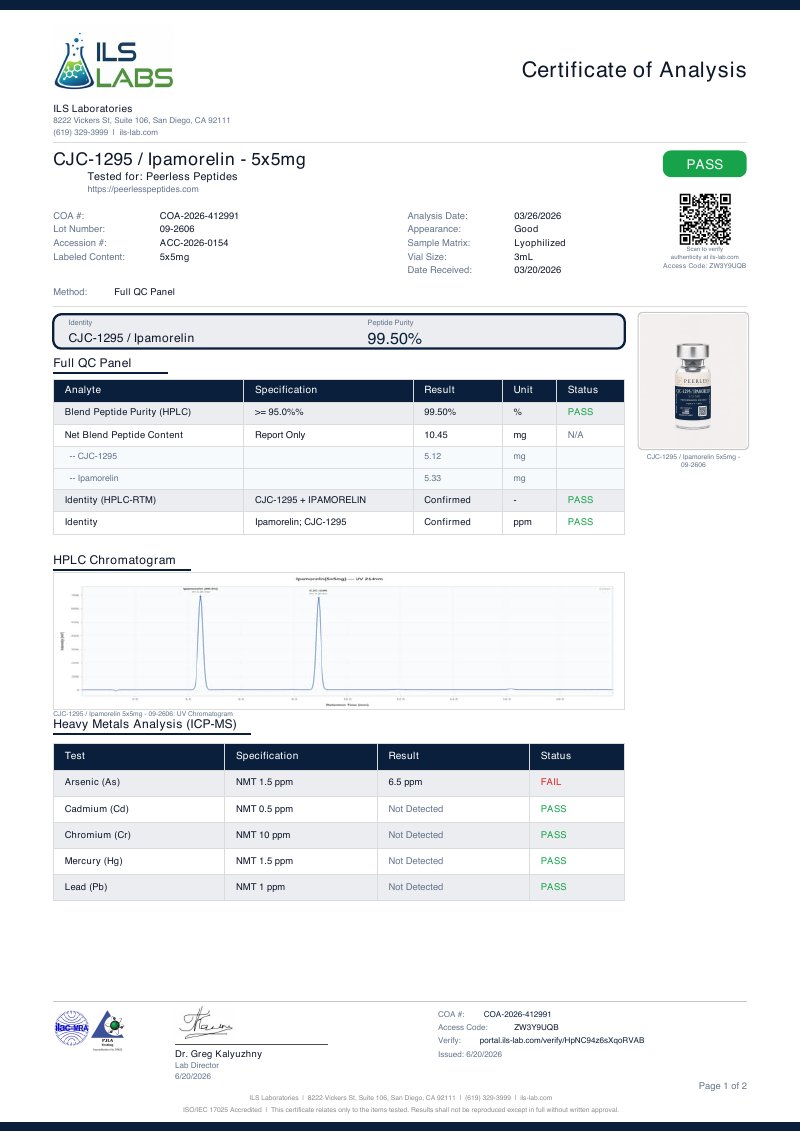
The most comprehensive testing panel in research peptide commerce. Every batch is independently verified by ILS Laboratories — an ISO/IEC 17025 and PJLA-accredited facility in San Diego, CA.
- Identity
- Purity (HPLC)
- Endotoxin (USP <85>)
- Sterility screen (PCR)
- Heavy metals (ICP-MS per USP <233>)
Biochemical Profile
- CAS Number
- 863288-34-0 (CJC-1295 with DAC) / 170851-70-4 (Ipamorelin)
- Molecular Formula
- C165H269N47O46 (CJC-1295) / C38H49N9O5 (Ipamorelin)
- Molecular Weight
- 3647.25 g/mol (CJC-1295) / 711.86 g/mol (Ipamorelin)
- Purity
- >99% (each component) (RP-HPLC-UV (220 nm) per component; LC-MS deconvolution on CJC-1295 batches to confirm DAC integrity)
- Amino Acid Sequence
- CJC-1295: Tyr-D-Ala-Asp-Ala-Ile-Phe-Thr-Gln-Ser-Tyr-Arg-Lys-Val-Leu-Ala-Gln-Leu-Ser-Ala-Arg-Lys-Leu-Leu-Gln-Asp-Ile-Leu-Ser-Arg-Lys(Nε-MPA); Ipamorelin: H-Aib-His-D-2Nal-D-Phe-Lys-NH2
Dual-Receptor Class Pharmacology of GHRH-R Agonism and GHS-R1a Agonism
This preparation contains two peptides that engage two chemically distinct G-protein-coupled receptors expressed on the same target cell population (the anterior pituitary somatotroph) through different second-messenger pathways. CJC-1295 with DAC binds growth hormone-releasing hormone receptor (GHRH-R), a Gαs-coupled receptor whose activation drives cyclic AMP elevation and pulsatile GH transcription[1]. Ipamorelin binds growth hormone secretagogue receptor type 1a (GHS-R1a), a Gαq-coupled receptor whose activation drives phospholipase-C, IP3, and intracellular calcium release[2]. The two pathways converge on somatotroph GH release through independent signaling cascades.
CJC-1295 with DAC differs from sermorelin (native GHRH 1-29, FDA-approved 1990, commercially withdrawn 2008) at four positions (D-Ala at position 2, Gln at position 8, Ala at position 15, Leu at position 27) that block enzymatic degradation, plus a maleimidopropionic acid (MPA) linker on the ε-amine of lysine-30. After subcutaneous administration, the maleimide undergoes Michael addition with the free Cys34 thiol of circulating human serum albumin, forming a stable thioether covalent bond. The peptide is now tethered to albumin and inherits albumin's natural 19 to 21 day plasma residence[3]. The without-DAC form (Mod GRF 1-29) lacks this linker and is a chemically distinct 29-amino-acid molecule with an extrapolated half-life closer to 30 minutes; the two forms differ in mass by approximately 280 daltons and in half-life by roughly three orders of magnitude. The form supplied as the CJC-1295 component of this preparation is the with-DAC molecule.
Ipamorelin was derived through medicinal-chemistry simplification of the GHRP-1, GHRP-2, GHRP-6, and Hexarelin series at Novo Nordisk in the mid-1990s. The Raun et al. 1998 foundational paper reported GHS-R1a binding in the low-nanomolar range and growth hormone release from primary rat pituitary cells, anesthetized rats, and conscious swine at potencies comparable to GHRP-6, while plasma ACTH, cortisol, prolactin, FSH, LH, and TSH were not detectably elevated at doses 200-fold above the GH ED50[4]. The methodology has bounds: the cortisol comparator was GHRH rather than vehicle, and human plasma cortisol, ACTH, and prolactin under Ipamorelin have not been measured in the most-cited human pharmacokinetic study (Gobburu et al. 1999)[5]. The narrow defensible claim is that Ipamorelin was more selective than GHRP-6 and GHRP-2 at the pituitary somatotroph in animal preparations.
The dual-receptor class pharmacology of GHRH-analog plus GHRP-class compounds was characterized across multiple human studies by Bowers and colleagues across the 1980s and 1990s. The combined-administration evidence used different GHRH analogs (typically native GHRH or sermorelin) and different GHRPs (typically GHRP-6 or GHRP-2)[6]. Combined administration produced a GH excursion larger than either compound singly in healthy adult preparations. The biological mechanism is established at the level of pulse-amplitude versus basal-frequency control of somatotroph activity. No peer-reviewed randomized controlled trial of CJC-1295 plus Ipamorelin specifically has been conducted. The combined-administration evidence base for this specific pairing is inferred from non-pairing evidence: each molecule's individual pharmacology (Teichman 2006, Ionescu 2006 for the with-DAC CJC-1295 form; Raun 1998 and Gobburu 1999 for Ipamorelin) plus Bowers-class combined-administration biology with substituent non-identical compounds[7][8]. Direct head-to-head Phase 2 or Phase 3 clinical efficacy data on this specific combined administration is absent from the peer-reviewed published literature.
Research Applications
Component Composition
CJC-1295 with DAC is a 30-amino-acid GHRH analog (Tyr-D-Ala-Asp-Ala-Ile-Phe-Thr-Gln-Ser-Tyr-Arg-Lys-Val-Leu-Ala-Gln-Leu-Ser-Ala-Arg-Lys-Leu-Leu-Gln-Asp-Ile-Leu-Ser-Arg-Lys(Nε-MPA), MW 3647.25 g/mol, CAS 863288-34-0, PubChem CID 91971820). The molecule was derived from sermorelin (native GHRH 1-29) by four protease-resistance substitutions (D-Ala at position 2 blocks DPP-IV cleavage; Gln at position 8 removes an asparagine deamidation hotspot; Ala at position 15 stabilizes the backbone; Leu at position 27 eliminates a methionine oxidation site) plus the maleimidopropionic acid (MPA) linker conjugated to the ε-amine of lysine-30[3]. The without-DAC sequence sibling, Mod GRF 1-29, is a 29-amino-acid molecule (MW 3367.95 Da) lacking the MPA linker, with an extrapolated half-life closer to 30 minutes; the two molecules differ by approximately 280 daltons of mass and roughly three orders of magnitude in plasma residence.
Ipamorelin is a synthetic pentapeptide (H-Aib-His-D-2Nal-D-Phe-Lys-NH2, MW 711.86 g/mol, CAS 170851-70-4, PubChem CID 11226745) designed at Novo Nordisk by Raun, Ankersen, Johansen, and colleagues across the mid-1990s. The N-terminal residue is alpha-aminoisobutyric acid (Aib), not isonipecotic acid (Inp); the Inp notation that drifts through some vendor copy belongs to a different Novo Nordisk peptidomimetic series. Two non-canonical D-isomer residues (D-2-naphthylalanine at position 3 and D-phenylalanine at position 4) plus C-terminal amidation distinguish the pentapeptide from proteinogenic precursors. Both component COAs report chiral verification and the LC-MS deconvolution panel that quantifies the three DAC isoforms of CJC-1295.
CJC-1295 Research Summary
The peer-reviewed human pharmacology record for CJC-1295 in either form consists of two ConjuChem-sponsored papers from 2006. Teichman et al. reported two randomized controlled trials in approximately 30 healthy adults (28-day and 49-day arms) with subcutaneous administration of the with-DAC form (CAS 863288-34-0, PubChem 91971820)[7]. Reported plasma half-life was 5.8 to 8.1 days, with GH and IGF-1 elevation persisting for several days per administration in the trial. The ConjuChem chief medical officer was first author and the chief executive a co-author; the trial was internal to the sponsor and has not been independently replicated.
Ionescu and Frohman reported preservation of pulsatile GH secretion over 7 days of continuous GHRH-R activation in 8 healthy young men[8]; generalization to chronic multi-month administration is not in the peer-reviewed literature. The critical disambiguation across both papers is the with-DAC versus without-DAC form. The DAC modification (maleimidopropionic acid linker on lysine-30, covalent Michael addition to Cys34 of human serum albumin) is the entire mechanism behind the 6 to 8 day half-life. The without-DAC sequence sibling (Mod GRF 1-29) is a chemically distinct 29-amino-acid molecule lacking a widely-accepted CAS number, lacking any Phase 1 human pharmacokinetic study under any name, and carrying an extrapolated 30-minute half-life derived from sermorelin comparison rather than direct measurement.
The two FDA-approved GHRH-analog members took a different design path. Sermorelin (approved 1990, withdrawn 2008 for commercial reasons) and tesamorelin (approved 2010 for a narrow HIV-associated indication) are short-half-life molecules that preserve native pulsatile GHRH signaling by design[12]. The with-DAC form of CJC-1295 takes the opposite pharmacokinetic path: albumin tethering converts pulsatile GHRH signaling into sustained, multi-day GHRH-R occupancy. Whether sustained signaling phenocopies pulsatile signaling at chronic timescales is unresolved in the published record.
The ConjuChem program halted in July 2006 following a participant fatality at the Argentina site of NCT00267527 (Phase 2 HIV-associated visceral adiposity, n=192 planned) after the eleventh weekly subcutaneous dose. The attending physician's clinical impression was acute myocardial infarction attributed to asymptomatic pre-existing coronary artery disease; no autopsy, Data Safety Monitoring Board minutes, or regulator report have surfaced in the public record. ConjuChem filed for Canadian bankruptcy on July 21, 2010, and the relaunched ConjuChem LLC (Los Angeles, August 2011) pivoted to a DAC-modified GLP-1 program and never resumed GHRH development. The peer-reviewed evidence base for CJC-1295 is structurally frozen at 2006[9].
Ipamorelin Research Summary
Ipamorelin was designed at Novo Nordisk by Raun, Hansen, Johansen, Ankersen, and colleagues in the mid-1990s through medicinal-chemistry simplification of the GHRP series originally characterized by Cyril Bowers and the Reynolds laboratory. The Raun et al. 1998 paper (PMID 9849822) reported GHS-R1a binding in the low-nanomolar range and GH release from primary rat pituitary, rats, and conscious swine at potencies comparable to GHRP-6, while plasma ACTH, cortisol, prolactin, FSH, LH, and TSH were not detectably elevated at doses 200-fold above the GH ED50[4]. The selectivity finding is animal-only; the cortisol comparator in Raun 1998 was GHRH rather than vehicle, so the published comparison cannot resolve an Ipamorelin-specific cortisol signal smaller than the (zero) GHRH-driven signal. The narrow defensible claim is that Ipamorelin was more selective than GHRP-6 and GHRP-2 at the somatotroph in animals.
The most-cited human pharmacokinetic study (Gobburu et al. 1999, PMID 10496658) reported a plasma half-life of approximately two hours after intravenous administration in healthy male volunteers and measured GH release as the pharmacodynamic readout, but did not measure cortisol, ACTH, or prolactin in humans[5]. GHS-R1a is also expressed in hypothalamus, hippocampus, cardiac tissue, pancreas, immune cells, adipose, and bone. The reported selectivity is intra-pituitary (somatotroph relative to corticotroph and lactotroph), not inter-organ.
The single Phase 2 human-efficacy randomized controlled trial of Ipamorelin in any indication is Beck et al. 2014 (NCT00672074, Helsinn Therapeutics, PMID 25331030) in postoperative ileus[10]. Approximately 114 to 117 adults undergoing bowel resection received intravenous ipamorelin acetate or placebo for up to seven days. The pre-specified primary endpoint, median time to first tolerated meal, was 25.3 hours in the Ipamorelin arm versus 32.6 hours in placebo, p=0.15; secondary endpoints did not meet pre-specified thresholds either. Helsinn discontinued Ipamorelin development, and no Phase 3 in any indication has been attempted since.
The FDA Pharmacy Compounding Advisory Committee voted against 503A bulks-list inclusion for Ipamorelin on October 29, 2024[15]. Helsinn pivoted to anamorelin, an oral nonpeptide GHS-R1a successor that achieved Japan PMDA approval in January 2021 but received an FDA Complete Response Letter in 2017 (never resubmitted) and was refused by the EMA in 2017 (confirmed on re-examination)[11]. Importing anamorelin's clinical dataset to Ipamorelin claims is methodologically inappropriate: the molecules differ in chemistry (pentapeptide versus small molecule), route (subcutaneous versus oral), and indication. Chronic GHS-R1a tachyphylaxis at research-channel timescales has not been published for Ipamorelin in any peer-reviewed work.
GHRH + GHS-R Pharmacology
The two receptors targeted by this preparation are distinct G-protein-coupled receptors expressed on the same anterior pituitary somatotroph population. GHRH receptor (GHRH-R) is Gαs-coupled and signals through adenylyl cyclase, cyclic AMP, and protein kinase A to drive GH gene transcription and pulse amplitude. GHS-R1a is Gαq-coupled and signals through phospholipase C, inositol triphosphate, and intracellular calcium release; the endogenous ligand is acyl-ghrelin (the 28-residue peptide with serine-3 octanoylation by the GOAT enzyme). The two pathways converge on somatotroph GH release through independent second-messenger cascades, and the combined-receptor pharmacology in healthy-adult human preparations across the Bowers laboratory work in the 1980s and 1990s reported a larger GH excursion under combined GHRH-analog plus GHRP-class administration than under either compound singly[6]. The biological mechanism rests on column 1 (GHRH-R) raising pulse amplitude while column 2 (GHS-R1a) raises basal release frequency and antagonizes somatostatin tone.
The pharmacokinetic design of the two molecules in this preparation is asymmetric. CJC-1295 with DAC converts the native pulsatile GHRH signal into sustained, multi-day GHRH-R occupancy through covalent albumin tethering; Ipamorelin has an approximate 2-hour plasma half-life with pulsatile GHS-R1a engagement[5]. The two FDA-approved members of the GHRH-analog class (sermorelin 1990, tesamorelin 2010) are short-half-life molecules that preserve pulsatile GHRH-R signaling by design[12]. Whether sustained multi-day GHRH-R signaling (the with-DAC form's design) phenocopies pulsatile signaling at chronic timescales has not been characterized in the peer-reviewed human literature beyond the 8-subject, 7-day Ionescu 2006 study[8].
Combined Administration Literature
No peer-reviewed randomized controlled trial of CJC-1295 plus Ipamorelin combined administration has been published in any indication, in any population, in any study design, by any sponsor as of May 2026. PubMed search across the index terms CJC-1295, Ipamorelin, GHRH analog, and growth hormone secretagogue returns the per-component literature characterized in the previous applications, plus the broader Bowers-class GHRH analog plus GHRP combined-administration literature from the 1980s and 1990s using substituent non-identical compounds. The combined-administration evidence base for this specific pairing is inferred from non-pairing evidence: each molecule's individual pharmacology (Teichman 2006 and Ionescu 2006 for the with-DAC CJC-1295 form; Raun 1998 and Gobburu 1999 for Ipamorelin) plus Bowers-class combined-administration biology with different GHRH analogs and different GHRPs[6][7][8].
The Walker 1994 work characterized GH-pulse-amplifying interactions between GHRH and the GHRP class in young adult humans using native GHRH plus GHRP-6, not CJC-1295 plus Ipamorelin[13]. The Sigalos and Pastuszak 2018 narrative review summarized the growth hormone secretagogue class for medical-clinical readership and reported clinical applications across the GHRP class generally; the review did not contain primary trial data on CJC-1295 plus Ipamorelin specifically[14]. The Teichman 2006 trials administered CJC-1295 with DAC as monotherapy, not in combined administration with Ipamorelin or any other GHRP-class compound[7]. The Beck 2014 trial administered Ipamorelin acetate as monotherapy[10]. No registered clinical trial on ClinicalTrials.gov pairs CJC-1295 (in either form) with Ipamorelin specifically as of May 2026.
The honest framing in the peer-reviewed record: the dual-receptor (GHRH-R plus GHS-R1a) class pharmacology has theoretical and animal-level support; combined administration of substituent non-identical GHRH analogs plus GHRPs has been characterized in healthy-adult human preparations; the specific CJC-1295 plus Ipamorelin pairing has not been subject to peer-reviewed RCT.
Replication & Clinical Status
Neither component of this preparation holds FDA approval for any human or veterinary indication. The FDA Pharmacy Compounding Advisory Committee (PCAC) voted against 503A bulks-list inclusion for Ipamorelin on October 29, 2024 (for both proposed indications, growth hormone deficiency and postoperative ileus, and for both the acetate and free-base forms; the FDA briefing document recommended against inclusion)[15]. The same PCAC voted against 503A bulks-list inclusion for CJC-1295 on December 4, 2024 (for all five SKU variants: free base, acetate, DAC free base, DAC acetate, DAC trifluoroacetate)[16]. Neither molecule is on the July 23-24, 2026 PCAC docket nor on the February 2027 review tranche. The 503A door is closed for both. The CJC-1295 plus Ipamorelin pairing is the only catalog cohort that has been adjudicated and rejected at the federal compounding level.
The sponsoring corporate programs are dormant or pivoted. ConjuChem Biotechnologies Inc. (founded 1997 Montreal, TSX-listed November 2000) terminated the Phase 2 HIV-associated visceral adiposity trial NCT00267527 in 2006 following a participant fatality at the Argentina site after the eleventh weekly subcutaneous dose; the company filed for Canadian bankruptcy on July 21, 2010, and the relaunched ConjuChem LLC pivoted to a DAC-modified GLP-1 program with no GHRH resumption[9]. Helsinn Therapeutics discontinued ipamorelin development following the Beck 2014 Phase 2 endpoint miss and pivoted to anamorelin (Japan PMDA approval January 2021; FDA Complete Response Letter 2017; EMA refused 2017)[11].
The World Anti-Doping Agency lists CJC-1295 explicitly under category S2.2.4 (Growth Hormone Releasing Factors) and Ipamorelin explicitly under category S2 (Growth Hormone Secretagogues), both prohibited at all times in all sports with no Therapeutic Use Exemption pathway[17]. The CJC-1295 plus Ipamorelin pairing was explicitly named together in the Tailor Made Compounding plea and $1.79 million forfeiture (2022 to 2023) and in the April 1, 2026 federal indictment of Justin Bradley Watkins (USA v. Watkins, 1:26-cr-00015-DBB, District of Utah), the first federal indictment of a US-licensed physician for selling misbranded peptides[18]. Australia's Therapeutic Goods Administration scheduled both molecules as Schedule 4 with Appendix D Item 5.
Handling & Storage
- Storage (lyophilized)
- -20°C, dry, dark, 18-24 months
- Storage (in solution)
- 2-8°C, use within 14 days (maleimide hydrolysis clock runs on CJC-1295 with DAC component in aqueous solution)
- Shelf Life
- 18-24 months lyophilized (rate-limited by CJC-1295 with DAC component)
Research References
- [1] Mayo KE. Molecular cloning and expression of a pituitary-specific receptor for growth hormone-releasing hormone. Mol Endocrinol. 1992;6(10):1734-1744. PMID:1333056
- [2] Howard AD, Feighner SD, Cully DF, et al. A receptor in pituitary and hypothalamus that functions in growth hormone release. Science. 1996;273(5277):974-977. PMID:8688086
- [3] Jetté L, Léger R, Thibaudeau K, et al. Human growth hormone-releasing factor (hGRF)1-29-albumin bioconjugates activate the GRF receptor on the anterior pituitary in rats. Endocrinology. 2005;146(7):3052-3058. PMID:15817669
- [4] Raun K, Hansen BS, Johansen NL, et al. Ipamorelin, the first selective growth hormone secretagogue. Eur J Endocrinol. 1998;139(5):552-561. doi:10.1530/eje.0.1390552PMID:9849822
- [5] Gobburu JV, Agersø H, Jusko WJ, Ynddal L. Pharmacokinetic-pharmacodynamic modeling of ipamorelin, a growth hormone releasing peptide, in human volunteers. Pharm Res. 1999;16(9):1412-1416. PMID:10496658
- [6] Bowers CY. Growth hormone-releasing peptide (GHRP). Cell Mol Life Sci. 1998;54(12):1316-1329. PMID:9893707
- [7] Teichman SL, Neale A, Lawrence B, Gagnon C, Castaigne JP, Frohman LA. Prolonged stimulation of growth hormone (GH) and insulin-like growth factor I secretion by CJC-1295, a long-acting analog of GH-releasing hormone, in healthy adults. J Clin Endocrinol Metab. 2006;91(3):799-805. PMID:16352683
- [8] Ionescu M, Frohman LA. Pulsatile secretion of growth hormone (GH) persists during continuous stimulation by CJC-1295, a long-acting GH-releasing hormone analog. J Clin Endocrinol Metab. 2006;91(12):4792-4797. PMID:17018654
- [9] ConjuChem Biotechnologies Inc. corporate filings. TSX delisting and Canadian bankruptcy proceedings July 21, 2010; ConjuChem LLC relaunch within the Soon-Shiong portfolio, Los Angeles, August 30, 2011 (verified 2026-05-19 from public corporate records and aidsmap contemporaneous reporting on NCT00267527 trial halt).
- [10] Beck DE, Sweeney WB, McCarter MD; Ipamorelin 201 Study Group. Prospective, randomized, controlled, proof-of-concept study of the ghrelin mimetic ipamorelin for the management of postoperative ileus in bowel resection patients. Int J Colorectal Dis. 2014;29(12):1527-1534. doi:10.1007/s00384-014-2030-8PMID:25331030
- [11] European Medicines Agency. Refusal of the marketing authorisation for Adlumiz (anamorelin hydrochloride). CHMP opinion adopted 18 May 2017; confirmed on re-examination 14 September 2017. Adlumiz subsequently approved by the Japan PMDA on January 22, 2021 for cancer cachexia in NSCLC, gastric, pancreatic, and colorectal cancers; launched April 2021 via Ono Pharmaceutical (verified 2026-05-19).
- [12] Falutz J, Mamputu JC, Potvin D, et al. Effects of tesamorelin (TH9507), a growth hormone-releasing factor analog, in human immunodeficiency virus-infected patients with excess abdominal fat: a pooled analysis of two multicenter, double-blind placebo-controlled phase 3 trials with safety extension data. J Clin Endocrinol Metab. 2010;95(9):4291-4304. PMID:20554713
- [13] Walker RF, Codd EE, Barone FC, Nelson AH, Goodwin T, Campbell SA. Oral activity of the growth hormone releasing peptide His-D-Trp-Ala-Trp-D-Phe-Lys-NH2 in rats, dogs and monkeys. Life Sci. 1994;55(15):1183-1190. PMID:8232178
- [14] Sigalos JT, Pastuszak AW. The safety and efficacy of growth hormone secretagogues. Sex Med Rev. 2018;6(1):45-53. doi:10.1016/j.sxmr.2017.02.004PMID:28526632
- [15] U.S. Food and Drug Administration. Pharmacy Compounding Advisory Committee Meeting, October 29, 2024 — vote on ipamorelin acetate and ipamorelin free base for 503A bulks-list inclusion. PCAC voted against inclusion for both indications (growth hormone deficiency; postoperative ileus). FDA briefing document recommended against inclusion (verified 2026-05-19).
- [16] U.S. Food and Drug Administration. Pharmacy Compounding Advisory Committee Meeting, December 4, 2024 — vote on CJC-1295 (all five SKU variants: free base, acetate, DAC free base, DAC acetate, DAC trifluoroacetate) for 503A bulks-list inclusion. PCAC voted against inclusion. FDA briefing document recommended against inclusion (verified 2026-05-19).
- [17] World Anti-Doping Agency. 2026 Prohibited List. CJC-1295 listed under S2.2.4 (Growth Hormone Releasing Factors); Ipamorelin listed under S2 (Growth Hormone Secretagogues). Both prohibited at all times in all sports, all categories, no Therapeutic Use Exemption pathway.
- [18] United States v. Justin Bradley Watkins. United States District Court, District of Utah, Case No. 1:26-cr-00015-DBB. Indictment filed April 1, 2026. CJC-1295 and Ipamorelin explicitly named together alongside additional compounding peptides; first federal indictment of a US-licensed physician for selling misbranded peptides. CJC-1295 and Ipamorelin were also explicitly named together in the United States v. Tailor Made Compounding LLC plea agreement and $1.79 million forfeiture record, 2022 to 2023.
Scientific Journal Author
Lawrence A. Frohman, MD
Landmark Publications
- Teichman SL, Neale A, Lawrence B, Gagnon C, Castaigne JP, Frohman LA. Prolonged stimulation of growth hormone (GH) and insulin-like growth factor I secretion by CJC-1295, a long-acting analog of GH-releasing hormone, in healthy adults. J Clin Endocrinol Metab. 2006;91(3):799-805. (PMID 16352683)
- Ionescu M, Frohman LA. Pulsatile secretion of growth hormone (GH) persists during continuous stimulation by CJC-1295, a long-acting GH-releasing hormone analog. J Clin Endocrinol Metab. 2006;91(12):4792-4797. (PMID 17018654)
- Frohman LA, Kineman RD. Growth hormone-releasing hormone and pituitary development, hyperplasia and tumorigenesis. Trends Endocrinol Metab. 2002;13(7):299-303. (PMID 12114112)
Dr. Frohman is independently cited here as the external academic co-author of the two 2006 human pharmacology papers on CJC-1295 with DAC, the GHRH-analog component of this preparation. The originating medicinal chemistry program for the Ipamorelin component was led by Kirsten Raun and colleagues at Novo Nordisk; see the Ipamorelin individual PDP for the Ipamorelin Scientific Journal Author citation. There is no affiliation or commercial relationship between Dr. Frohman, the University of Illinois at Chicago, Novo Nordisk A/S, or any associated commercial entity, and Peerless Peptides.
Component Compounds
This blend is formulated from the following individual research compounds, each with its own reference entry.