
Quality Standards
American Owned
Mixed, bottled, and tested in the USA
Third-Party Tested
Independently tested for purity and quality
>99% Purity
Exceptional purity you can trust
Also Screened For
Endotoxins + Heavy Metals
Beyond the identity, purity & sterility panel.
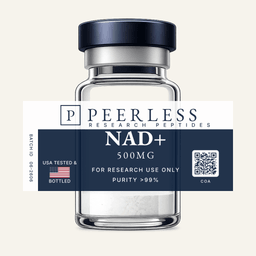
NAD+
Nicotinamide adenine dinucleotide coenzyme; pyridine dinucleotide cofactor more info
Available for laboratory research use only.
Quality Standards
American Owned
Mixed, bottled, and tested in the USA
Third-Party Tested
Independently tested for purity and quality
>99% Purity
Exceptional purity you can trust
Also Screened For
Endotoxins + Heavy Metals
Beyond the identity, purity & sterility panel.
Vial size
Choose your supply
3 vials· 1500mg total
Save $11.25 (5% off)
Total
$213.75
Volume pricing applies to your total vials, not just this product. Mix or match any vials in your cart to reach the next tier.
Independent Lab Results
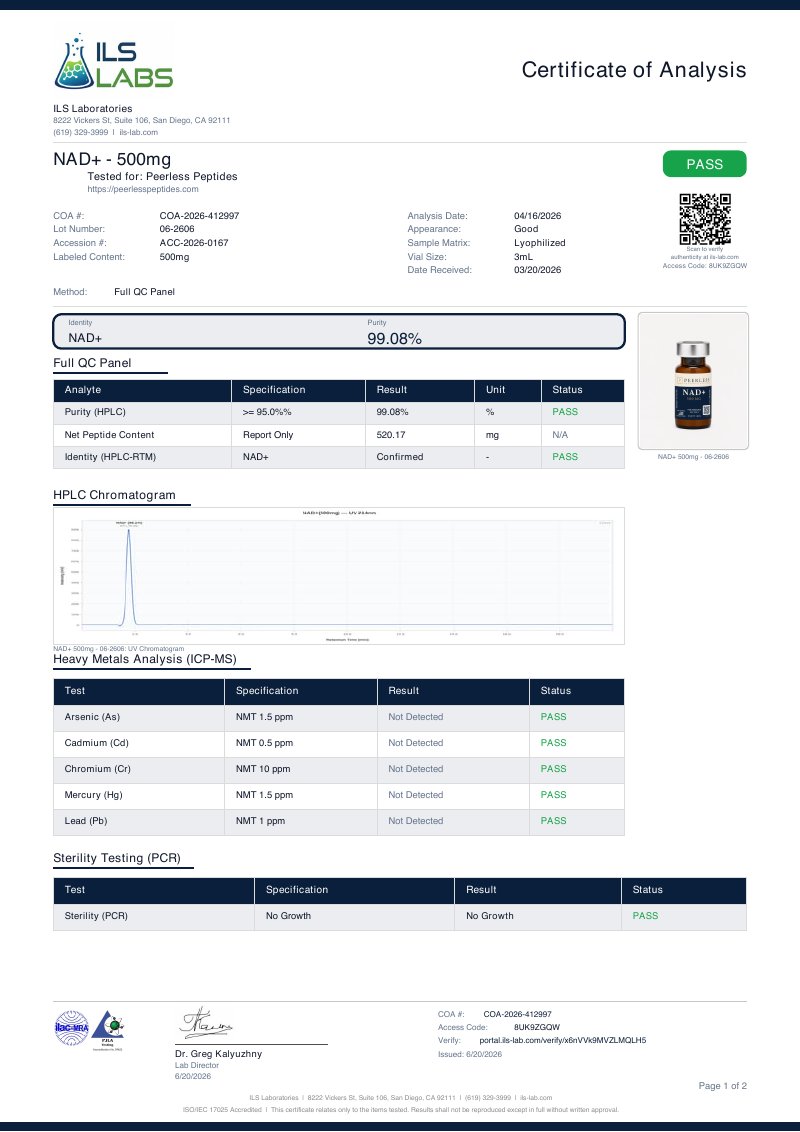
The most comprehensive testing panel in research peptide commerce. Every batch is independently verified by ILS Laboratories — an ISO/IEC 17025 and PJLA-accredited facility in San Diego, CA.
- Identity
- Purity (HPLC)
- Endotoxin (USP <85>)
- Sterility screen (PCR)
- Heavy metals (ICP-MS per USP <233>)
Biochemical Profile
- CAS Number
- 53-84-9
- Molecular Formula
- C21H27N7O14P2
- Molecular Weight
- 663.43 g/mol
- Purity
- >99% (HPLC-UV (260 nm))
- PubChem CID
- 5892
- Amino Acid Sequence
- Not a peptide; nicotinamide-adenine dinucleotide coenzyme. See structural identifiers above.
Redox Cofactor Function and NAD+-Consuming Enzyme Pathway Context
NAD+ functions in two operationally distinct modes. The classical mode is hydride-transfer redox cycling: NAD+ accepts a hydride (H-) from a substrate to become NADH, and NADH later donates the hydride to a downstream substrate or to the mitochondrial electron transport chain to regenerate NAD+. This cycling is non-consumptive across dozens of dehydrogenase-catalyzed reactions in glycolysis, the TCA cycle, beta-oxidation, the malate-aspartate shuttle, and alcohol dehydrogenase chemistry. Otto Warburg established the hydride-transfer biology in 1935 to 1936; Hans von Euler-Chelpin shared the 1929 Nobel Prize in Chemistry with Arthur Harden for the broader fermentation-coenzyme work[1].
The second mode, characterized since 2000, is NAD+ consumption by three principal enzyme classes that cleave NAD+ to release free nicotinamide and transfer the ADP-ribose moiety to a substrate. Imai, Armstrong, Kaeberlein, and Guarente reported in Nature 2000 that yeast Sir2 is an NAD+-dependent histone deacetylase, opening the modern NAD+ research program[2]. The mammalian sirtuin family (SIRT1 through SIRT7) deacetylates histone and non-histone protein substrates in nuclear, cytoplasmic, and mitochondrial compartments[3]. Poly-ADP-ribose polymerases (PARP1, PARP2) consume NAD+ in the DNA-damage response. The CD38 ectoenzyme, expressed on endothelium and immune cells, hydrolyzes NAD+ at the cell surface; CD38 expression rises with age and with inflammation in the Verdin laboratory framing at the Buck Institute[3].
Intracellular NAD+ concentration is reported in the 1 to 10 millimolar range across mammalian tissues; plasma NAD+ is approximately 2 to 20 micromolar. The salvage pathway recycles the nicotinamide released by sirtuin, PARP, and CD38 catalysis back into NAD+ via NAMPT (the rate-limiting enzyme) to NMN to NMNAT to NAD+. Mouse studies have replicated an age-associated decline in tissue NAD+ across liver, muscle, brain, and immune cells; the directional finding is reproducible, the causal interpretation is contested[3].
A precursor bypass pathway was characterized by Charles Brenner at Dartmouth (later Iowa, then City of Hope), who reported in Cell 2004 that NRK1 and NRK2 (nicotinamide riboside kinases) phosphorylate NR to NMN, defining a route into the salvage pathway that bypasses NAMPT[4]. This precursor pharmacology underlies the commercial NR / NMN segment of the research market. Trammell, Brenner, and colleagues reported in Nature Communications 2016 that oral NR is uniquely and orally bioavailable in mice and humans, with dose-dependent NAD+ blood metabolome elevation at single oral doses of 100, 300, and 1000 milligrams[5].
The pharmacokinetic question for intact NAD+ is distinct from the precursor pharmacokinetics. Grant, Berg, Mestayer and colleagues reported in Frontiers in Aging Neuroscience 2019 the first published human intravenous NAD+ pilot pharmacokinetic study, in which infused NAD+ did not appear in plasma until after two hours of continuous infusion in n=8 healthy adult males[6]. The authors concluded that infused NAD+ was rapidly removed from the plasma compartment for at least the first two hours, consistent with extra-vascular tissue extraction or hydrolysis at the vascular surface rather than free systemic circulation.
Research Applications
Geroscience and Sirtuin-Substrate Research
Geroscience research preparations using NAD+ and its precursors examine the sirtuin-substrate hypothesis: that the NAD+-dependent deacylase activity of SIRT1 through SIRT7 is rate-limited by cellular NAD+ availability, and that age-associated decline in tissue NAD+ reduces sirtuin-dependent gene-expression and DNA-damage-response programs[2][3]. The yeast Sir2 program established by Imai, Armstrong, Kaeberlein, and Guarente at MIT in 2000 is the foundational citation; the broader Sinclair, Imai, Guarente, and Verdin research programs have extended the substrate-limitation framework into mammalian tissues[2][3].
Independent contradictions of the sirtuin-as-conserved-longevity-gene framing exist in the published literature. Kaeberlein and colleagues reported in PLoS Biology 2005 that calorie-restriction-induced lifespan extension in yeast does not require Sir2[7]. Burnett, Valentini and colleagues reported in Nature 2011 that prior claims of SIR2 and sir-2.1 overexpression extending lifespan in C. elegans and Drosophila were not reproduced in their hands when genetic background was controlled, a published failure-to-replicate of one of the foundational claims in the field[8].
The Charles Brenner research program at Iowa and the David Sinclair research program at Harvard have engaged in a sustained published methodological dispute over the dominance of sirtuins as longevity genes, the assay artifacts in early STAC (sirtuin-activating compound) screens, and the magnitude of expected clinical effects from NAD+ elevation. The dispute is 20-plus years long, both researchers are senior figures in the field, and the methodological disagreements are not resolved. Neutral research content reports the disagreement and the contested findings; it does not pick a winner.
Mitochondrial Function Research
Mitochondrial preparations have been a sustained focus across the NAD+ research literature. NAD+ and NADH cycle through Complex I (NADH dehydrogenase) of the electron transport chain, providing the electron source for the proton gradient that drives ATP synthase. NAD+ is also a substrate for SIRT3, the principal mitochondrial sirtuin, which deacetylates mitochondrial proteins including succinate dehydrogenase, isocitrate dehydrogenase 2, and superoxide dismutase 2[3].
Gomes, Sinclair and colleagues reported in Cell 2013 that declining NAD+ levels in aged mouse tissues were associated with a pseudohypoxic shift in nuclear-mitochondrial communication and with deacetylation-pattern changes in mitochondrial-encoded versus nuclear-encoded electron transport chain components[3]. Covarrubias, Verdin and colleagues reviewed the NAD+ metabolism literature in Nature Reviews Molecular Cell Biology 2021, summarizing the age-associated tissue NAD+ decline pattern and the CD38-driven NAD+ sink hypothesis[3].
A separate research thread examines NAD+ in mitochondrial unfolded-protein response signaling and in mitophagy quality-control pathways. The replication consistency of the directional NAD+-decline finding in aged mouse tissues is well-replicated across laboratories; the magnitude of mitochondrial bioenergetic effect from pharmacological NAD+ elevation is more variable across the published preclinical literature, and the translation to durable human mitochondrial readouts remains an open research question.
Metabolic Pathway Research
Metabolic pathway research using NAD+ and the NR and NMN precursors has examined skeletal muscle glucose handling, hepatic lipid metabolism, and skeletal muscle NAD+ metabolome composition in preclinical and Phase 1 / Phase 2 clinical preparations. The most-cited NMN clinical paper is Yoshino, Klein, Imai and colleagues in Science 2021, an open-label trial of oral NMN at 250 milligrams daily for 10 weeks in n=25 postmenopausal prediabetic women that reported increased muscle NAD+ metabolome turnover and changes in skeletal-muscle glucose-uptake readouts[9].
The MetroBiotech MIB-626 Phase 1 trial reported by Pencina, Bhasin and colleagues in the Journal of Gerontology 2022 (NCT04764006) tested a microcrystalline polymorph oral NMN formulation across single- and multiple-ascending-dose arms in middle-aged and older adults; the trial reported dose-dependent NAD+ and metabolome elevation with an acceptable safety profile[10]. The MIB-626 IND filing was the regulatory trigger for the November 2022 FDA reclassification of NMN out of dietary-supplement status under the drug-exclusion clause of 21 USC 321(ff)(3)(B); the reclassification was subsequently reversed in September and December 2025 letters to ingredient marketers under pressure from the Natural Products Association v. FDA federal lawsuit filed August 28, 2024.
No Phase 3 randomized placebo-controlled trial of NAD+, NMN, or NR has powered a disease-modification endpoint to completion in any indication as of May 2026. The clinical signal across published trials is the dose-dependent elevation of blood NAD+ metabolome with oral precursor administration; clinical-outcome translation for any specific metabolic indication remains the subject of ongoing investigation.
Neuroprotection Research
Central nervous system preparations using NAD+ and its precursors have examined effects in rodent models of Parkinson's disease, Alzheimer's disease, and axonal injury, and in pilot human cohorts. SARM1 (sterile alpha and TIR motif-containing protein 1) is an axonal NAD+ glycohydrolase activated under axonal stress that has been characterized as a determinant of Wallerian degeneration[3]. The SARM1 mechanism is the smaller-commercial-footprint NAD+-consuming-enzyme class compared to sirtuins, PARPs, and CD38; the neurodegeneration relevance has been examined in peripheral neuropathy and ALS preclinical preparations.
The NADPARK study reported by Brakedal and colleagues in Cell Metabolism 2022 was a Phase 1 randomized trial of oral nicotinamide riboside at 1000 milligrams daily for 30 days in n=30 patients with Parkinson's disease (NCT03568968)[11]. The trial reported a cerebral NAD+-metabolome rise on magnetic resonance spectroscopy with modest motor-function endpoint changes. The N-DOSE AD trial in Alzheimer's disease (NCT05617508) is the dose-optimization follow-up, recruiting as of 2026 with anticipated readout pending.
The receptor-binding profile and the tissue-distribution behavior of intact NAD+ versus the NR and NMN precursors are mechanistically distinct, and the CNS bioavailability literature is dominated by the oral-precursor pharmacokinetics rather than by intact NAD+ tissue measurement. Direct human brain NAD+ tissue measurement during pharmacological NAD+ elevation has been performed in single-tissue magnetic-resonance-spectroscopy preparations and is not a routine clinical readout.
Cell-Culture Coenzyme Research
Cell-culture preparations use NAD+ as a coenzyme substrate in in vitro enzymology, including dehydrogenase activity assays (lactate dehydrogenase, alcohol dehydrogenase, glyceraldehyde-3-phosphate dehydrogenase, malate dehydrogenase, isocitrate dehydrogenase), in sirtuin in vitro deacetylase assays with fluorophore-tagged or native histone substrates, and in PARP automodification assays in DNA-damage-response biochemistry. The cell-culture coenzyme-substrate use case is the most chemically settled application area for the molecule; NAD+ has been a workhorse coenzyme in cell-free biochemistry since the 1930s.
Cellular uptake of intact NAD+ is poorly characterized in the published literature. The dominant published view is that NAD+ does not cross the plasma membrane freely and must be degraded to NR or to nicotinamide at the cell surface before uptake via specific transporters, with subsequent intracellular resynthesis through the salvage pathway. This is the central pharmacokinetic constraint that distinguishes intact NAD+ supplementation from precursor supplementation in any administration route.
In enzymology applications, the operating considerations are concentration precision (NAD+ extinction coefficient at 260 nm is well-characterized; concentration determination by absorbance is straightforward), acid sensitivity of the N-glycosidic bond connecting nicotinamide to ribose, light sensitivity of the nicotinamide ring, and pyrophosphate-bridge stability. Aqueous NAD+ in solution has substantially shorter stability than the lyophilized solid; the cell-culture standard is fresh preparation from -20 degree Celsius lyophilizate.
Replication and Clinical Status
The NR / NMN / NAD+ market confusion is the central editorial issue in the published NAD+ literature. Vendor copy across the broader market conflates three structurally distinct molecules: intact NAD+ itself, NMN (the immediate precursor; one phosphate group plus the nicotinamide riboside), and NR (the upstream precursor; nicotinamide riboside without the phosphate). The molecules have different oral bioavailability profiles, different tissue distribution, different regulatory status, and different published clinical evidence bases. Consumer copy that markets NAD+ supplementation without molecular disambiguation is technically inaccurate; when the product administered is an oral capsule, the molecule is almost always NR or NMN rather than NAD+ itself.
The Sinclair-affiliated Sirtris Pharmaceuticals resveratrol-and-STAC sirtuin-activator program has been substantially contradicted in the peer-reviewed literature. Pacholec, Schmidt and colleagues reported in the Journal of Biological Chemistry 2010 that the apparent SIRT1 activation by resveratrol and by the Sirtris lead STACs (SRT1720, SRT2183, SRT1460) was an artifact of the fluorophore-tagged peptide substrate used in the activator-screening assay; when tested against native substrates, the compounds did not directly activate SIRT1[12]. The assay-artifact critique has been independently confirmed by multiple laboratories; the Sirtris program was effectively discontinued by GSK around 2013 after lead-compound clinical-trial failures.
The intact IV NAD+ wellness-clinic protocol is the cleanest example of commercially mature, clinically under-evidenced in the broader NAD+ research market. The Grant 2019 first-human IV NAD+ pilot reported no plasma NAD+ during the first two hours of infusion in n=8 healthy adult males[6]. Reyna, Pojednic and colleagues in Frontiers in Aging 2026 reported a retrospective real-world comparison of IV NAD+ versus IV NR in n=6 NAD+ versus n=8 NR subjects across 4 days of administration, in which the NAD+ group reported abdominal cramping, diarrhea, nausea, vomiting, and chest pressure during infusion at substantially higher rates than the NR group[13]. Zero placebo-controlled randomized Phase 3 trials of IV NAD+ for any indication have been published as of May 2026. The Springfield Wellness Center BR+NAD protocol for opioid and alcohol withdrawal is the most published IV NAD+ wellness-clinic protocol; the evidence base is retrospective case series rather than randomized controlled trials.
The FDA Class I recall of GenoGenix LLC NAD+ for Injection (100 milligram per milliliter and 200 milligram per milliliter, 10 milliliter amber vials, Lot GG121624-023) issued on October 21, 2025 for elevated endotoxin levels is the canary in the IV NAD+ compounding-quality coal mine[14]. The FDA published an explicit warning in 2024 and 2025 that food-grade NAD+ is unsuitable for sterile injectable compounding. The November 2022 NMN drug-exclusion reclassification and the September / December 2025 reversal under NPA v. FDA litigation pressure illustrates how IND filings can reshape supplement regulation in either direction[15][16].
Handling & Storage
- Storage (lyophilized)
- -20°C, desiccated, sealed amber vials, dark; 24+ months
- Storage (in solution)
- -80°C aqueous solution preferred (months stability); 2-8°C limited to days-to-weeks (NAD+ is acid-labile and light-sensitive)
- Shelf Life
- 24 months lyophilized at -20°C
Research References
- [1] Warburg O, Christian W. Pyridin, der wasserstoffübertragende Bestandteil von Gärungsfermenten (Pyridin-Nucleotide). Biochem Z. 1936;287:291-328. (Historical paper; Otto Warburg's foundational characterization of nicotinamide as the hydride-transferring moiety of NAD+; Euler-Chelpin Nobel Prize in Chemistry 1929 with Harden for fermentation and coenzyme work.)
- [2] Imai S, Armstrong CM, Kaeberlein M, Guarente L. Transcriptional silencing and longevity protein Sir2 is an NAD-dependent histone deacetylase. Nature. 2000;403(6771):795-800. doi:10.1038/35001622PMID:10693811
- [3] Covarrubias AJ, Perrone R, Grozio A, Verdin E. NAD+ metabolism and its roles in cellular processes during ageing. Nat Rev Mol Cell Biol. 2021;22(2):119-141. doi:10.1038/s41580-020-00313-xPMID:33353981
- [4] Bieganowski P, Brenner C. Discoveries of nicotinamide riboside as a nutrient and conserved NRK genes establish a Preiss-Handler independent route to NAD+ in fungi and humans. Cell. 2004;117(4):495-502. doi:10.1016/s0092-8674(04)00416-7PMID:15137942
- [5] Trammell SAJ, Schmidt MS, Weidemann BJ, et al. Nicotinamide riboside is uniquely and orally bioavailable in mice and humans. Nat Commun. 2016;7:12948. doi:10.1038/ncomms12948PMID:27721479
- [6] Grant R, Berg J, Mestayer R, et al. A pilot study investigating changes in the human plasma and urine NAD+ metabolome during a 6 hour intravenous infusion of NAD+. Front Aging Neurosci. 2019;11:257. doi:10.3389/fnagi.2019.00257PMID:31572171
- [7] Kaeberlein M, Steffen KK, Hu D, et al. Sir2-independent lifespan extension by calorie restriction in yeast. PLoS Biol. 2005;3(9):e296. doi:10.1371/journal.pbio.0030296PMID:16086653
- [8] Burnett C, Valentini S, Cabreiro F, et al. Absence of effects of Sir2 overexpression on lifespan in C. elegans and Drosophila. Nature. 2011;477(7365):482-485. doi:10.1038/nature10296PMID:21938067
- [9] Yoshino M, Yoshino J, Kayser BD, et al. Nicotinamide mononucleotide increases muscle insulin sensitivity in prediabetic women. Science. 2021;372(6547):1224-1229. doi:10.1126/science.abe9985PMID:33888596
- [10] Pencina KM, Lavu S, Dos Santos M, et al. MIB-626, an oral formulation of a microcrystalline unique polymorph of beta-nicotinamide mononucleotide, increases circulating nicotinamide adenine dinucleotide and its metabolome in middle-aged and older adults. J Gerontol A Biol Sci Med Sci. 2022;77(7):1366-1376. doi:10.1093/gerona/glac049PMID:35182418
- [11] Brakedal B, Dolle C, Riemer F, et al. The NADPARK study: a randomized phase I trial of nicotinamide riboside supplementation in Parkinson's disease. Cell Metab. 2022;34(3):396-407.e6. doi:10.1016/j.cmet.2022.02.001PMID:35235774
- [12] Pacholec M, Bleasdale JE, Chrunyk B, et al. SRT1720, SRT2183, SRT1460, and resveratrol are not direct activators of SIRT1. J Biol Chem. 2010;285(11):8340-8351. doi:10.1074/jbc.M109.088682PMID:20061378
- [13] Reyna K, Pojednic R, Mestayer R, et al. Intravenous infusion of NAD+ versus nicotinamide riboside: a retrospective tolerability pilot study in a real-world setting. Front Aging. 2026;7:1652582. doi:10.3389/fragi.2026.1652582
- [14] U.S. Food and Drug Administration. Class I Recall: GenoGenix LLC NAD+ for Injection, 100 and 200 milligram per milliliter strengths in 10 milliliter amber vials, Lot GG121624-023; reason: elevated endotoxin levels. Issued October 21, 2025.
- [15] Conze D, Brenner C, Kruger CL. Safety and metabolism of long-term administration of NIAGEN (nicotinamide riboside chloride) in a randomized, double-blind, placebo-controlled clinical trial of healthy overweight adults. Sci Rep. 2019;9(1):9772. doi:10.1038/s41598-019-46120-zPMID:31278280
- [16] U.S. Food and Drug Administration. Response letters to ingredient marketers, September and December 2025, confirming beta-nicotinamide mononucleotide (NMN) is not excluded from the dietary supplement definition; reverses November 2022 drug-exclusion determination following Natural Products Association v. FDA federal lawsuit filed August 28, 2024.
Scientific Journal Author
Charles M. Brenner, PhD
Landmark Publications
- Bieganowski P, Brenner C. Discoveries of nicotinamide riboside as a nutrient and conserved NRK genes establish a Preiss-Handler independent route to NAD+ in fungi and humans. Cell. 2004;117(4):495-502. (PMID 15137942)
- Trammell SAJ, Schmidt MS, Weidemann BJ, et al. Nicotinamide riboside is uniquely and orally bioavailable in mice and humans. Nat Commun. 2016;7:12948. (PMID 27721479)
- Conze D, Brenner C, Kruger CL. Safety and metabolism of long-term administration of NIAGEN (nicotinamide riboside chloride) in a randomized, double-blind, placebo-controlled clinical trial of healthy overweight adults. Sci Rep. 2019;9(1):9772. (PMID 31278280)
Dr. Brenner is independently cited here as the originating researcher of the nicotinamide riboside (NR) kinase pathway and a senior figure in the published NAD+ precursor pharmacology literature. Dr. Brenner has served as Chief Scientific Advisor to ChromaDex Inc. (NASDAQ: CDXC), the commercial vehicle for branded nicotinamide riboside. The Sinclair-Brenner methodological dispute over the dominance of sirtuins as longevity genes and the published assay artifacts in early STAC sirtuin-activator screens is a 20-plus-year unresolved disagreement between senior researchers in the field; Peerless Peptides reports the disagreement neutrally and does not pick a winner. There is no affiliation or commercial relationship between Dr. Brenner, ChromaDex Inc., City of Hope National Medical Center, the University of Iowa, or any associated commercial entity, and Peerless Peptides.