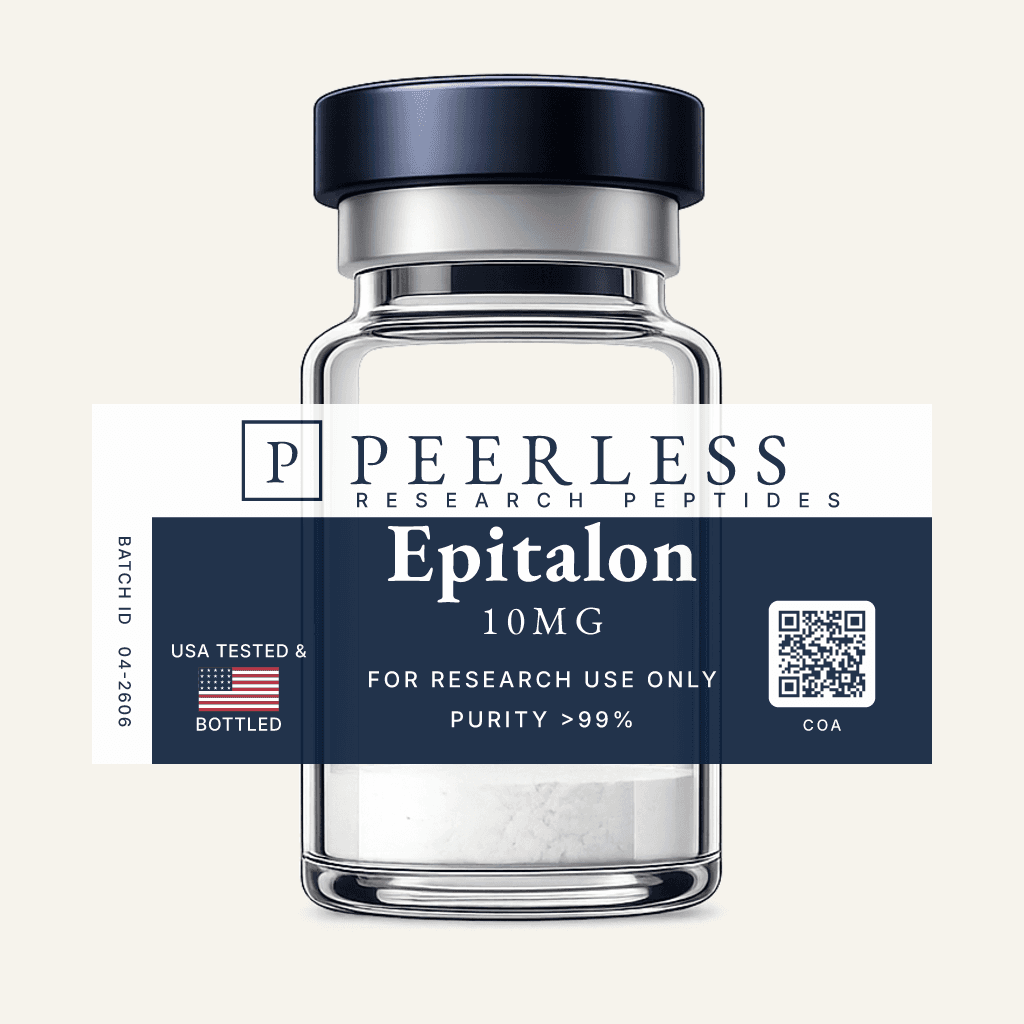
Quality Standards
American Owned
Mixed, bottled, and tested in the USA
Third-Party Tested
Independently tested for purity and quality
>99% Purity
Exceptional purity you can trust
Also Screened For
Endotoxins + Heavy Metals
Beyond the identity, purity & sterility panel.
Pinealon
Synthetic tripeptide Glu-Asp-Arg (EDR), Khavinson short-peptide-bioregulator class more info
Available for laboratory research use only.
Quality Standards
American Owned
Mixed, bottled, and tested in the USA
Third-Party Tested
Independently tested for purity and quality
>99% Purity
Exceptional purity you can trust
Also Screened For
Endotoxins + Heavy Metals
Beyond the identity, purity & sterility panel.
Vial size
Choose your supply
3 vials· 15mg total
Save $8.85 (5% off)
Total
$168.15
Volume pricing applies to your total vials, not just this product. Mix or match any vials in your cart to reach the next tier.
Independent Lab Results
The most comprehensive testing panel in research peptide commerce. Every batch is independently verified by ILS Laboratories — an ISO/IEC 17025 and PJLA-accredited facility in San Diego, CA.
- Identity
- Purity (HPLC)
- Endotoxin (USP <85>)
- Sterility screen (PCR)
- Heavy metals (ICP-MS per USP <233>)
Biochemical Profile
- CAS Number
- 175175-23-2
- Molecular Formula
- C15H26N6O8
- Molecular Weight
- 418.41 g/mol
- Purity
- >99% (HPLC-UV (214-220 nm))
- PubChem CID
- 10273502
- Amino Acid Sequence
- Glu-Asp-Arg
Receptor Targets and Signaling Pathway Context
Pinealon has been investigated within the Khavinson laboratory's broader framework of short-peptide bioregulators, which proposes that 2 to 4 amino-acid peptides bind directly to gene promoters in a sequence-specific manner and drive tissue-specific gene-expression effects[1]. For Pinealon specifically, the Khavinson 2020 Molecules review proposes that the EDR tripeptide enters cells, binds histone proteins and DNA, and modulates promoter regions of PPARA, PPARG, SOD2, GPX1, and TPH1, with downstream readouts including antioxidant-enzyme expression and serotonin-synthesis machinery effects[2].
Standard structural biology indicates that sequence-specific recognition of DNA major-groove contacts in evolved transcription factors requires folded DNA-binding domains in the 25 to 500+ residue range. Zinc fingers span 23 to 28 residues per finger, typically in arrays of 3 to 11 fingers (100 to 300 residues total); basic helix-loop-helix domains span 50 to 80 residues; homeodomains are roughly 60-residue three-helix bundles; leucine zippers operate as dimerized coiled-coils. A 3-amino-acid peptide of approximately 418 Da lacks the residue count for major-groove sequence-specific recognition, the folding capacity for stable secondary structure, the dimerization machinery characteristic of canonical transcription-factor function, and the metal-coordination motifs of zinc-finger geometry.
The Khavinson EDR-DNA evidence base consists of fluorescence-quenching assays with FITC-labeled peptides and ethidium-bromide-stained DNA reporting CNG-sequence-motif preference (Fedoreyeva et al., 2011)[3], in-silico molecular-docking work (Khavinson et al., 2020)[2], and cellular gene-expression readouts after peptide exposure (Khavinson et al., 2014, serotonin in cortical cells)[4]. No high-resolution co-crystal structures of EDR with DNA or histones have been deposited in the Protein Data Bank. No orthogonal biophysical confirmation by isothermal titration calorimetry, surface plasmon resonance, or nuclear magnetic resonance titration has been published by laboratories outside the IBG St. Petersburg research program.
The single non-IBG-affiliated peptide-DNA biophysics paper for Pinealon is Silanteva et al. (2019) at St. Petersburg State University, examining EDR-DNA interaction in the presence of mono- and divalent ions[5]. The paper confirms physical interaction at the same level as the Khavinson fluorescence-quenching work but does not demonstrate sequence-specific recognition under standard structural-biology criteria. The institutional reach extends within the St. Petersburg metropolitan ecosystem; independent biophysics-grade replication by Western structural-biology consortia has not been published.
The receptor-binding profile of Pinealon has not been characterized in human tissue, and no specific high-affinity receptor has been identified in the published peer-reviewed literature. Current mechanism proposals are drawn from single-laboratory cell-culture and rodent preparations rather than from direct receptor pharmacology or independently replicated structural-biology data. Pharmacokinetic data for Pinealon in any species are not available in the indexed peer-reviewed literature.
Research Applications
In Vitro Cellular Oxidative-Stress Research
The anchor cellular paper for Pinealon is Khavinson et al. (2011) in Rejuvenation Research, a single-laboratory study at IBG St. Petersburg examining EDR in cerebellar granule cells, neutrophils, and PC12 rat pheochromocytoma cells under oxidative challenge[6]. The reported readouts included dose-dependent reactive-oxygen-species accumulation, propidium-iodide necrosis under H2O2 challenge, ERK1/2 activation kinetics, and cell-cycle modulation that continued at concentrations above the ROS-suppression saturation point.
Related Khavinson-group in-vitro work has reported lipid-peroxidation restriction in cerebellar tissue comparable to other short peptides in the Khavinson catalog (Vesugen, Vilon, Epitalon)[7], modified signaling-molecule expression in organotypic pineal cell culture[8], and altered TPH1-pathway involvement in cerebral-cortex neurons[4]. The specific cellular signatures (ROS suppression in oxidatively challenged systems) are observed across many short peptides containing charged residues; whether the effects are specific to the EDR sequence rather than to general charged-short-peptide biology has not been disentangled in head-to-head preparations outside the Khavinson program.
Independent replication of the specific findings under matched protocols by laboratories outside the IBG ecosystem has not been documented in the peer-reviewed peptide-specific primary literature.
Rodent Cognitive and Stress Models
The anchor in-vivo paper is Arutjunyan et al. (2012), a Wistar-rat prenatal hyperhomocysteinemia preparation conducted at IBG St. Petersburg[9]. Pregnant females received methionine loading (1 plus or minus 0.01 g per kilogram per day in drinking water) from the second trimester onward, with EDR administered intraperitoneally at 10 micrograms per kilogram per day for 5 days prior to methionine loading. Family-level sample size was n equals 6 per arm with approximately 8 to 9 pups per brood. Offspring readouts included Morris water maze spatial-learning measures, cerebellar reactive-oxygen-species concentrations, and H2O2-challenge necrotic cell fraction. The reported result was offspring spatial-learning recovery toward control levels in the EDR-administered arm.
A second line of rodent work from the Mendzheritsky and Karantysh group at Rostov-na-Donu has compared Pinealon to Cortexin in aged-rat models of hypoxia, hypothermia, and carotid-occlusion stress, with caspase-3 and behavioral endpoints[10]. The institutional address is non-IBG; the research culture and publication venue (Advances in Gerontology) sit within the broader Khavinson-affiliated network. The reported pattern across the series is Cortexin showing more pronounced effect on certain parameters and Pinealon contributing on others.
The rodent literature is single-laboratory at the IBG level (Arutjunyan series) and small-cohort observational at the Rostov level. Effects in the named preparations are consistent with general reactive-oxygen-species suppression attributable to charged short peptides under oxidative stress; they do not require the sequence-specific gene-expression mechanism the Khavinson framework invokes.
Peptide-DNA Interaction Biophysics
Fedoreyeva et al. (2011), a Khavinson-Vanyushin collaboration with Lomonosov Moscow State University, reported FITC-labeled-peptide fluorescence-quenching evidence of EDR interaction with deoxyribooligonucleotides, with preferential binding reported for CNG-sequence-motif oligonucleotides (where N denotes any base; CNG sites are targets for cytosine DNA methylation in eukaryotes)[3]. The same paper reported nuclear penetration of short fluorescence-labeled peptides in HeLa cells.
Silanteva et al. (2019), at St. Petersburg State University, extended the biophysics outside the IBG institutional address, examining EDR-DNA interactions in the presence of mono- and divalent ions[5]. Physical interaction is confirmed at the same level as the Khavinson fluorescence-quenching work; sequence-specific recognition by the criteria of standard structural biology (X-ray co-crystallography, NMR titration with chemical-shift mapping, isothermal titration calorimetry, surface plasmon resonance affinity measurement) is not demonstrated.
No Pinealon-DNA co-crystal structures have been deposited in the Protein Data Bank. The 15-year gap between the 2011 Fedoreyeva paper and the present has not produced the orthogonal biophysics-grade verification that the Khavinson framework requires. The Khavinson 2020 Molecules review extends the framework with in-silico molecular-docking predictions of EDR binding to PPARA, PPARG, SOD2, GPX1, and TPH1 promoter sequences[2]; the predictions have not been confirmed by direct biochemical demonstration.
Khavinson Short-Peptide Family Research
Pinealon sits within the broader Khavinson short-peptide-bioregulator program, a catalog of approximately 70 organ-specific dipeptides, tripeptides, and tetrapeptides developed at IBG Saint Petersburg from the 1970s onward. The peptides were synthesized based on amino-acid compositional analysis of organ-specific tissue extracts: Epithalamin (pineal) was the parent extract for Epitalon (AEDG) and Pinealon (EDR); Cortexin precursors (cortex) for Cortexin; Thymalin precursors (thymus) for Thymalin; and parallel parent-extract lineages for Cardiogen (AED), Vesugen (KED), Vilon (KE), Pancragen, Glandokort, Testagen, Ovagen, Crystagen, Visoluten, Suprefort, Prostamax, and Livagen[1].
Within the Khavinson catalog, approximately 6 of the bioregulators (including Cortexin, Thymalin, and the predecessor pineal extract Epithalamin) hold Russian Federation drug registration as pharmaceuticals. The remaining approximately 64 are categorized in Russian regulatory practice as food supplements (БАД, Biologically Active Additives). Synthetic Pinealon sits in the food-supplement category, not the registered-drug category, alongside Epitalon and unlike Cortexin, Thymalin, Semax, or Selank.
The Russian commercial vehicle NPCRIZ (Scientific-Production Center of Revitalization and Health, founded 2010 as the exclusive IBG licensee) distributes Pinealon under the Cytogen consumer product line as an oral supplement in a 60-capsule pack. Vladimir Khavinson, the founding scientist of the IBG program, died on January 6, 2024 at age 77. Post-Khavinson institutional succession at IBG and at NPCRIZ has not been publicly clarified at the time of writing.
Independent Western Preclinical Signal
The first non-Khavinson Western preclinical signal in the Pinealon literature is an Anonymous et al. bioRxiv preprint deposited February 26, 2026, examining 17α-estradiol, rapamycin plus Smer28, berberine plus resveratrol, sildenafil, and Pinealon in an 8-week multi-arm screening assay in mice[11]. Endpoints included body weight and temperature, food intake, grip strength, locomotor activity, Y-maze cognition, social behavior, hematology, and urinalysis. The reported Pinealon-arm observation was a trend toward improved working-memory readouts with no detectable adverse effects; 17α-estradiol in the comparator arm induced significant weight loss, increased grip strength, and dorsal alopecia consistent with metabolic remodeling.
The preprint is the first preclinical signal for Pinealon outside the Khavinson IBG research orbit in approximately 15 years from the 2011 Rejuvenation Research anchor paper. The signal is modest (a trend rather than a statistically robust primary endpoint), the n is small in a multi-arm screening rather than powered single-intervention format, and the publication has not survived peer review at the time of this writing.
The fact that this preprint is the first such signal across 15 years of indexed Pinealon research is itself a finding about the replication gap. Independent biophysics-grade demonstration of sequence-specific 3-amino-acid DNA-promoter binding that the Khavinson framework requires has not been published in any venue across the same window.
Replication, Citation Concentration, and Status
Pinealon-specific PubMed indexing returns approximately 22 papers for the search term, among the smallest primary corpora in the indexed research-peptide literature, comparable to Epitalon and Selank. Within that corpus, approximately 80 to 90 percent of papers have Khavinson laboratory first or senior authorship or IBG Saint Petersburg institutional affiliation, an unusually high single-laboratory citation concentration at the catalog ceiling alongside Epitalon. The core collaborator lineage includes Linkova, Kozina, Arutjunyan, Trofimova, Ryzhak, Mendzheritsky, Karantysh, Fedoreyeva, Umnov, Chalisova, and Vanyushin (the DNA-interaction line at Lomonosov MSU). The Khavinson 2020 EDR Molecules review is the central mechanistic synthesis paper from the group[2].
The biochemical-implausibility critique on the 3-amino-acid sequence-specific DNA-binding framework is the most distinctive feature of the Pinealon evidence base. Folded DNA-binding domains require 25 to 500+ residues with structured scaffolding and dimerization machinery that a 3-residue peptide cannot supply. No high-resolution co-crystal structures, no isothermal titration calorimetry affinity measurements, no surface plasmon resonance kinetics, and no NMR-grade chemical-shift mapping by laboratories outside the IBG ecosystem are published for the EDR-DNA interaction. The provenance narrative is correspondingly stretched: Pinealon was synthesized from bulk amino-acid compositional analysis of the Epithalamin pineal extract rather than isolated by activity-guided fractionation. Direct mass-spectrometry detection of EDR in bovine pineal extract is not prominent in the public record.
The Russian regulatory status of synthetic Pinealon is the food-supplement category (БАД), not the registered-drug category. Statements characterizing Pinealon as Russian-approved as a drug are not supported by the regulatory record. In the United States, Pinealon was never placed on FDA 503A Category 2 (Do-Not-Compound). Pinealon was NOT among the 12 peptides in the April 22, 2026 reclassification batch (BPC-157, LL-37, DiHexa, DSIP, Epitalon, GHK-Cu injectable, KPV, PEG-MGF, Melanotan II, MOTS-c, Semax, TB-500)[12]. Pinealon is NOT on the July 23-24, 2026 Pharmacy Compounding Advisory Committee docket: Day 1 reviews BPC-157, KPV, TB-500, and MOTS-c; Day 2 reviews DSIP, Semax, and Epitalon[13]. The regulatory posture is unmarked-but-unapproved rather than marked-and-deferred; both postures sit on the same legal ground of unapproved new drug under the FDCA, lawful only for research-use-only research-chemical sale. The World Anti-Doping Agency 2026 Prohibited List does not name Pinealon explicitly; the molecule is captured by the S0 (Non-Approved Substances) catch-all clause[14].
Research Literature
Published literature reviews from the Peerless research desk that reference Pinealon.

June 4, 2026
Khavinson Bioregulators: The Lab, the Claims, and the Evidence
The Khavinson short-peptide bioregulators are a four-decade, single-institution body of work proposing that two-to-four-amino-acid peptides regulate gene expression sequence-specifically. The framework is biophysically unconfirmed, the longevity claims sit below the modern geroscience bar, and the first independent Western replications arrived only in 2025.
May 20, 2026
Pinealon: A Literature Review of the Khavinson Bioregulator Program
Pinealon is the smallest peptide in the Khavinson bioregulator catalog, a synthetic three-amino-acid Glu-Asp-Arg sequence positioned as a transcription-factor-grade gene regulator. The mechanism story runs against four decades of structural biology, and the literature is concentrated in a single Russian research program.
Handling & Storage
- Storage (lyophilized)
- -20°C, dry, dark, 24+ months
- Storage (in solution)
- 2-8°C, use within 28 days
- Shelf Life
- 24+ months lyophilized
Research References
- [1] Khavinson VKh. Peptides and ageing. Neuroendocrinol Lett. 2002;23 Suppl 3:11-144. PMID:12624841
- [2] Khavinson V, Linkova N, Kozhevnikova E, Trofimova S. EDR Peptide: Possible Mechanism of Gene Expression and Protein Synthesis Regulation Involved in the Pathogenesis of Alzheimer's Disease. Molecules. 2020;26(1):159. doi:10.3390/molecules26010159PMID:33396470
- [3] Fedoreyeva LI, Kireev II, Khavinson VKh, Vanyushin BF. Penetration of short fluorescence-labeled peptides into the nucleus in HeLa cells and in vitro specific interaction of the peptides with deoxyribooligonucleotides and DNA. Biochemistry (Mosc). 2011;76(11):1210-1219. doi:10.1134/S0006297911110022PMID:22117547
- [4] Khavinson VKh, Lin'kova NS, Tarnovskaya SI, Umnov RS, Elashkina EV, Durnova AO. Short peptides stimulate serotonin expression in cells of brain cortex. Bull Exp Biol Med. 2014;157(1):77-80. doi:10.1007/s10517-014-2497-xPMID:24909721
- [5] Silanteva IA, Komolkin AV, Morozova EA, Vorontsov-Velyaminov PN, Kasyanenko NA. Role of Mono- and Divalent Ions in Peptide Glu-Asp-Arg-DNA Interaction. J Phys Chem B. 2019;123(8):1786-1795. doi:10.1021/acs.jpcb.8b11783PMID:30762356
- [6] Khavinson V, Ribakova Y, Kulebiakin K, Vladychenskaya E, Kozina L, Arutjunyan A, Boldyrev A. Pinealon increases cell viability by suppression of free radical levels and activating proliferative processes. Rejuvenation Res. 2011;14(5):535-541. doi:10.1089/rej.2011.1172PMID:21978084
- [7] Kozina LS, Arutiunian AV, Stvolinskiĭ SL, Khavinson VKh. Biological activity of regulatory peptides in model experiments in vitro. Adv Gerontol. 2008;21(1):68-73. PMID:18546826
- [8] Khavinson VKh, Linkova NS, Chalisova NI, Dudkov AV, Koncevaya EA. Effect of short peptides on expression of signaling molecules in organotypic pineal cell culture. Bull Exp Biol Med. 2011;151(3):343-345. PMID:22803060
- [9] Arutjunyan A, Kozina L, Stvolinskiy S, Bulygina Y, Mashkina A, Khavinson V. Pinealon protects the rat offspring from prenatal hyperhomocysteinemia. Int J Clin Exp Med. 2012;5(2):179-185. PMID:22567179
- [10] Mendzheritskiĭ AM, Karantysh GV, Ryzhak GA, Dem'ianenko SV. Regulation of content of cytokines in blood serum and of caspase-3 activity in brains of old rats in model of sharp hypoxic hypoxia with Cortexin and Pinealon. Adv Gerontol. 2014;27(1):94-97. PMID:25051764
- [11] Anonymous et al. Short-Term Performance Assay Identifies Functional Benefits and Early Toxicity of Longevity Interventions in Mice. bioRxiv. 2026 Feb 26;10.64898/2026.02.25.707674v1. Preprint, not peer-reviewed. doi:10.64898/2026.02.25.707674
- [12] U.S. Food and Drug Administration. Section 503A Bulks List: 12-peptide reclassification announcement covering BPC-157, LL-37, DiHexa, DSIP, Epitalon, GHK-Cu injectable, KPV, PEG-MGF, Melanotan II, MOTS-c, Semax, and TB-500. April 22, 2026. Pinealon NOT included.
- [13] U.S. Food and Drug Administration. Pharmacy Compounding Advisory Committee Meeting Announcement, July 23-24 2026. Federal Register Document 2026-07361. Day 1: BPC-157, KPV, TB-500, MOTS-c. Day 2: DSIP, Semax, Epitalon. Pinealon NOT scheduled on either day.
- [14] World Anti-Doping Agency. The 2026 Prohibited List, S0 Non-Approved Substances. WADA, January 2026. Pinealon not explicitly named; captured by S0 catch-all clause for substances without current approval by any governmental regulatory health authority.
- [15] Umnov RS, Lin'kova NS, Khavinson VKh. Neuroprotective effects of peptides bioregulators in people of various age. Adv Gerontol. 2013;26(2):231-238. PMID:24738258
- [16] Bashkireva AS, Artamonova VG. The peptide correction of neurotic disorders among professional truck-drivers. Adv Gerontol. 2012;25(4):717-724. PMID:23734521
- [17] Meshchaninov VN, Tkachenko EL, Zhuravlev VF, Katyreva YE, Gavrilov IV. Effect of synthetic peptides on aging of patients with chronic polymorbidity and organic brain syndrome of the central nervous system in remission. Adv Gerontol. 2015;28(2):332-339. PMID:26390612
- [18] Khavinson VKh, et al. Russian Federation patent RF No. 2301678. A peptide that stimulates the regeneration of neurons of the central nervous system, a pharmaceutical composition based on it and a method for its use. Issued 2007.
Scientific Journal Author
Vladimir Kh. Khavinson, MD, PhD, DSc (1946-2024)
Saint Petersburg Institute of Bioregulation and Gerontology (IBG), Russian Academy of Sciences
Landmark Publications
- Khavinson V, Ribakova Y, Kulebiakin K, Vladychenskaya E, Kozina L, Arutjunyan A, Boldyrev A. Pinealon increases cell viability by suppression of free radical levels and activating proliferative processes. Rejuvenation Res. 2011;14(5):535-541. (PMID 21978084)
- Khavinson V, Linkova N, Kozhevnikova E, Trofimova S. EDR Peptide: Possible Mechanism of Gene Expression and Protein Synthesis Regulation Involved in the Pathogenesis of Alzheimer's Disease. Molecules. 2020;26(1):159. (PMID 33396470)
- Fedoreyeva LI, Kireev II, Khavinson VKh, Vanyushin BF. Penetration of short fluorescence-labeled peptides into the nucleus in HeLa cells and in vitro specific interaction of the peptides with deoxyribooligonucleotides and DNA. Biochemistry (Mosc). 2011;76(11):1210-1219. (PMID 22117547)
Dr. Khavinson is independently cited here as the founding scientist of Pinealon and the broader Khavinson short-peptide-bioregulator program at the Saint Petersburg Institute of Bioregulation and Gerontology. Dr. Khavinson died on January 6, 2024. There is no affiliation or commercial relationship between Dr. Khavinson, IBG Saint Petersburg, NPCRIZ, the Cytomedics manufacturing entity, or any associated commercial enterprise, and Peerless Peptides.
Related Research Compounds
Other compounds in the khavinson bioregulators research class.