Quality Standards
American Owned
Mixed, bottled, and tested in the USA
Third-Party Tested
Independently tested for purity and quality
>99% Purity
Exceptional purity you can trust
Also Screened For
Endotoxins + Heavy Metals
Beyond the identity, purity & sterility panel.
PT-141
Synthetic cyclic heptapeptide melanocortin receptor agonist with primary activity at MC4R more info
Available for laboratory research use only.
Quality Standards
American Owned
Mixed, bottled, and tested in the USA
Third-Party Tested
Independently tested for purity and quality
>99% Purity
Exceptional purity you can trust
Also Screened For
Endotoxins + Heavy Metals
Beyond the identity, purity & sterility panel.
Vial size
Choose your supply
3 vials· 30mg total
Save $13.35 (5% off)
Total
$253.65
Volume pricing applies to your total vials, not just this product. Mix or match any vials in your cart to reach the next tier.
Independent Lab Results
The most comprehensive testing panel in research peptide commerce. Every batch is independently verified by ILS Laboratories — an ISO/IEC 17025 and PJLA-accredited facility in San Diego, CA.
- Identity
- Purity (HPLC)
- Endotoxin (USP <85>)
- Sterility screen (PCR)
- Heavy metals (ICP-MS per USP <233>)
Biochemical Profile
- CAS Number
- 189691-06-3
- Molecular Formula
- C50H68N14O10
- Molecular Weight
- 1025.18 g/mol
- Purity
- >99% (HPLC-UV (214-220 nm))
- PubChem CID
- 9941379
- Amino Acid Sequence
- Ac-Nle-cyclo[Asp-His-D-Phe-Arg-Trp-Lys]-OH
Receptor Targets and Signaling Pathway Context
PT-141 / bremelanotide is a synthetic conformationally constrained cyclic heptapeptide and non-selective agonist at the five melanocortin receptors (MC1R, MC3R, MC4R, MC5R), with clinically characterized activity localized at MC3R and MC4R in central nervous system pathways. The molecular scaffold originated in the Hruby and Hadley laboratories at the University of Arizona in the late 1980s as a conformationally constrained α-melanocyte-stimulating hormone (α-MSH) analog, with Al-Obeidi et al. (1989) reporting the cyclic lactam design framework that has anchored the entire melanocortin analog series since[1].
The sequence Ac-Nle-cyclo[Asp-His-D-Phe-Arg-Trp-Lys]-OH is structurally identical to Melanotan-2 (MT-II) except at the C-terminus, where bremelanotide carries a free acid (-OH) and MT-II carries an amide (-NH2). The amide-to-acid conversion shifted pharmacokinetic and receptor-engagement properties enough that Palatin Technologies filed bremelanotide as a separate composition-of-matter entity under US 6,794,489 (issued 2004; patent term extended; expired June 25, 2025).
The Asp5-Lys10 lactam bridge constrains the molecule into an α-MSH-like β-turn conformation that engages all four melanocortin receptors at agonist concentrations. Norleucine (Nle) replaces Met4 of α-MSH for oxidation stability, and D-phenylalanine at position 7 replaces L-Phe to confer protease resistance and to lock the active receptor-binding conformation.
The centrally-mediated mechanism proposed in the published melanocortin literature, as summarized by Pfaus, Edinoff and colleagues (2022), proceeds through MC4R agonism on neurons of the medial preoptic area (mPOA) of the hypothalamus and adjacent structures including the ventral tegmental area, nucleus accumbens, and arcuate nucleus[2][3]. MC4R activation has been associated with dopamine release in the mPOA-VTA-NAc reward circuit on the basis of rat microdialysis findings. Direct measurement of human CNS dopamine flux on the bremelanotide pharmacology timescale has not been published.
Independent peripheral effects account for the documented adverse-event profile reported in the clinical literature. MC1R agonism at cutaneous melanocytes is mechanistically associated with the focal hyperpigmentation reported in a small percentage of trial participants. MC4R action on autonomic outflow has been associated with a transient blood-pressure elevation observed 2-4 hours post-dose. Bremelanotide terminal plasma half-life was reported at approximately 2.7 hours; full pressor effect resolution within 8-12 hours[4].
Research Applications
Melanocortin Receptor Pharmacology Research
Bremelanotide is a non-selective agonist at MC1R, MC3R, MC4R, and MC5R. In vitro binding-affinity data submitted in the Palatin clinical pharmacology package and supporting peer-reviewed literature place agonist activity at all four receptors, with the clinically relevant central activity attributed to MC4R and MC3R engagement[1][2]. The receptor profile distinguishes bremelanotide from setmelanotide, an MC4R-selective agonist rather than a non-selective one.
The cyclic lactam constraint between Asp5 and Lys10 forces the molecule into an α-MSH-like β-turn conformation that engages the receptor binding site at agonist concentrations. The conformational analysis framework was established by the Al-Obeidi 1989 molecular-dynamics paper on the parent MT-II scaffold and has been adopted across the broader melanocortin-analog medicinal chemistry literature[1].
The melanocortin pathway has several distinct chemical entities that have reached FDA approval: bremelanotide, setmelanotide, and afamelanotide. Each is the active ingredient of a separate finished drug product with its own receptor selectivity and its own narrow, population-specific approved use. The receptor pharmacology of the class is well-characterized in the published literature.
Central Nervous System Sexual-Function Pathway Research
The centrally-mediated mechanism developed by Pfaus and colleagues involves MC4R agonism on neurons of the medial preoptic area (mPOA) of the hypothalamus and downstream activation of the mesocorticolimbic dopaminergic reward circuit[2][3]. Rat microdialysis findings have documented extracellular dopamine elevation in mPOA and nucleus accumbens regions on a time scale consistent with the central pharmacological framework.
In female rodent partner-preference and proceptive-behavior assays (the rodent correlate of sexual motivation as far as such a correlate exists), bremelanotide administration was associated with modulation of proceptive behaviors via central MC4R agonism. The translation from rodent dopamine-release data to the human RECONNECT Phase 3 endpoint (change in FSFI-D Desire subscale score) is inferential rather than direct: the clinical endpoint was symptom-scale change, not measured human CNS dopamine flux.
The centrally-mediated framework does not account for the full reported phenotype across the broader bremelanotide development history. Erectile-response findings in the discontinued Phase 1-2 intranasal program in male erectile dysfunction (Diamond et al. 2004-2006) proceeded through central pathways that included but were not limited to mPOA-MC4R signaling[5][6][7].
RECONNECT Phase 3 Clinical Evidence Research
The pivotal Phase 3 evidence base for the bremelanotide finished drug product consists of two identically-designed randomized, double-blind, placebo-controlled trials: RECONNECT Study 301 (NCT02333071) and Study 302 (NCT02338960), reported by Kingsberg et al. in Obstetrics and Gynecology, November 2019[8]. Combined enrollment was 1,267 randomized participants across both trials over a 24-week on-demand subcutaneous administration schedule vs. placebo.
Both co-primary endpoints met statistical significance with reasonable internal consistency: change from baseline in FSFI-D (Female Sexual Function Index, Desire domain) and change from baseline in FSDS-DAO Item 13 (Female Sexual Distress Scale-Desire/Arousal/Orgasm, distress item). Responder rates on the FSFI-D anchor were higher in the bremelanotide arm than placebo, with a high placebo response rate that the authors noted warrants cautious interpretation of the absolute effect size.
The 52-week open-label extension reported by Simon et al. (2019) enrolled 684 women who completed the 24-week core trials[9]. No new safety signals emerged across the extended exposure window. Mean exposure during the extension was 407-409 days; approximately 272 women (40% of those entering) completed the full 52-week extension period.
Adverse-Event Profile and Discontinuation Research
The Phase 3 adverse-event profile is the load-bearing real-world tolerability finding. Nausea was reported in 40.0% of bremelanotide-randomized participants vs. 1.3% placebo, with median onset at 30 minutes post-dose and median duration 2.4 hours[8][10]. Pre-treatment with ondansetron was reported as ineffective, consistent with a centrally-mediated nausea mechanism rather than a peripheral GI mechanism. Flushing occurred in 20.3%, injection-site reactions in 13.2%, and headache in 11.3% of bremelanotide subjects across the integrated Phase 3 data set.
Focal hyperpigmentation was reported in approximately 1% of trial participants, with higher incidence in those with darker baseline skin pigmentation and with chronic rather than on-demand administration. Per the approved prescribing information, resolution was not confirmed in all affected participants[11]. Transient cardiovascular effects 2-4 hours post-dose included approximately +6 mmHg systolic and +3 mmHg diastolic mean peak blood pressure elevation and a -5 bpm heart-rate decrease.
The Phase 3 discontinuation rate was 41.9% in Study 301 and 43.8% in Study 302 over 24 weeks, vs. 16.0% and 28.4% in the respective placebo arms[8]. The 14-26 percentage-point excess discontinuation reflects the adverse-event burden, primarily nausea, and frames the real-world tolerability ceiling.
Bremelanotide vs. Melanotan-2 Chemistry Research
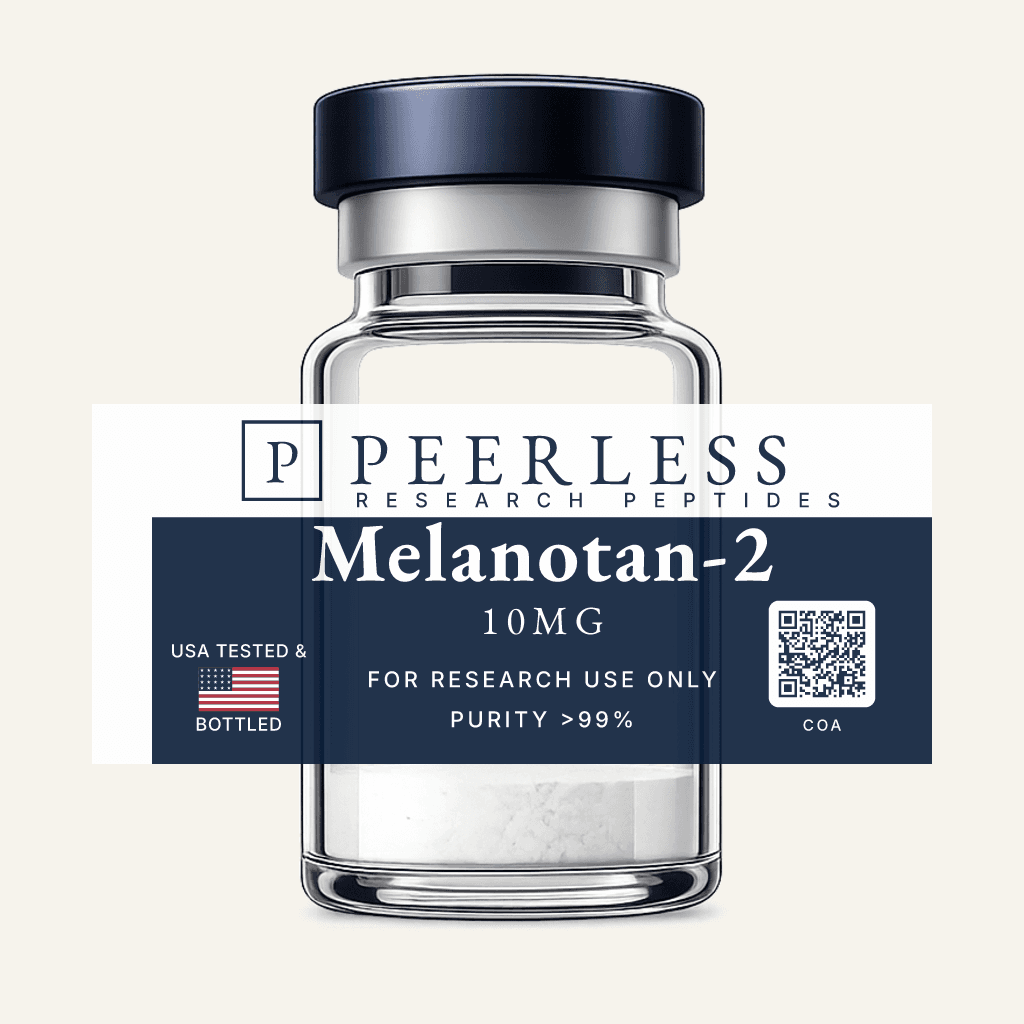
Bremelanotide and Melanotan-2 (MT-II) share the cyclic heptapeptide scaffold and differ at a single chemical position: bremelanotide carries a free-acid C-terminus (-OH), whereas MT-II carries an amide C-terminus (-NH2). The amide-to-acid conversion shifted pharmacokinetic properties and receptor-engagement kinetics enough that Palatin Technologies filed bremelanotide as a separate composition-of-matter entity under US 6,794,489 (issued 2004; patent term extended through PTE; expired June 25, 2025).
The shared scaffold has the same Asp5-Lys10 lactam bridge, the same Nle4 oxidation-stable surrogate at the methionine position, and the same D-Phe7 protease-resistant inversion. The full sequence is Ac-Nle-cyclo[Asp-His-D-Phe-Arg-Trp-Lys]-(OH or NH2). Confirming the C-terminus on a Certificate of Analysis is the appropriate method for distinguishing the two structurally similar molecules.
The regulatory categorization of the two diverges sharply. The bremelanotide molecule is the active ingredient of an FDA-approved finished drug product; MT-II is not FDA-approved for any indication. MT-II is explicitly named on the WADA 2026 Prohibited List; bremelanotide is not explicitly named but may fall under broad readings of the same list. The shared molecular origin in the Hruby/Hadley Arizona α-MSH analog program is documented across both compounds.
Approved-Drug Context & Replication
Bremelanotide is unusual in the broader peptide-research catalogue in that the underlying chemical entity is the active ingredient of an FDA-approved finished drug product (NDA 210557, approved 2019). This regulatory fact does not transfer to the research-use material sold here, which is a separate article supplied for laboratory research use only with no approved labeling, indication, or human dosing.
The Phase 3 placebo response in RECONNECT (approximately 35% on the FSFI-D anchor) is consistent with the placebo response in the broader female sexual dysfunction trial literature and modulates the absolute effect-size interpretation: the active-vs-placebo absolute difference was statistically reliable but modest. Edinoff et al. (2022) specifically noted that the high placebo response rates warrant cautious interpretation of absolute efficacy estimates[10]. The 42-44% Phase 3 discontinuation rate further constrains the interpretation of the trial record.
The compounding pathway for bremelanotide bulk active is narrow. The bulk active is not on the FDA 503A positive (Category 1) bulks list, and because a commercially available FDA-approved drug product exists, the 503A prohibition on essentially copying a commercially available drug applies. The commercial trajectory is the third strand of the story: the approved product passed through three successive sponsors in seven years, with the originator licensing it to a second company in 2017 for $60M upfront, taking rights back in July 2020, and selling worldwide rights to a third company in December 2023. The originator recognized $0 in product revenue for that drug in fiscal year 2025[12]. Three sponsors in seven years suggests the Phase 3 efficacy did not translate cleanly to commercial adoption; this pattern is shared with the other small-molecule entrant in the same indication category.
Handling & Storage
- Storage (lyophilized)
- -20°C, dry, dark, 24-36 months
- Storage (in solution)
- 2-8°C, use within 28 days
- Shelf Life
- 24-36 months lyophilized
Research References
- [1] Al-Obeidi F, Castrucci AM, Hadley ME, Hruby VJ. Potent and prolonged acting cyclic lactam analogues of alpha-melanotropin: design based on molecular dynamics. J Med Chem. 1989;32(12):2555-2561. PMID:2555512
- [2] Pfaus JG, Sadiq A, Spana C, Clayton AH. The neurobiology of bremelanotide for the treatment of hypoactive sexual desire disorder in premenopausal women. CNS Spectr. 2022;27(3):281-289. PMID:33455598
- [3] Pfaus J, Giuliano F, Gelez H. Bremelanotide: an overview of preclinical CNS effects on female sexual function. J Sex Med. 2007;4 Suppl 4:269-279. PMID:17958617
- [4] Molinoff PB, Shadiack AM, Earle D, Diamond LE, Quon CY. PT-141: a melanocortin agonist for the treatment of sexual dysfunction. Ann N Y Acad Sci. 2003;994:96-102. PMID:12851303
- [5] Diamond LE, Earle DC, Rosen RC, Willett MS, Molinoff PB. Double-blind, placebo-controlled evaluation of the safety, pharmacokinetic properties and pharmacodynamic effects of intranasal PT-141, a melanocortin receptor agonist, in healthy males and patients with mild-to-moderate erectile dysfunction. Int J Impot Res. 2004;16(1):51-59. PMID:14963471
- [6] Diamond LE, Earle DC, Garcia WD, Spana C. Co-administration of low doses of intranasal PT-141, a melanocortin receptor agonist, and sildenafil to men with erectile dysfunction results in an enhanced erectile response. Urology. 2005;65(4):755-759. PMID:15833525
- [7] Diamond LE, Earle DC, Heiman JR, Rosen RC, Perelman MA, Harning R. An effect on the subjective sexual response in premenopausal women with sexual arousal disorder by bremelanotide (PT-141), a melanocortin receptor agonist. J Sex Med. 2006;3(4):628-638. PMID:16839319
- [8] Kingsberg SA, Clayton AH, Portman D, Williams LA, Krop J, Jordan R, Lucas J, Simon JA. Bremelanotide for the treatment of hypoactive sexual desire disorder: Two randomized phase 3 trials. Obstet Gynecol. 2019;134(5):899-908. PMID:31599846
- [9] Simon JA, Kingsberg SA, Portman D, Williams LA, Krop J, Jordan R, Lucas J, Clayton AH. Long-term safety and efficacy of bremelanotide for hypoactive sexual desire disorder. Obstet Gynecol. 2019;134(5):909-917. PMID:31599847
- [10] Edinoff AN, Sanders NM, Lewis KB, Apgar TL, Cornett EM, Kaye AM, Kaye AD. Bremelanotide for treatment of female hypoactive sexual desire. Neurol Int. 2022;14(1):75-88. PMID:35051160
- [11] Bremelanotide injection, Full Prescribing Information. Palatin Technologies / Cosette Pharmaceuticals. Initial U.S. Approval: 2019. NDA 210557.
- [12] Clayton AH, Kingsberg SA, Portman D, Williams LA, Krop J, Jordan R, Lucas J, Simon JA. Safety profile of bremelanotide across the clinical development program. J Womens Health (Larchmt). 2022;31(2):171-182. PMID:34403615
- [13] Clayton AH, Althof SE, Kingsberg S, DeRogatis LR, Kroll R, Goldstein I, Kaminetsky J, Spana C, Lucas J, Jordan R, Portman DJ. Bremelanotide for female sexual dysfunctions in premenopausal women: A randomized, placebo-controlled dose-finding trial. Womens Health (Lond). 2016;12(3):325-337. PMID:27181790
- [14] Safarinejad MR, Hosseini SY. Salvage of sildenafil failures with bremelanotide: a randomized, double-blind, placebo controlled study. J Sex Med. 2008;5(3):770-775. PMID:18269596
- [15] Hadley ME, Dorr RT. Melanocortin peptide therapeutics: historical milestones, clinical studies and commercialization. Peptides. 2006;27(4):921-930. PMID:16412534
- [16] NCT02333071 (RECONNECT Study 301) and NCT02338960 (RECONNECT Study 302) on ClinicalTrials.gov. Phase 3 randomized double-blind placebo-controlled trials of subcutaneous bremelanotide vs. placebo. Sponsor: Palatin Technologies. Both trials completed; pivotal evidence base for the 2019 FDA approval of the bremelanotide finished drug product.
Scientific Journal Author
Victor J. Hruby, PhD
Landmark Publications
- Al-Obeidi F, Castrucci AM, Hadley ME, Hruby VJ. Potent and prolonged acting cyclic lactam analogues of alpha-melanotropin: design based on molecular dynamics. J Med Chem. 1989;32(12):2555-2561. (PMID 2555512)
- Hadley ME, Dorr RT. Melanocortin peptide therapeutics: historical milestones, clinical studies and commercialization. Peptides. 2006;27(4):921-930. (PMID 16412534)
- Hruby VJ, Wilkes BC, Hadley ME, et al. alpha-Melanotropin: the minimal active sequence in the frog skin bioassay. J Med Chem. 1987;30(11):2126-2130. (PMID 2822931)
Dr. Hruby is independently cited here as the originating medicinal chemist of the α-MSH cyclic lactam analog series at the University of Arizona, the molecular scaffold from which both Melanotan-2 and bremelanotide were derived. The bremelanotide finished pharmaceutical product (NDA 210557) was developed by Palatin Technologies (Cranbury, NJ), later licensed to AMAG Pharmaceuticals (2017-2020) and acquired by Cosette Pharmaceuticals (December 2023). There is no affiliation or commercial relationship between Dr. Hruby, the University of Arizona, Palatin Technologies, Cosette Pharmaceuticals, and Peerless Peptides.
Related Research Compounds
Other compounds in the melanocortin-receptor peptides research class.