

Quality Standards
American Owned
Mixed, bottled, and tested in the USA
Third-Party Tested
Independently tested for purity and quality
>99% Purity
Exceptional purity you can trust
Also Screened For
Endotoxins + Heavy Metals
Beyond the identity, purity & sterility panel.
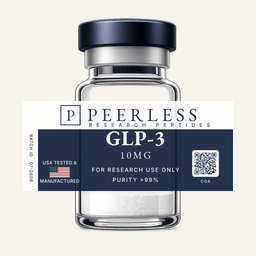
GLP-3
Investigational 39-amino-acid triple GLP-1 / GIP / glucagon receptor agonist (LY3437943) more info
Available for laboratory research use only.
Quality Standards
American Owned
Mixed, bottled, and tested in the USA
Third-Party Tested
Independently tested for purity and quality
>99% Purity
Exceptional purity you can trust
Also Screened For
Endotoxins + Heavy Metals
Beyond the identity, purity & sterility panel.
Vial size
Choose your supply
3 vials· 30mg total
Save $18.75 (5% off)
Total
$356.25
Volume pricing applies to your total vials, not just this product. Mix or match any vials in your cart to reach the next tier.
Independent Lab Results
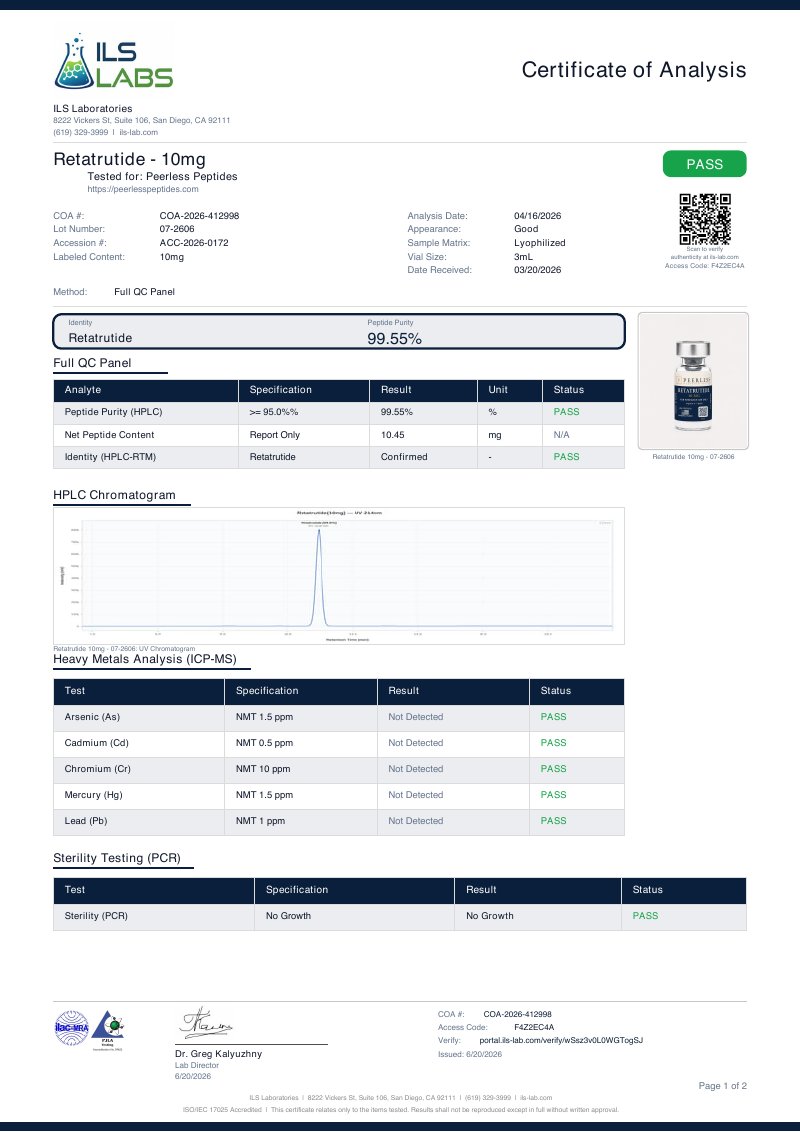
The most comprehensive testing panel in research peptide commerce. Every batch is independently verified by ILS Laboratories — an ISO/IEC 17025 and PJLA-accredited facility in San Diego, CA.
- Identity
- Purity (HPLC)
- Endotoxin (USP <85>)
- Sterility screen (PCR)
- Heavy metals (ICP-MS per USP <233>)
Biochemical Profile
- CAS Number
- 2381089-83-2
- Molecular Formula
- C226H346N48O68
- Molecular Weight
- 4894.58 g/mol
- Purity
- >99% (HPLC-UV with LC-MS deconvolution of lipidation-state isoforms)
- PubChem CID
- 157012423
- Amino Acid Sequence
- 39-residue GIP-backbone scaffold; non-coded Aib at positions 2 and 20; (αS)-α-methyl-Leu at position 13; γGlu-AEEA-C20 diacid lipidation at Lys-17 ε-amine; C-terminal serinamide
Receptor Targets and Triple-Agonism Design
Retatrutide is a 39-amino-acid acylated peptide investigated as a single-molecule agonist at three incretin and metabolic receptors: the GLP-1 receptor (GLP-1R), the glucose-dependent insulinotropic polypeptide receptor (GIPR), and the glucagon receptor (GCGR). The molecule was disclosed by the Coskun research group at Eli Lilly Research Laboratories and is the third generation in a medicinal-chemistry lineage that began with the GIP-backbone dual-agonist tirzepatide (LY3298176)[1]. The scaffold places the molecule in the class of unimolecular multi-receptor agonists. Three receptors derive from two precursor genes: GLP-1R and GCGR share the proglucagon precursor (GCG gene) via tissue-specific PC1/3 and PC2 processing, while GIPR is encoded separately and binds the intestinal K-cell hormone GIP[1].
Receptor pharmacology has been characterized in the published in vitro cAMP-accumulation literature with reported EC₅₀ values of approximately 0.064 nM at GIPR (the most potent of the three contacts, reported as approximately 8.9-fold more potent than native GIP at the same receptor), 0.775 nM at GLP-1R, and 5.79 nM at GCGR[1]. The reported potency profile is described in the discovery literature as GIPR-biased, with GCGR engagement intentionally attenuated to approximately one-third of native glucagon's reported potency in the same assay system. The design rationale stated in the discovery paper is that subordinating GCGR potency to GLP-1R potency keeps glucagon-receptor signaling within a window compatible with concurrent GLP-1R insulinotropic activity in the preclinical models used for selection[1].
The structural basis of the triple-receptor engagement was characterized by Cao and colleagues in a 2024 cryo-electron microscopy trilogy at 2.68, 3.26, and 2.84 Å resolution, with public Protein Data Bank depositions 8YW3, 8YW4, and 8YW5[2]. The Cao study reports that residues 1-13 of the peptide form a continuous α-helix penetrating the receptor transmembrane bundle and driving receptor activation at all three receptors, while residues 14-30 contact the extracellular domain and tune selectivity. Extracellular loop 1 contacts at peptide positions 11, 14, 15, 18, 22, and 25 are described as the principal selectivity-tuning surface; GLP-1R and GCGR present a short α-helix in this region, while GIPR's extracellular loop 1 is described as an unwound loop on account of three proline residues. This study is the strongest non-Lilly structural validation in the retatrutide literature.
The peptide carries three non-coded residues that influence pharmacokinetics and synthesis. Aib at positions 2 and 20 blocks DPP-IV proteolysis and an endopeptidase cleavage site and locks helical conformation. (αS)-α-methyl-Leu at position 13 is described in the synthetic literature as a proprietary custom Fmoc building block. Lipidation at the Lys-17 ε-amine uses a γ-L-Glu spacer, a single AEEA unit, and a C20 α,ω-eicosanedioic fatty diacid. The acylation arm supports serum albumin binding and a reported plasma half-life of approximately 6 days in the published Phase 1b multiple-ascending-dose pharmacokinetic literature (Urva et al., 2022)[3].
Receptor potency assays alone do not distinguish the intact 4894.58 Da parent from des-lipidation truncation isoforms because the lipid arm does not contact the receptor in the published cryo-EM model. The diagnostic moat lever for retatrutide identity is liquid chromatography mass spectrometry deconvolution that reports peak ratios for the intact parent versus des-C20, des-AEEA, des-γGlu, and free-Lys-17 truncation variants. Standard chromatography paired with receptor cAMP assays alone has been published as insufficient for full identity confirmation across the lipidation-arm degradation pathway[1].
Research Applications
Triple Receptor Agonist Pharmacology Research
Receptor-binding and signal-transduction studies have characterized retatrutide as a multi-receptor incretin and metabolic agonist with simultaneous engagement at GLP-1R, GIPR, and GCGR[1]. The reported potency ordering (GIPR > GLP-1R > GCGR) places the molecule in the in vitro pharmacology literature as a model compound for the imbalanced-agonist design framework, in which receptor potencies are deliberately set to non-equimolar ratios to bias the integrated cellular response.
The discovery paper described retatrutide as engineered to subordinate glucagon-receptor potency to GLP-1 receptor potency on the rationale that the GLP-1R insulinotropic axis counter-regulates the GCGR hepatic-glycogenolysis axis in the in vitro signaling context[1]. This balanced-but-asymmetric design is studied in the comparative pharmacology literature alongside the mono-agonist semaglutide (GLP-1R only), the dual agonist tirzepatide (GIPR and GLP-1R), and the dual GLP-1R / GCGR class (mazdutide, survodutide) as a framework for examining the relationship between receptor stoichiometry and the integrated downstream signaling profile.
The cryo-electron microscopy structures reported by Cao and colleagues map the receptor contact surfaces and identify extracellular loop 1 as the principal selectivity-tuning region[2]. Independent non-Lilly structural biology validation through the public Protein Data Bank depositions 8YW3, 8YW4, and 8YW5 is the strongest external mechanistic anchor in the retatrutide literature.
Long-Acting Acylated Peptide Engineering Research
Retatrutide is studied in the synthetic peptide chemistry literature as a model compound for the γGlu-AEEA-C20 fatty diacid acylation architecture at the Lys-17 ε-amine[1]. The lipidation strategy supports serum albumin binding in vitro and an approximately 6-day plasma half-life in the published Phase 1b multiple-ascending-dose data in subjects with type 2 diabetes (Urva et al., 2022)[3]. The molecule uses a single AEEA spacer between the γGlu and the C20 diacid, distinguishing it in the published acylated-peptide literature from semaglutide and tirzepatide, which use two AEEA spacers in their respective lipidation arms[1].
The published synthetic literature characterizes three non-coded residues in the 39-mer (Aib at positions 2 and 20; (αS)-α-methyl-Leu at position 13) as the design choices intended to confer resistance to DPP-IV and endopeptidase cleavage and to stabilize the helical conformation observed in the cryo-electron microscopy structures[1][2]. The αMeL-13 building block is described in synthetic notes as proprietary to the originating program. The molecule deliberately omits methionine, tryptophan, and cysteine, eliminating the principal oxidation-mediated degradation pathways common to other acylated peptides.
Aggregation hotspots reported in the synthetic literature include the Leu-27 / Leu-28 stretch, the Pro-36 / Pro-37 / Pro-38 kink, and the Gly-29 / Gly-30 region. Aspartimide-formation risk has been described at Asp-9 and Asp-15. These features place retatrutide in the published acylated-peptide stability literature as a molecule whose primary degradation vectors are lipidation-arm hydrolysis and aspartimide chemistry rather than oxidation.
Comparative Incretin Pharmacology Research
Retatrutide has been investigated in the published comparative pharmacology literature alongside the GLP-1 mono-agonist class (semaglutide, liraglutide, exenatide, orforglipron), the GLP-1 / GIP dual-agonist tirzepatide, and the GLP-1 / glucagon dual-agonist class (mazdutide, survodutide, pemvidutide, cotadutide)[1]. This comparative literature characterizes the sequential layering of incretin receptors (one, two, then three) as a research framework for asking whether each additional receptor in a unimolecular agonist contributes independently to the integrated downstream signaling profile or whether receptor interactions are non-additive.
The published in vitro receptor pharmacology positions the GLP-1R activity of retatrutide between that of the mono-agonist semaglutide and the dual-agonist tirzepatide[1]. The GIPR activity is reported in the in vitro literature as more potent than native GIP at the same receptor in the same assay system. The GCGR activity is reported as approximately one-third of native glucagon's reported potency, distinguishing retatrutide in the comparative literature from the higher-potency GCGR agonist arms reported for mazdutide and survodutide.
The published comparative literature also identifies the Amgen bispecific maritide (AMG 133) as the diametrically opposite GIP pharmacology, combining a GLP-1 receptor agonist with a GIP receptor antagonist; the maritide MARITIME Phase 3 program is the principal head-to-head reference point for the GIPR-agonism-versus-GIPR-antagonism question in the published incretin literature.
Glucagon Receptor and Hepatic Metabolism Research
The glucagon-receptor arm of retatrutide is investigated in the published metabolism literature as an orthogonal catabolic axis acting on hepatic and adipose tissue substrates. Glucagon receptor signaling has been characterized in the broader endocrinology literature in association with hepatic glycogenolysis, hepatic fatty-acid oxidation, FGF21 induction with adipose insulin sensitization, bile-acid production, and reduced de novo lipogenesis. The unique pharmacology of unimolecular GLP-1 / GCGR co-agonism is that GLP-1 receptor insulinotropic signaling has been reported to counter-regulate the hepatic glycogenolytic effect of glucagon receptor agonism in the preclinical model systems used for selection[1].
A Phase 2 substudy in metabolic dysfunction-associated steatotic liver disease (MASLD) reported a magnetic resonance imaging proton density fat fraction reduction in liver fat content over the study period, with elevated plasma β-hydroxybutyrate observed as a ketone-body marker consistent with the published glucagon-receptor fatty-acid-oxidation literature (Sanyal et al., 2024)[4]. The substudy used an imaging endpoint rather than histology and is not a registration-grade pivotal trial. The TRIUMPH-MASH Phase 3 trial uses a histology endpoint and is the registration-grade pivotal for the indication.
The published clinical literature in the dual GLP-1 / GCGR agonist class (mazdutide, survodutide, pemvidutide) and the regulatory approval of mazdutide by China's National Medical Products Administration in June 2025 (for weight) and September 2025 (for type 2 diabetes) establish the dual GLP-1 / GCGR agonist mechanism as one that has cleared a national regulator's review. Retatrutide adds GIPR agonism on top of the GLP-1 / GCGR scaffold.
Published Phase 2 Clinical Pharmacology Research
The Phase 2 clinical pharmacology literature on retatrutide consists primarily of three reports. Jastreboff and colleagues reported a 48-week Phase 2 obesity trial with n=338 randomized participants across multiple dose arms with retatrutide and placebo[5]. The published primary endpoint was percent change in body weight from baseline at 48 weeks. The trial reported that the body-weight trajectory in the highest-exposure arm had not plateaued by the end of the 48-week window, leaving the long-run trajectory at higher exposure unresolved at the Phase 2 horizon.
Rosenstock and colleagues reported a Phase 2 type 2 diabetes trial of retatrutide with mean change from baseline in glycated hemoglobin as the primary endpoint at 36 weeks (Rosenstock et al., 2023)[6]. The trial reported a glycated hemoglobin reduction relative to placebo in the published study population, without an increase in clinical hypoglycemia events despite the molecule's glucagon-receptor agonism.
Urva and colleagues reported the Phase 1b multiple-ascending-dose study in subjects with type 2 diabetes that established the approximately 6-day plasma elimination half-life across the dose range studied[3]. The reported half-life is consistent with the once-weekly subcutaneous administration schedule used in the subsequent Phase 2 and Phase 3 program. Reported Phase 2 adverse-event profiles in the published trials describe gastrointestinal events as the most common class adverse-event type, consistent with the broader class of GLP-1 receptor agonists. The Phase 2 sample sizes (n=338 for obesity; n=281 for type 2 diabetes) are smaller than the corresponding semaglutide and tirzepatide Phase 2 cohorts and are under-powered for detection of low-frequency class safety signals.
Replication, Phase 3 Status, and Regulatory Posture
The published primary-data literature on retatrutide is small in absolute terms (approximately 350 to 500 PubMed-indexed papers as of mid-2026) and concentrated by sponsor: more than 90 percent of primary-data papers carry an Eli Lilly author, with Coskun and Hartman appearing on more than 70 percent. The dominant citation node is the Jastreboff and colleagues Phase 2 obesity paper, which accounts for an outsized share of total citation volume[5]. The structural-biology cryo-electron microscopy work by Cao and colleagues with public Protein Data Bank depositions is the strongest non-Lilly external validation in the retatrutide literature[2]. EC₅₀ values reported in the discovery paper have not been independently re-derived in published non-Lilly receptor pharmacology work as of May 2026.
The Phase 3 TRIUMPH program comprises multiple pivotal trials and a cardiovascular outcomes trial[7]. TRIUMPH-4 (obesity with osteoarthritis of the knee, NCT05882045) reported topline results in December 2025. TRIUMPH-1 (general obesity, NCT05929066) and TRIUMPH-2 (obesity with type 2 diabetes, NCT05929079) are pivotal trials with readouts pending in 2026. TRIUMPH-NASH (NCT06859268) uses a histology endpoint and is the registration-grade liver pivotal. TRIUMPH-CVOT is an event-driven cardiovascular outcomes trial of approximately 10,000 participants with a readout horizon of 2027 to 2029[7]. New drug application filing has not occurred as of May 2026; the earliest possible FDA approval timing is contingent on completion of the pivotal program.
Retatrutide has not been approved by the FDA for any indication. It has no USP or NF monograph, is not a component of any FDA-approved drug product, does not appear on either the 503A bulks list or the 503B bulks list, and is not on the FDA drug shortage list. The September 9, 2025 FDA warning letter to GLP-1 Solution stated explicitly that retatrutide cannot be used in compounding under federal law[8]. The September 2025 enforcement wave included more than 50 warning letters, and a March 2026 wave added more than 30 additional letters with retatrutide named[8]. The April 1, 2026 federal indictment in the District of Utah (1:26-cr-00015-DBB) was the first federal physician indictment to name an investigational drug, with retatrutide explicitly listed in the indictment[9]. The investigational status of retatrutide is one regulatory category stricter than the closed-shortage posture that applies to semaglutide and tirzepatide.
The research-supply integrity question for retatrutide is uniquely load-bearing. An independent analytical-chemistry record published across 40 retatrutide samples sourced from a single major research-use-only distributor between December 17, 2024 and April 28, 2026 reported 9 of 40 samples returning a verdict of sample-does-not-contain-retatrutide and one confirmed counterfeit vial in November 2025[10]. The named distributor announced a voluntary cessation of operations on March 6, 2026[10]. The identity-failure pattern is uniquely hazardous for an investigational triple-receptor molecule because shifts in the GIPR-to-GLP-1R-to-GCGR ratio could in principle change rather than reduce signaling, making per-batch identity confirmation through accredited mass-spectrometry deconvolution the structural answer to the failure mode observed in the retatrutide gray market.
Handling & Storage
- Storage (lyophilized)
- -20°C, dry, dark, 24 months
- Storage (in solution)
- 2-8°C, use within 28 days
- Shelf Life
- 24 months lyophilized
Research References
- [1] Coskun T, Urva S, Roell WC, et al. LY3437943, a novel triple glucagon, GIP, and GLP-1 receptor agonist for glycemic control and weight loss: From discovery to clinical proof of concept. Cell Metab. 2022;34(9):1234-1247.e9. doi:10.1016/j.cmet.2022.07.013PMID:35985340
- [2] Cao J, Wu C, Jia Y, et al. Molecular insights into peptide agonist engagement with the GIP receptor. Cell Discov. 2024;10:79. doi:10.1038/s41421-024-00691-yPMID:39019866
- [3] Urva S, Coskun T, Loh MT, et al. LY3437943, a novel triple GIP/GLP-1/glucagon receptor agonist in people with type 2 diabetes: a phase 1b, multicentre, double-blind, placebo-controlled, randomised, multiple-ascending dose trial. Lancet. 2022;400(10366):1869-1881. doi:10.1016/S0140-6736(22)02033-5PMID:36354040
- [4] Sanyal AJ, Kaplan LM, Frias JP, et al. Triple hormone receptor agonist retatrutide for metabolic dysfunction-associated steatotic liver disease: a randomized phase 2a trial. Nat Med. 2024;30(7):2037-2048. doi:10.1038/s41591-024-03018-2PMID:38858523
- [5] Jastreboff AM, Kaplan LM, Frías JP, et al. Triple-hormone-receptor agonist retatrutide for obesity — A phase 2 trial. N Engl J Med. 2023;389(6):514-526. doi:10.1056/NEJMoa2301972PMID:37366315
- [6] Rosenstock J, Frias J, Jastreboff AM, et al. Retatrutide, a GIP, GLP-1 and glucagon receptor agonist, for people with type 2 diabetes: a randomised, double-blind, placebo and active-controlled, parallel-group, phase 2 trial conducted in the USA. Lancet. 2023;402(10401):529-544. doi:10.1016/S0140-6736(23)01053-XPMID:37385280
- [7] Jastreboff AM, Aronne LJ, Knop FK, Garvey WT. The TRIUMPH phase 3 program for retatrutide: a comprehensive evaluation of efficacy and safety across multiple obesity-related indications. Diabetes Obes Metab. 2025. Includes TRIUMPH-1 (NCT05929066), TRIUMPH-2 (NCT05929079), TRIUMPH-4 (NCT05882045), TRIUMPH-NASH (NCT06859268), TRIUMPH-CVOT (NCT06383390 / NCT07232719). PMID:41090431
- [8] US Food and Drug Administration. Warning Letter to GLP-1 Solution dated September 9, 2025; stated explicitly that retatrutide and cagrilintide cannot be used in compounding under federal law. Part of the December 2024 / September 2025 / March 2026 enforcement wave (80+ warning letters in total) targeting compounded GLP-1 and investigational triple-receptor agonist products.
- [9] United States v. Watkins, 1:26-cr-00015-DBB (D. Utah, indictment unsealed April 1, 2026). Federal physician indictment naming retatrutide as one of the investigational drugs underlying misbranding and adulteration counts; the first federal physician indictment to name an investigational drug among the charged molecules.
- [10] Independent third-party analytical record on commercial retatrutide vials sourced from a single major US research-use-only distributor: 40 samples tested December 17, 2024 - April 28, 2026; 9 of 40 returned a sample-does-not-contain-retatrutide verdict; one confirmed counterfeit vial in November 2025; the named distributor announced a voluntary cessation of operations on March 6, 2026. Aggregate record available in the published peptide-vendor analytical-testing literature.
- [11] Knerr PJ, Mowery SA, Finan B, et al. Selection and progression of unimolecular agonists at the GIP, GLP-1, and glucagon receptors as drug candidates. Peptides. 2020;125:170225. doi:10.1016/j.peptides.2019.170225PMID:31786282
- [12] Finan B, Yang B, Ottaway N, et al. A rationally designed monomeric peptide triagonist corrects obesity and diabetes in rodents. Nat Med. 2015;21(1):27-36. doi:10.1038/nm.3761PMID:25485909
- [13] Coskun T, Sloop KW, Loghin C, et al. LY3298176, a novel dual GIP and GLP-1 receptor agonist for the treatment of type 2 diabetes mellitus: From discovery to clinical proof of concept. Mol Metab. 2018;18:3-14. doi:10.1016/j.molmet.2018.09.009PMID:30473097
- [14] Bossart M, Wagner M, Elvert R, et al. Effects on weight loss and glycemic control with SAR441255, a potent unimolecular peptide GLP-1/GIP/GCG receptor triagonist. Cell Metab. 2022;34(1):59-74.e10. doi:10.1016/j.cmet.2021.12.005PMID:34932984
- [15] Lau J, Bloch P, Schäffer L, et al. Discovery of the once-weekly glucagon-like peptide-1 (GLP-1) analogue semaglutide. J Med Chem. 2015;58(18):7370-7380. doi:10.1021/acs.jmedchem.5b00726PMID:26308095
- [16] Müller TD, Finan B, Bloom SR, et al. Glucagon-like peptide 1 (GLP-1). Mol Metab. 2019;30:72-130. doi:10.1016/j.molmet.2019.09.010PMID:31767182
- [17] Boer GA, Holst JJ. Incretin hormones and type 2 diabetes-Mechanistic insights and therapeutic approaches. Biology (Basel). 2020;9(12):473. doi:10.3390/biology9120473PMID:33339298
Scientific Journal Author
Tamas Coskun, PhD
Landmark Publications
- Coskun T, Urva S, Roell WC, et al. LY3437943, a novel triple glucagon, GIP, and GLP-1 receptor agonist for glycemic control and weight loss: From discovery to clinical proof of concept. Cell Metab. 2022;34(9):1234-1247.e9. (PMID 35985340)
- Coskun T, Sloop KW, Loghin C, et al. LY3298176, a novel dual GIP and GLP-1 receptor agonist for the treatment of type 2 diabetes mellitus: From discovery to clinical proof of concept. Mol Metab. 2018;18:3-14. (PMID 30473097)
- Knerr PJ, Mowery SA, Finan B, et al. Selection and progression of unimolecular agonists at the GIP, GLP-1, and glucagon receptors as drug candidates. Peptides. 2020;125:170225. (PMID 31786282)
Dr. Coskun is independently cited here as the lead author on the originating discovery publication for the LY3437943 program at Lilly Research Laboratories. There is no affiliation or commercial relationship between Dr. Coskun, Eli Lilly and Company, and Peerless Peptides. Eli Lilly is the originator and clinical-stage developer of retatrutide; Peerless Peptides has no business relationship with Eli Lilly and does not sell the proprietary Eli Lilly clinical investigational drug product.