Quality Standards
American Owned
Mixed, bottled, and tested in the USA
Third-Party Tested
Independently tested for purity and quality
>99% Purity
Exceptional purity you can trust
Also Screened For
Endotoxins + Heavy Metals
Beyond the identity, purity & sterility panel.
Tesamorelin + Ipamorelin Blend
Contents: Tesamorelin (12mg) · Ipamorelin (6mg)
Dual GHRH-axis research peptide preparation: Tesamorelin (synthetic GHRH 1-44 analog) + Ipamorelin (selective ghrelin-receptor pentapeptide) more info
Available for laboratory research use only.
Quality Standards
American Owned
Mixed, bottled, and tested in the USA
Third-Party Tested
Independently tested for purity and quality
>99% Purity
Exceptional purity you can trust
Also Screened For
Endotoxins + Heavy Metals
Beyond the identity, purity & sterility panel.
Vial size
Choose your supply
3 vials· 36mg + 6mg total
Save $18.75 (5% off)
Total
$356.25
Volume pricing applies to your total vials, not just this product. Mix or match any vials in your cart to reach the next tier.
Independent Lab Results
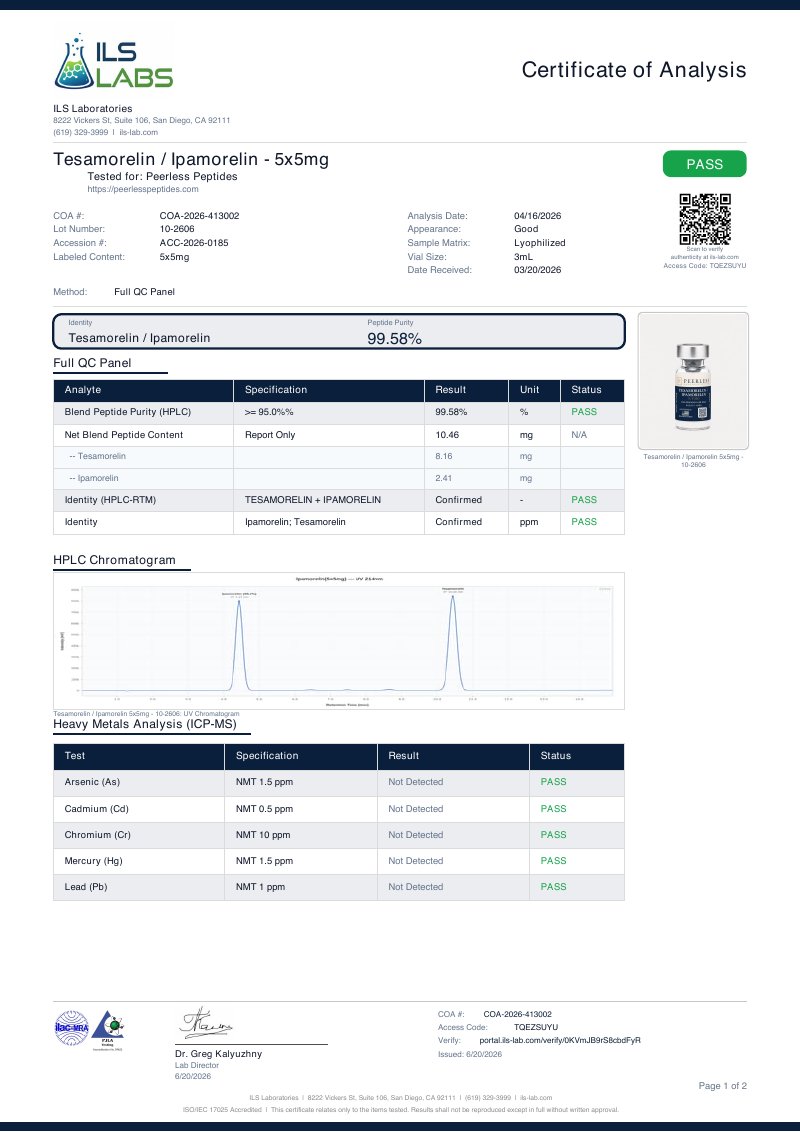
The most comprehensive testing panel in research peptide commerce. Every batch is independently verified by ILS Laboratories — an ISO/IEC 17025 and PJLA-accredited facility in San Diego, CA.
- Identity
- Purity (HPLC)
- Endotoxin (USP <85>)
- Sterility screen (PCR)
- Heavy metals (ICP-MS per USP <233>)
Biochemical Profile
- CAS Number
- Tesamorelin 218949-48-5 (free base) / 901758-09-6 (acetate); Ipamorelin 170851-70-4
- Molecular Formula
- Tesamorelin C221H366N72O67S; Ipamorelin C38H49N9O5
- Molecular Weight
- Tesamorelin 5135.86 g/mol; Ipamorelin 711.86 g/mol
- Purity
- >99% (each component) (HPLC-UV (each component))
- Amino Acid Sequence
- Tesamorelin: trans-3-hexenoyl-Tyr-Ala-Asp-Ala-Ile-Phe-Thr-Asn-Ser-Tyr-Arg-Lys-Val-Leu-Gly-Gln-Leu-Ser-Ala-Arg-Lys-Leu-Leu-Gln-Asp-Ile-Met-Ser-Arg-Gln-Gln-Gly-Glu-Ser-Asn-Gln-Glu-Arg-Gly-Ala-Arg-Ala-Arg-Leu-NH2 | Ipamorelin: H-Aib-His-D-2Nal-D-Phe-Lys-NH2
Dual-Receptor Pharmacology and the Absence of Combined-Administration Evidence
This blend product is a fixed-composition vial containing two distinct synthetic peptides that bind two independent G-protein-coupled receptors. Tesamorelin is a synthetic 44-amino-acid analog of human growth hormone-releasing hormone (GHRH 1-44; somatocrinin) carrying a single structural distinction from the native parent peptide: a trans-3-hexenoic acid moiety amide-coupled to the α-amine of N-terminal Tyr1[1]. The hexenoyl cap sterically blocks dipeptidyl peptidase IV access to the Tyr1-Ala2 cleavage site while preserving the full 44-amino-acid sequence and the GHRH-receptor binding affinity of the native parent[2]. Tesamorelin signals through the GHRH receptor (GHRH-R), a class B G-protein-coupled receptor expressed on anterior pituitary somatotrophs, via Gαs/cAMP/PKA signaling that drives growth hormone gene transcription and exocytosis of pre-formed growth hormone from secretory granules[2]. The plasma half-life of subcutaneous tesamorelin in healthy adults is approximately 26 to 38 minutes per the FDA Clinical Pharmacology Review for NDA 022505[2], which preserves the pulsatile GHRH-R signaling mode characteristic of native hypothalamic GHRH release.
Ipamorelin is a synthetic pentapeptide (H-Aib-His-D-2Nal-D-Phe-Lys-NH2) designed at Novo Nordisk in the mid-1990s as a structurally simplified, receptor-selective agonist of the growth hormone secretagogue receptor type 1a (GHS-R1a), the cognate receptor of the endogenous 28-residue peptide acyl-ghrelin[3]. Ipamorelin mimics the receptor-binding interaction with a designed pentapeptide scaffold structurally distinct from ghrelin. The Raun et al. 1998 foundational paper reported GHS-R1a binding affinity in the low-nanomolar range and growth hormone release from primary rat pituitary cells, anesthetized rats, and conscious swine at potencies comparable to GHRP-6, while plasma ACTH, cortisol, prolactin, FSH, LH, and TSH were not detectably elevated at doses greater than 200-fold above the GH ED50 in those animal preparations[3]. The selectivity finding has methodological limits the published evidence does not exit: the cortisol comparator in Raun 1998 was GHRH rather than vehicle, and the most-cited human pharmacokinetic study (Gobburu et al. 1999, plasma half-life approximately two hours after intravenous administration in healthy male volunteers) measured growth hormone release as the sole pharmacodynamic readout and did not measure plasma cortisol, ACTH, or prolactin in humans[4]. The narrow defensible claim in the published evidence is that ipamorelin was more selective than GHRP-6 / GHRP-2 at the pituitary somatotroph in animal preparations.
The two receptor systems are biologically independent at the molecular level. GHRH-R agonism through Gαs/cAMP and GHS-R1a agonism through Gαq/PLC/IP3 mobilize different second-messenger pathways on the same anterior pituitary somatotroph population. The Bowers and colleagues canonical work across the 1980s and 1990s reported synergistic growth hormone release at the somatotroph when a GHRH analog and a GHRP-class agent were co-administered, with the synergy mechanism interpreted as pulse-amplitude (GHRH-R) versus basal-frequency (GHS-R1a) control of pituitary growth hormone release[5]. The Bowers synergy literature used non-tesamorelin GHRH analogs and non-ipamorelin GHRPs.
No peer-reviewed randomized controlled trial of combined tesamorelin plus ipamorelin administration has been conducted in any species. The published Phase 1, Phase 2, and Phase 3 evidence base supporting the November 10, 2010 FDA approval (Falutz 2007 N Engl J Med; Falutz 2010 J Clin Endocrinol Metab pooled analysis; combined n = 816 HIV-infected adults with lipodystrophy) was generated with tesamorelin monotherapy[6][7]. The single Phase 2 human-efficacy trial of ipamorelin in any indication (Beck et al. 2014, NCT00672074, postoperative ileus, n = 114 to 117 mITT) was conducted with ipamorelin monotherapy, missed its pre-specified primary endpoint at p = 0.15, and led Helsinn to discontinue ipamorelin development[8]. The dual-receptor-axis pharmacology described above is therefore a class-pharmacology observation extrapolated from non-combined evidence; it is not direct evidence for combined tesamorelin plus ipamorelin safety, efficacy, or recommended use in any species or indication.
Research Applications
Component Composition
This product is a fixed-composition vial containing tesamorelin and ipamorelin in defined ratios. Tesamorelin is a synthetic 44-amino-acid GHRH 1-44 analog (molecular formula C221H366N72O67S, molecular weight 5135.86 g/mol, CAS 218949-48-5 free base / 901758-09-6 acetate, PubChem CID 16137828) bearing a trans-3-hexenoyl modification on the α-amine of N-terminal Tyr1. Ipamorelin is a synthetic pentapeptide (H-Aib-His-D-2Nal-D-Phe-Lys-NH2; molecular formula C38H49N9O5, molecular weight 711.86 g/mol, CAS 170851-70-4, PubChem CID 11226745) with non-proteinogenic alpha-aminoisobutyric acid at position 1 and D-isomer residues at positions 3 (D-2-naphthylalanine) and 4 (D-phenylalanine). Each component is manufactured by Fmoc solid-phase peptide synthesis on Rink amide resin (yielding the required C-terminal amide), purified to ≥99% by preparative reversed-phase HPLC, and characterized by RP-HPLC at 220 nm and 280 nm plus ESI-MS deconvolution. Per-batch Certificates of Analysis include identity, purity, residual solvent, counter-ion identity, and endotoxin testing for each component. Refer to the individual tesamorelin and ipamorelin PDP entries for full per-component chemistry, synthesis, and analytical specifications.
Tesamorelin Research Summary
Tesamorelin is a synthetic 44-amino-acid analog of GHRH 1-44 discovered at Theratechnologies in Montreal in 1995 under the development code TH9507. The molecule carries one structural distinction from the native parent: a trans-3-hexenoic acid moiety amide-coupled to the α-amine of N-terminal Tyr1. The hexenoyl cap sterically blocks dipeptidyl peptidase IV access to the Tyr1-Ala2 cleavage site while preserving the full 44-amino-acid sequence and the pulsatile GHRH-receptor signaling mode of the native parent[1][2]. Tesamorelin is the active drug substance in an FDA-approved finished product (NDA 022505, Theratechnologies), originally approved November 10, 2010; the blend sold here is not that finished drug product and is not approved for any indication.
The Phase 3 evidence base supporting the November 10, 2010 approval comprised two identically-designed Phase 3 placebo-controlled trials. Falutz et al. 2007 in the New England Journal of Medicine (NCT00123253, n = 412 HIV-infected adults, 2:1 tesamorelin to placebo, 26-week primary phase) met its pre-specified visceral-adipose-tissue primary endpoint by CT versus placebo, with concurrent IGF-1 elevation from baseline[6]. Falutz et al. 2010 in J Clin Endocrinol Metab pooled the original Phase 3 with the confirmatory NCT00435136 (combined n = 816) and reported sustained visceral-adipose-tissue reduction over 52 weeks alongside broadly stable glucose parameters[7].
The Massachusetts General Hospital research program led by Steven K. Grinspoon has run a sustained academic investigation of tesamorelin in HIV-associated nonalcoholic fatty liver disease extending beyond its narrow approval. The Stanley et al. 2019 Lancet HIV trial (NCT02196831, n = 61 HIV-infected adults with hepatic fat fraction ≥ 5%) met its pre-specified hepatic-fat-fraction primary endpoint by 1H-MR spectroscopy versus placebo, with a pre-specified analysis reporting lower fibrosis progression on tesamorelin than placebo[9]. A separate single-center Phase 2 trial in mild cognitive impairment and healthy aging (Baker et al. 2012 Arch Neurol, n = 152 adults aged 55-87) examined cognitive outcomes at the University of Washington[18]; the cognition signal has not been replicated at Phase 3 scale.
A reduced-reconstitution-volume formulation (F4) was approved in 2019. A weekly-reconstituted formulation (F8) was approved March 25, 2025; US patent protection on F8 extends through 2033[12]. Tesamorelin was reclassified as a biologic under the BPCIA on March 23, 2020, which closes the 503A bulks-list compounding pathway available to other unapproved drug substances.
Ipamorelin Research Summary
Ipamorelin is a synthetic pentapeptide GHS-R1a agonist designed at Novo Nordisk in the mid-1990s as a receptor-selective successor to the GHRP-1, GHRP-2, GHRP-6, Hexarelin lineage developed through the GHRP discovery work of Cyril Y. Bowers (Tulane) and Frank Reynolds[5]. The structural moves yielding the reported selectivity were the alpha-aminoisobutyric acid (Aib) N-cap and deletion of the GHRP-1 central Ala-Trp dipeptide[15]. Raun et al. 1998 reported low-nanomolar GHS-R1a binding affinity and growth hormone release at potency comparable to GHRP-6 in rat pituitary cells, anesthetized rats, and conscious swine, with no detectable elevation of plasma ACTH, cortisol, prolactin, FSH, LH, or TSH at doses greater than 200-fold above the GH ED50[3].
The selectivity claim is animal-only. The cortisol comparator in Raun 1998 was GHRH rather than vehicle, limiting the resolution of an ipamorelin-specific cortisol signal smaller than the (zero) GHRH-driven signal. The most-cited human pharmacokinetic study (Gobburu et al. 1999, plasma half-life approximately two hours intravenous in healthy male volunteers) measured growth hormone release as the sole pharmacodynamic readout and did not measure plasma cortisol, ACTH, or prolactin[4]. The reported selectivity is intra-pituitary (somatotroph relative to corticotroph and lactotroph), not inter-organ; GHS-R1a is also expressed in hypothalamus, hippocampus, cardiac tissue, pancreas, immune cells, adipose tissue, and bone. Whether chronic administration produces GHS-R1a tachyphylaxis at research-use dosing patterns has not been characterized in published literature.
The single Phase 2 human-efficacy trial of ipamorelin in any indication (Beck et al. 2014, NCT00672074, postoperative ileus, n = 114 to 117 mITT) reported the pre-specified primary endpoint of median time to first tolerated meal as 25.3 hours on ipamorelin versus 32.6 hours on placebo, p = 0.15[8]. The trial missed its primary endpoint, Helsinn discontinued ipamorelin development, and no Phase 3 trial in any indication has ever been attempted by any sponsor.
The FDA Pharmacy Compounding Advisory Committee voted against 503A bulks-list inclusion for ipamorelin on October 29, 2024 for both acetate and free-base forms and for both proposed indications (growth hormone deficiency; postoperative ileus); the briefing document recommended against inclusion[10]. The same Helsinn pivoted to anamorelin, an oral nonpeptide GHS-R1a successor that achieved Japan PMDA approval in January 2021 for cancer cachexia (launched April 2021 via Ono Pharmaceutical), while the EMA refused marketing authorization in 2017 and the FDA issued a Complete Response Letter the sponsor never resubmitted[19]. Anamorelin's clinical record cannot be imported to ipamorelin claims; the molecules differ in chemistry, route, and indication.
GHRH + GHS-R Pharmacology
The GHRH receptor (GHRH-R) is a class B G-protein-coupled receptor expressed on anterior pituitary somatotrophs. Receptor binding activates Gαs/cAMP/PKA signaling, with downstream activation of GH gene transcription and exocytosis of pre-formed growth hormone from secretory granules[2]. The growth hormone secretagogue receptor type 1a (GHS-R1a) is a class A G-protein-coupled receptor expressed on the same anterior pituitary somatotroph population (and extensively in the hypothalamus, hippocampus, cardiac tissue, pancreas, immune cells, adipose tissue, and bone). Receptor binding activates Gαq/PLC/IP3/Ca²⁺ signaling and antagonizes hypothalamic somatostatin tone[3]. The two receptors are coupled to different heterotrimeric G-proteins and different second-messenger cascades, but converge on the same end-cell population for growth hormone release.
The Bowers and colleagues canonical work across the 1980s and 1990s reported that co-administration of a GHRH-R agonist with a GHRP-class agent produced greater growth hormone release than either compound alone in healthy human volunteers, with the synergy mechanism interpreted as pulse-amplitude (GHRH-R) versus basal-frequency (GHS-R1a) control of pituitary somatotroph release plus differential engagement of the somatostatin tone[5]. The Bowers synergy literature used non-tesamorelin GHRH analogs (sermorelin, native GHRH) plus non-ipamorelin GHRPs (GHRP-2, GHRP-6, Hexarelin). The class-pharmacology framework is biologically supported at the receptor-coupling level. No peer-reviewed RCT of the tesamorelin-plus-ipamorelin specific pairing has ever been conducted. Whether the GHRH-R-plus-GHS-R1a class pharmacology observed by Bowers with sermorelin-plus-GHRP-6 (or related compositions) translates quantitatively to the tesamorelin-plus-ipamorelin pairing under the pharmacokinetic profile of subcutaneous administration (tesamorelin half-life approximately 26 to 38 minutes; ipamorelin half-life approximately two hours intravenous) has not been characterized in the published peer-reviewed literature.
Combined Administration Literature
No peer-reviewed randomized controlled trial of combined tesamorelin plus ipamorelin administration has been conducted in any species. As of May 2026, a PubMed search for trials examining the specific tesamorelin-plus-ipamorelin pairing returns zero results. The published Phase 1, Phase 2, and Phase 3 clinical evidence supporting the November 10, 2010 FDA approval (Falutz 2007 NEJM; Falutz 2010 JCEM pooled analysis; combined n = 816 HIV-infected adults with lipodystrophy) was generated with tesamorelin monotherapy[6][7]. The Massachusetts General Hospital / Steven Grinspoon program in HIV-associated NAFLD (Stanley 2014 JAMA n = 50; Stanley 2019 Lancet HIV n = 61) was conducted with tesamorelin monotherapy[9][11]. The single Phase 2 human-efficacy trial of ipamorelin in any indication (Beck 2014 NCT00672074 postoperative ileus, n = 114 to 117 mITT) was conducted with ipamorelin monotherapy and missed its pre-specified primary endpoint at p = 0.15[8].
Combined administration of tesamorelin with ipamorelin is therefore outside tesamorelin's narrow FDA approval. It is not an approved indication in any jurisdiction, has not been adjudicated by any regulatory authority, and has no peer-reviewed clinical-trial evidence base in any species. The class-pharmacology observations described in the Pharmacology section above are inferences from non-combined evidence on different molecule pairings. The published clinical-trial evidence describing tesamorelin's safety and efficacy applies to tesamorelin monotherapy in HIV-infected adults with lipodystrophy under the cGMP-manufactured FDA-approved finished drug product. It does not extend to combined administration with ipamorelin, to non-HIV general populations, to compounded or research-grade tesamorelin, or to any indication outside the narrow FDA-approved label.
Approved-Drug Context & Status
Tesamorelin's regulatory posture is structurally distinct from every other peptide in the research-supply channel. The FDA approval is narrow and specific to a single clinical indication. Three FDA-approved formulations exist under NDA 022505: the original formulation (F1, approved November 10, 2010), a reduced-reconstitution-volume formulation (F4, approved 2019), and a weekly-reconstituted formulation (F8, approved March 25, 2025, with reduced administration volume relative to F4)[12]. Tesamorelin was reclassified as a biologic under the Biologics Price Competition and Innovation Act of 2009 on March 23, 2020, which closes the 503A bulks-list compounding pathway available to BPC-157, TB-500, GHK-Cu, and other unapproved drug substances. Patient-specific 503A compounding remains theoretically possible with a valid individual prescription. Tesamorelin was not named in the 2020 Tailor Made Compounding plea agreement or the April 1, 2026 Watkins federal indictment in the District of Utah. F8 patent protection in the United States extends through 2033.
Ipamorelin's regulatory posture is the inverse of tesamorelin's on every relevant dimension. The molecule has no FDA approval in any indication. The FDA Pharmacy Compounding Advisory Committee (PCAC) voted against 503A bulks-list inclusion on October 29, 2024 for both the acetate and free-base forms and for both proposed indications (growth hormone deficiency; postoperative ileus); the FDA briefing document itself recommended against inclusion[10]. Ipamorelin is not scheduled for the July 23-24, 2026 PCAC docket. The 503A door is closed for ipamorelin. Ipamorelin was named explicitly in the 2020 Tailor Made Compounding plea and in the April 1, 2026 Watkins federal indictment alongside CJC-1295, BPC-157, TB-500, GHK, GHK-Cu, NAD+, and GLP-1 analogs as substances at issue in the misbranding charges[13]. The World Anti-Doping Agency lists ipamorelin explicitly under S2 (Growth Hormone Secretagogues), prohibited at all times in all sports with no Therapeutic Use Exemption pathway; tesamorelin is banned at all times under WADA S2.2.4 (Growth Hormone Releasing Factors)[14]. Combined administration of the two molecules carries the regulatory implications of both components. The combined preparation is sold strictly for laboratory research use only and is not represented as the FDA-approved finished drug product or as any approved therapeutic.
Handling & Storage
- Storage (lyophilized)
- -20°C, dry, dark, sealed amber vial with desiccant
- Storage (in solution)
- 2-8°C, use within 14 days
- Shelf Life
- 24 months lyophilized
Research References
- [1] Frohman LA, Downs TR, Williams TC, Heimer EP, Pan YC, Felix AM. Rapid enzymatic degradation of growth hormone-releasing hormone by plasma in vitro and in vivo to a biologically inactive product cleaved at the NH2 terminus. J Clin Invest. 1986;78(4):906-913. PMID:3093534
- [2] FDA Clinical Pharmacology Review for tesamorelin, NDA 022505. United States Food and Drug Administration; original approval November 10, 2010.
- [3] Raun K, Hansen BS, Johansen NL, et al. Ipamorelin, the first selective growth hormone secretagogue. Eur J Endocrinol. 1998;139(5):552-561. doi:10.1530/eje.0.1390552PMID:9849822
- [4] Gobburu JV, Agersø H, Jusko WJ, Ynddal L. Pharmacokinetic-pharmacodynamic modeling of ipamorelin, a growth hormone releasing peptide, in human volunteers. Pharm Res. 1999;16(9):1412-1416. PMID:10496658
- [5] Bowers CY. Growth hormone-releasing peptide (GHRP). Cell Mol Life Sci. 1998;54(12):1316-1329. PMID:9893707
- [6] Falutz J, Allas S, Blot K, et al. Metabolic effects of a growth hormone-releasing factor in patients with HIV. N Engl J Med. 2007;357(23):2359-2370. PMID:18057338
- [7] Falutz J, Mamputu JC, Potvin D, et al. Effects of tesamorelin (TH9507), a growth hormone-releasing factor analog, in human immunodeficiency virus-infected patients with excess abdominal fat: a pooled analysis of two multicenter, double-blind placebo-controlled Phase 3 trials with safety extension data. J Clin Endocrinol Metab. 2010;95(9):4291-4304. PMID:20554713
- [8] Beck DE, Sweeney WB, McCarter MD; Ipamorelin 201 Study Group. Prospective, randomized, controlled, proof-of-concept study of the ghrelin mimetic ipamorelin for the management of postoperative ileus in bowel resection patients. Int J Colorectal Dis. 2014;29(12):1527-1534. doi:10.1007/s00384-014-2030-8PMID:25331030
- [9] Stanley TL, Fourman LT, Feldpausch MN, et al. Effects of tesamorelin on non-alcoholic fatty liver disease in HIV: a randomised, double-blind, multicentre trial. Lancet HIV. 2019;6(12):e821-e830. PMID:31611038
- [10] U.S. Food and Drug Administration. Pharmacy Compounding Advisory Committee Meeting, October 29, 2024 — vote on ipamorelin acetate and ipamorelin free base for 503A bulks-list inclusion. PCAC voted against inclusion for both indications (growth hormone deficiency; postoperative ileus). FDA briefing document recommended against inclusion (verified 2026-05-19).
- [11] Stanley TL, Feldpausch MN, Oh J, et al. Effect of tesamorelin on visceral fat and liver fat in HIV-infected patients with abdominal fat accumulation: a randomized clinical trial. JAMA. 2014;312(4):380-389. PMID:25038357
- [12] Theratechnologies Inc. FDA approval of the weekly-reconstituted tesamorelin formulation (F8) under NDA 022505 for the existing HIV-associated lipodystrophy indication. Corporate news release; approval date March 25, 2025.
- [13] United States v. Justin Bradley Watkins, Case No. 1:26-cr-00015-DBB, U.S. District Court for the District of Utah. Federal indictment filed April 1, 2026. Ipamorelin named explicitly alongside CJC-1295, BPC-157, TB-500, GHK, GHK-Cu, NAD+, and GLP-1 analogs as substances at issue in the misbranding charges. Tesamorelin was not named in the published indictment text.
- [14] World Anti-Doping Agency. The 2026 Prohibited List, Section S2 (Peptide Hormones, Growth Factors, Related Substances and Mimetics). Tesamorelin banned at all times under S2.2.4 (Growth Hormone Releasing Factors). Ipamorelin named explicitly under S2 (Growth Hormone Secretagogues). Prohibited at all times in all sports with no Therapeutic Use Exemption pathway. Effective January 1, 2026.
- [15] Ankersen M, Johansen NL, Madsen K, et al. A new series of highly potent growth hormone-releasing peptides derived from ipamorelin. J Med Chem. 1998;41(20):3699-3704. PMID:9733495
- [16] Falutz J, Potvin D, Mamputu JC, et al. Effects of tesamorelin, a growth hormone-releasing factor, in HIV-infected patients with abdominal fat accumulation: a randomized placebo-controlled trial with a safety extension. J Acquir Immune Defic Syndr. 2010;53(3):311-322. PMID:20101189
- [17] Fourman LT, Billingsley JM, Agyapong G, et al. Effects of tesamorelin on hepatic transcriptomic signatures in HIV-associated NAFLD. JCI Insight. 2020;5(16):e140134. PMID:32699192
- [18] Baker LD, Barsness SM, Borson S, et al. Effects of growth hormone-releasing hormone on cognitive function in adults with mild cognitive impairment and healthy older adults: results of a controlled trial. Arch Neurol. 2012;69(11):1420-1429. PMID:22869065
- [19] European Medicines Agency. Refusal of the marketing authorisation for Adlumiz (anamorelin hydrochloride). CHMP opinion adopted 18 May 2017; confirmed on re-examination 14 September 2017. Anamorelin subsequently approved by the Japan PMDA on January 22, 2021 for cancer cachexia in NSCLC, gastric, pancreatic, and colorectal cancers; launched April 2021 via Ono Pharmaceutical. FDA issued a Complete Response Letter to Helsinn Therapeutics in 2017 that was never resubmitted (verified 2026-05-19).
Scientific Journal Author
Steven K. Grinspoon, MD
Landmark Publications
- Stanley TL, Feldpausch MN, Oh J, et al. Effect of tesamorelin on visceral fat and liver fat in HIV-infected patients with abdominal fat accumulation: a randomized clinical trial. JAMA. 2014;312(4):380-389. (PMID 25038357)
- Stanley TL, Fourman LT, Feldpausch MN, et al. Effects of tesamorelin on non-alcoholic fatty liver disease in HIV: a randomised, double-blind, multicentre trial. Lancet HIV. 2019;6(12):e821-e830. (PMID 31611038)
- Fourman LT, Billingsley JM, Agyapong G, et al. Effects of tesamorelin on hepatic transcriptomic signatures in HIV-associated NAFLD. JCI Insight. 2020;5(16):e140134. (PMID 32699192)
Dr. Grinspoon is independently cited here as the principal investigator on the Massachusetts General Hospital tesamorelin academic research program in HIV-associated NAFLD and metabolic complications of HIV. The Grinspoon program studied tesamorelin monotherapy in HIV-infected adults; the published research does not address combined administration of tesamorelin with ipamorelin. There is no affiliation or commercial relationship between Dr. Grinspoon, Massachusetts General Hospital, Harvard Medical School, and Peerless Peptides.
Component Compounds
This blend is formulated from the following individual research compounds, each with its own reference entry.