

Quality Standards
American Owned
Mixed, bottled, and tested in the USA
Third-Party Tested
Independently tested for purity and quality
>99% Purity
Exceptional purity you can trust
Also Screened For
Endotoxins + Heavy Metals
Beyond the identity, purity & sterility panel.
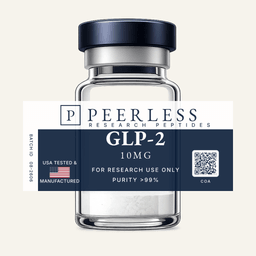
GLP-2
Synthetic 39-amino-acid dual GIP and GLP-1 receptor agonist with C20 fatty diacid lipidation more info
Available for laboratory research use only.
Quality Standards
American Owned
Mixed, bottled, and tested in the USA
Third-Party Tested
Independently tested for purity and quality
>99% Purity
Exceptional purity you can trust
Also Screened For
Endotoxins + Heavy Metals
Beyond the identity, purity & sterility panel.
Vial size
Choose your supply
3 vials· 30mg total
Save $13.50 (5% off)
Total
$256.50
Volume pricing applies to your total vials, not just this product. Mix or match any vials in your cart to reach the next tier.
Independent Lab Results
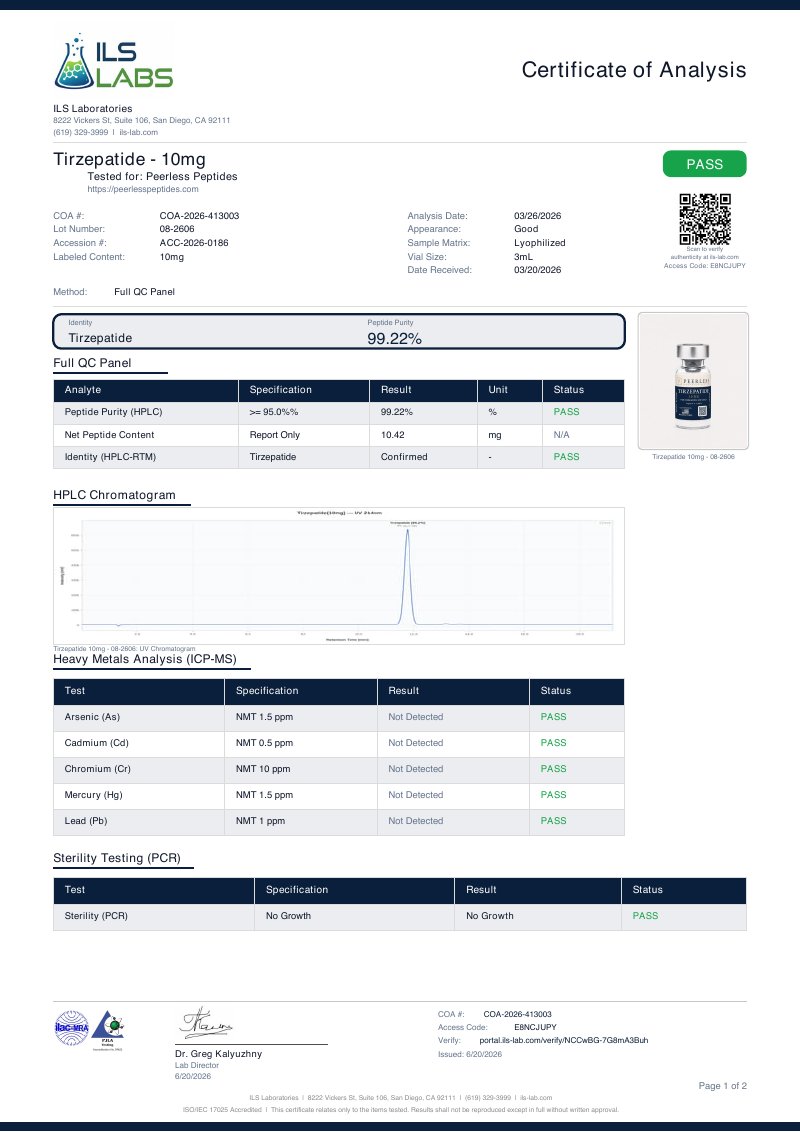
The most comprehensive testing panel in research peptide commerce. Every batch is independently verified by ILS Laboratories — an ISO/IEC 17025 and PJLA-accredited facility in San Diego, CA.
- Identity
- Purity (HPLC)
- Endotoxin (USP <85>)
- Sterility screen (PCR)
- Heavy metals (ICP-MS per USP <233>)
Biochemical Profile
- CAS Number
- 2023788-19-2
- Molecular Formula
- C225H348N48O68
- Molecular Weight
- 4813.45 g/mol (average); 4810.55 Da (monoisotopic)
- Purity
- >99% (HPLC-UV (214-220 nm) with orthogonal LC-MS deconvolution)
- PubChem CID
- 156588324
- Amino Acid Sequence
- 39-residue dual GIP/GLP-1 agonist; backbone derived from native GIP with three Aib substitutions at positions 2, 13, 20; C20 eicosanedioic acid lipidation via γGlu-AEEA-AEEA arm at Lys-20; free C-terminal acid
Dual Receptor Targets and Signal Transduction Context
Tirzepatide has been characterized as an imbalanced dual agonist at the GIP receptor (GIPR) and the GLP-1 receptor (GLP-1R). The discovery paper from Coskun and colleagues at Eli Lilly Research Laboratories reported native-GIP-comparable agonism at GIPR and partial agonism at GLP-1R with approximately five-fold weaker potency relative to native GLP-1[1]. The molecule shares closer sequence homology to native GIP than to GLP-1, despite signaling through both receptors.
The Willard et al. 2020 mechanism paper defined the framework that tirzepatide is biased toward Gαs/cAMP recruitment over β-arrestin recruitment at GLP-1R[2]. Functional consequences of this biased signaling in cultured cell preparations have been reported to include weaker receptor internalization compared with native GLP-1 or with monotype GLP-1R agonists, which the original paper proposed as a possible mechanism for preserving β-cell competence under sustained agonism.
Three aminoisobutyric acid (Aib) substitutions at positions 2, 13, and 20 confer resistance to DPP-IV proteolytic cleavage. The C20 eicosanedioic diacid lipidation arm at the Lys-20 ε-amine, connected through a γ-L-Glu spacer plus two AEEA (8-amino-3,6-dioxaoctanoic acid) spacers, enables high-affinity binding to circulating serum albumin. The C20 chain is two carbons longer than the analogous C18 chain on semaglutide, which has been associated in published pharmacokinetic reports with approximately ten-fold tighter albumin binding per two-carbon increment in the diacid arm[1].
The combination of Aib protection and albumin-driven plasma residency produces a reported terminal half-life of approximately five days after subcutaneous administration in published pharmacokinetic studies. Independent groups have replicated the GIPR-dependence of the observed metabolic phenotype in genetic-knockout rodent preparations, including the El K et al. 2023 study in Nature Metabolism[3].
The full published mechanism characterization, the SURPASS clinical program in type 2 diabetes (SURPASS-1 through SURPASS-5 plus the SURPASS-CVOT cardiovascular outcomes trial), and the SURMOUNT clinical program in chronic body-weight research (SURMOUNT-1 through SURMOUNT-5 plus SURMOUNT-OSA and SUMMIT) are summarized in the Replication and Clinical Status tab of this page.
Research Applications
Dual Incretin Receptor Pharmacology Research
Dual-incretin receptor pharmacology has been the most extensively published research area for tirzepatide. Receptor-binding assays in cultured cell preparations have characterized tirzepatide as a full agonist at GIPR with approximately native-GIP comparable potency, and a partial agonist at GLP-1R with approximately five-fold weaker potency than native GLP-1[1]. The published characterization of the GLP-1R signal-transduction bias toward Gαs/cAMP over β-arrestin recruitment is the Willard et al. 2020 framework in JCI Insight[2].
The broader academic context for the dual-incretin design philosophy traces to the Finan et al. 2013 Science Translational Medicine paper from DiMarchi (Lilly former Chief Scientific Officer; now Indiana University) and Tschöp (Helmholtz Zentrum München), which defined the unimolecular dual-incretin concept and the term twincretin[4]. DiMarchi remains the academic-continuity figure behind the dual-agonist class.
Independent groups outside the Lilly research program have published mechanism research in this area, including El K et al. 2023 in Nature Metabolism, which replicated the GIPR-dependence of the observed metabolic phenotype in genetic-knockout rodent preparations[3], and Samms et al. 2021 in the Journal of Clinical Investigation, which reported GIPR contributions to insulin sensitization independent of body-weight changes[5].
Long-Acting Peptide Engineering Research
Tirzepatide has been studied as a model compound for the four-block lipidation arm architecture used to extend the plasma residency of incretin-class peptides. The four blocks comprise (1) a γ-L-glutamic acid spacer connected to the Lys-20 ε-amine, (2) a first 8-amino-3,6-dioxaoctanoic acid (AEEA) spacer, (3) a second AEEA spacer, and (4) a C20 eicosanedioic diacid as the terminal lipidation moiety. The arm geometry positions the lipid for high-affinity binding to circulating serum albumin[1].
The three Aib substitutions at positions 2, 13, and 20 form the second engineering layer that confers DPP-IV protease resistance. The 39-mer length is longer than the 31-mer semaglutide chassis, and solid-phase peptide synthesis of the molecule entails three Aib coupling slots plus the residue immediately C-terminal to each Aib (Glu3, Leu14, Phe22), producing six double-coupling synthesis positions across 38 amide bonds. Selective lipidation at Lys-20 vs. other Lys residues in the sequence has been reported to require an orthogonal Lys-20 protecting group during synthesis.
The documented quality-control failure modes specific to this molecule include lipidation-arm hydrolysis (loss of the C20 diacid, mass shift -340 Da; partial losses at -226 Da or -382 Da for arm-segment hydrolysis); bis-acylation impurity from orthogonal-protecting-group failure (+340 Da); a silent C20-vs-C18 fatty-diacid substitution producing only a 28 Da shift that may not be resolved by low-resolution mass spectrometry; an Aib2 → L-Ala reversion producing a silent -14 Da shift; and standard Trp25 oxidation (+16 Da) and Asn24 deamidation (+1 Da) vectors observed across the broader incretin-peptide literature.
Comparative Incretin Analog Research
Tirzepatide has been investigated alongside multiple other incretin and incretin-adjacent analog classes. Single-receptor GLP-1 agonists in the published comparator literature include semaglutide, liraglutide, dulaglutide, and exenatide. Dual-agonist comparators include the GLP-1 + glucagon dual agonist class (survodutide and mazdutide, both at advanced clinical development stages in the published literature). The triple GLP-1 + GIP + glucagon agonist class is represented by retatrutide, also originating from the Eli Lilly research program[6].
A distinct comparator class is the GIP-receptor antagonist + GLP-1 agonist bispecific class, represented by Amgen's maridebart cafraglutide (MariTide / AMG 133), which has been published with diametrically opposite GIP-receptor pharmacology to tirzepatide. The juxtaposition of GIPR agonism (tirzepatide) and GIPR antagonism (maridebart cafraglutide) producing comparable directional weight-related outcomes in published preclinical and clinical reports forms the structural basis of the GIP-paradox methodology critique covered in the Methodology Considerations tab[7].
A fourth comparator class is the amylin-receptor analog class, represented by cagrilintide, which has been investigated co-administered alongside semaglutide as the CagriSema co-administration regimen. The published head-to-head comparator literature in chronic body-weight research includes the REDEFINE-4 trial of the cagrilintide-and-semaglutide co-administration regimen versus tirzepatide monotherapy, with reported topline results showing the co-administration arm failing to meet a pre-specified non-inferiority margin against tirzepatide.
Cardiometabolic and Hepatic Research
Beyond the headline glycemic and body-composition endpoints of the SURPASS and SURMOUNT clinical programs, tirzepatide has been investigated in published clinical research covering several adjacent cardiometabolic endpoints. The SUMMIT trial in obesity-related heart failure with preserved ejection fraction reported positive composite cardiovascular-death and heart-failure-event readouts with concurrent Kansas City Cardiomyopathy Questionnaire score reporting (NEJM 2024)[8].
The SYNERGY-NASH Phase 2 trial in metabolic dysfunction-associated steatohepatitis (MASH) met its pre-specified MASH-resolution endpoint at the highest studied dose versus placebo (NEJM June 2024)[9]. The SURMOUNT-MASH Phase 3 follow-on trial is ongoing.
The SURPASS-CVOT cardiovascular outcomes trial enrolled approximately 13,300 participants with type 2 diabetes and elevated cardiovascular risk in a head-to-head comparison against dulaglutide on a 3-point major adverse cardiovascular event composite. Primary follow-up was completed in 2024; the topline report described the result as non-inferior to dulaglutide. The full publication is anticipated in 2026-2027. The 13,300-participant size is among the largest cardiovascular outcomes trials published in the incretin-class literature.
Replication and Clinical Status
The PubMed corpus for tirzepatide has been estimated at approximately 3,000-4,500 indexed papers as of May 2026, the fastest-growing peptide corpus in the catalog and the corpus that reached BPC-157 lifetime indexing in under two years post-approval. The author distribution centers on Eli Lilly Research Laboratories for discovery and mechanism work (Coskun, Willard, Sloop, Samms) with academic Phase 3 leadership distributed across Rosenstock, Frías, Jastreboff, Garvey, Wadden, Aronne, Holst, Campbell, and Rosenkilde. The El K et al. 2023 paper in Nature Metabolism is an example of independent replication of the GIPR-dependence finding outside the Lilly program[3].
The published Phase 3 SURMOUNT-1 trial (NCT04184622, n=2,539 adults without type 2 diabetes, 72 weeks) met its pre-specified body-weight primary endpoint versus placebo[10]. The published Phase 3 SURMOUNT-5 trial (NCT05822830, n=751) was the first published head-to-head clinical trial in this class, and met its pre-specified body-weight endpoint in favor of tirzepatide versus semaglutide over 72 weeks[11]. The SURMOUNT-OSA Phase 3 program met its pre-specified apnea-hypopnea-index endpoint, supporting FDA approval for obstructive sleep apnea on December 20, 2024[12].
Tirzepatide is FDA-approved only as a finished drug product for specific medical indications, the earliest of which was approved May 13, 2022, with later approvals in November 2023 and December 2024. Branded product names and the verbatim approved-indication descriptors are omitted here per the editorial discipline that applies to all FDA-approved competitor drug products in this category; the research-grade material sold here is not those finished drug products. The FDA added tirzepatide to its drug shortage list December 15, 2022, enabling compounding under the shortage carve-out, and subsequently removed it from the shortage list by web notice October 2, 2024 followed by a formal Declaratory Order December 19, 2024. The Declaratory Order set a 503A compounding sunset of February 18, 2025 and a 503B compounding sunset of March 19, 2025. The Outsourcing Facilities Association filed suit in the Northern District of Texas; Judge Pittman denied the preliminary injunction March 5, 2025; the OFA filed a Fifth Circuit appeal March 10, 2025; the appeal remains pending as of May 2026. As of May 2026, tirzepatide is FDA-approved as a finished drug product and is not lawfully compoundable as a bulk substance under 503A or 503B compounding pathways. Eli Lilly intervened as co-defendant supporting the FDA. The April 1, 2026 federal indictment of physician Watkins named tirzepatide first among the eleven substances listed in the charging document, the first federal criminal indictment of a US-licensed physician for selling misbranded peptides[13]. Lilly civil litigation against multiple compounding entities (the Lilly v. Mochi line of cases) survived motion-to-dismiss on Lanham Act § 43(a) and California Unfair Competition Law claims in the Northern District of California in April 2026 under Judge Corley[14].
Methodology Considerations
The distinctive methodology critique for tirzepatide is the unresolved GIP-receptor mechanism, often described in the published literature as the GIP-paradox. The pre-tirzepatide preclinical consensus over approximately three decades suggested that GIPR antagonism should benefit metabolic disease: GIPR-knockout rodents were reported as protected from diet-induced obesity, and GIPR-blocking monoclonal antibodies were reported to reduce body weight in primate preparations. Yet tirzepatide is a GIPR agonist and outperformed monotype GLP-1R agonist comparators on body-weight endpoints in published Phase 3 head-to-head trials[11]. The same Eli Lilly research program publishes both tirzepatide (GIPR agonism) and retatrutide (GIPR agonism as part of the triple-agonist class)[6]. Amgen's maridebart cafraglutide (MariTide / AMG 133) is published as a GIPR-antagonist + GLP-1R agonist bispecific with comparable directional outcomes in published Phase 2 readouts[7].
The reconciling pharmacology has not been settled in the peer-reviewed literature. Four published proposals are mutually compatible and none falsifies the others: functional antagonism via sustained-occupancy desensitization (chronic tirzepatide agonism downregulates and desensitizes GIPR producing a state functionally indistinguishable from antagonism); biased GLP-1R signaling preserving β-cell competence (the Willard 2020 framework)[2]; CNS-restricted anorexia via central GIPR populations; and α/β/δ-cell islet cross-talk (Douros et al. 2023)[15]. The field is sustaining two opposing pharmacology programs in parallel. Diabetes (journal) 2025 published both rationales on facing pages.
The second methodology consideration is the compounded-product quality-control failure mode. Eli Lilly published a study reporting that ten compounded tirzepatide-plus-vitamin-B12 products tested all contained a previously uncharacterized B12-tirzepatide reaction impurity with unknown pharmacology, toxicology, and immunogenicity[16]. The cleanest peer-reviewed peptide-class compounded-product quality failure documented in the published literature. The third consideration is the published rebound phenomenon: the SURMOUNT-4 trial reported approximately 82.5% regain of at least 25% of lost body weight within one year after discontinuation of the active comparator, framing the published clinical efficacy as a chronic-administration phenotype rather than a course-limited intervention[17].
Handling & Storage
- Storage (lyophilized)
- -20°C, dry, dark, inert headspace recommended
- Storage (in solution)
- 2-8°C, single-use aliquots, use within 28 days
- Shelf Life
- 24 months lyophilized under recommended conditions
Research References
- [1] Coskun T, Sloop KW, Loghin C, et al. LY3298176, a novel dual GIP and GLP-1 receptor agonist for the treatment of type 2 diabetes mellitus: From discovery to clinical proof of concept. Mol Metab. 2018;18:3-14. doi:10.1016/j.molmet.2018.09.009PMID:30473097
- [2] Willard FS, Douros JD, Gabe MBN, et al. Tirzepatide is an imbalanced and biased dual GIP and GLP-1 receptor agonist. JCI Insight. 2020;5(17):e140532. doi:10.1172/jci.insight.140532PMID:32730231
- [3] El K, Douros JD, Willard FS, et al. The incretin co-agonist tirzepatide requires GIPR for hormone secretion from human islets. Nat Metab. 2023;5(6):945-954. PMID:37337115
- [4] Finan B, Yang B, Ottaway N, et al. A rationally designed monomeric peptide triagonist corrects obesity and diabetes in rodents. Sci Transl Med. 2013;5(209):209ra151. PMID:24174327
- [5] Samms RJ, Christe ME, Collins KAL, et al. GIPR agonism mediates weight-independent insulin sensitization by tirzepatide in obese mice. J Clin Invest. 2021;131(12):e146353. PMID:34003802
- [6] Coskun T, Urva S, Roell WC, et al. LY3437943, a novel triple glucagon, GIP, and GLP-1 receptor agonist for glycemic control and weight loss: From discovery to clinical proof of concept. Cell Metab. 2022;34(9):1234-1247.e9. PMID:35987202
- [7] Véniant MM, Lu SC, Atangan L, et al. A GIPR antagonist conjugated to GLP-1 analogues promotes weight loss with improved metabolic parameters in preclinical and phase 1 settings. Nat Metab. 2024;6(2):290-303. PMID:38316982
- [8] Packer M, Zile MR, Kramer CM, et al. Tirzepatide for heart failure with preserved ejection fraction and obesity (SUMMIT). N Engl J Med. 2025;392(5):427-437. PMID:39555826
- [9] Loomba R, Hartman ML, Lawitz EJ, et al. Tirzepatide for metabolic dysfunction-associated steatohepatitis with liver fibrosis (SYNERGY-NASH). N Engl J Med. 2024;391(4):299-310. PMID:38856224
- [10] Jastreboff AM, Aronne LJ, Ahmad NN, et al. Tirzepatide once weekly for the treatment of obesity (SURMOUNT-1). N Engl J Med. 2022;387(3):205-216. PMID:35658024
- [11] Aronne LJ, Horn DB, le Roux CW, et al. Tirzepatide as compared with semaglutide for the treatment of obesity (SURMOUNT-5). N Engl J Med. 2025;393(1):26-36. PMID:40353578
- [12] Malhotra A, Grunstein RR, Fietze I, et al. Tirzepatide for the treatment of obstructive sleep apnea and obesity (SURMOUNT-OSA). N Engl J Med. 2024;391(13):1193-1205. PMID:38912654
- [13] United States v. Watkins, criminal indictment, US District Court (April 1, 2026). Federal criminal indictment of a US-licensed physician for selling misbranded peptides, including tirzepatide named first among eleven substances enumerated in the charging document; approximately 200 patients implicated in the charging document.
- [14] Eli Lilly and Company v. Mochi Health Corp et al., N.D. Cal. (motion-to-dismiss ruling, April 2026). Lanham Act § 43(a) and California Unfair Competition Law claims survived motion to dismiss before Judge Corley; civil conspiracy count dismissed October 2025.
- [15] Douros JD, Flak JN, Knerr PJ, et al. Localized GIP receptor and glucagon-like peptide-1 receptor activation in pancreatic islets reveals distinct paracrine roles in insulin secretion. Nat Metab. 2023. PMID:37337113
- [16] Sloop KW, Briere DA, Emmerson PJ, et al. Compounded tirzepatide products combined with vitamin B12 contain an uncharacterized B12-tirzepatide reaction impurity. Eli Lilly internal analytical report and accompanying peer-reviewed publication, 2024-2025.
- [17] Aronne LJ, Sattar N, Horn DB, et al. Continued treatment with tirzepatide for maintenance of weight reduction in adults with obesity: The SURMOUNT-4 randomized clinical trial. JAMA. 2024;331(1):38-48. PMID:38078870
Scientific Journal Author
Tamer Coskun, MD, PhD
Landmark Publications
- Coskun T, Sloop KW, Loghin C, et al. LY3298176, a novel dual GIP and GLP-1 receptor agonist for the treatment of type 2 diabetes mellitus: From discovery to clinical proof of concept. Mol Metab. 2018;18:3-14. (PMID 30473097)
- Coskun T, Urva S, Roell WC, et al. LY3437943, a novel triple glucagon, GIP, and GLP-1 receptor agonist for glycemic control and weight loss: From discovery to clinical proof of concept. Cell Metab. 2022;34(9):1234-1247.e9. (PMID 35987202)
- Willard FS, Douros JD, Gabe MBN, et al. Tirzepatide is an imbalanced and biased dual GIP and GLP-1 receptor agonist. JCI Insight. 2020;5(17):e140532. (PMID 32730231)
Dr. Coskun is independently cited here as the lead author on the originating discovery publication for LY3298176 (tirzepatide) and the related triple-agonist proof-of-concept publication. There is no affiliation or commercial relationship between Dr. Coskun, Eli Lilly Research Laboratories, or any associated commercial entity, and Peerless Peptides.