

Quality Standards
American Owned
Mixed, bottled, and tested in the USA
Third-Party Tested
Independently tested for purity and quality
>99% Purity
Exceptional purity you can trust
Also Screened For
Endotoxins + Heavy Metals
Beyond the identity, purity & sterility panel.
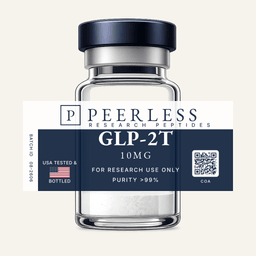
GLP-2T
Synthetic 39-amino-acid dual agonist at the GIP and GLP-1 receptors more info
Available for laboratory research use only.
Quality Standards
American Owned
Mixed, bottled, and tested in the USA
Third-Party Tested
Independently tested for purity and quality
>99% Purity
Exceptional purity you can trust
Also Screened For
Endotoxins + Heavy Metals
Beyond the identity, purity & sterility panel.
Vial size
Choose your supply
3 vials· 30mg total
Save $13.50 (5% off)
Total
$256.50
Volume pricing applies to your total vials, not just this product. Mix or match any vials in your cart to reach the next tier.
Independent Lab Results
The most comprehensive testing panel in research peptide commerce. Every batch is independently verified by ILS Laboratories — an ISO/IEC 17025 and PJLA-accredited facility in San Diego, CA.
- Identity
- Purity (HPLC)
- Endotoxin (USP <85>)
- Sterility screen (PCR)
- Heavy metals (ICP-MS per USP <233>)
Biochemical Profile
- CAS Number
- 2023788-19-2
- Molecular Formula
- C225H348N48O68
- Molecular Weight
- 4813.45 g/mol (average); 4810.55 Da (monoisotopic)
- Purity
- >99% (HPLC-UV (214-220 nm) with orthogonal LC-MS deconvolution)
- Amino Acid Sequence
- 39-residue GIP-derived backbone; non-coded Aib at positions 2 and 13; C20 eicosanedioic acid lipidation via γGlu-AEEA-AEEA linker at Lys-20 ε-amine; C-terminal serinamide
Dual Receptor Targets and Signal Transduction
GLP-2T is a unimolecular dual agonist: one 39-residue peptide chain with agonist activity at the GIP receptor (GIPR) and the GLP-1 receptor (GLP-1R). Both belong to the secretin family of class B G-protein-coupled receptors, which couple mainly to Gαs and cyclic AMP signaling. In its first published pharmacological characterization, GLP-2T bound GIPR with a Ki of about 0.135 nM, comparable to native GIP, and GLP-1R with a Ki of about 4.23 nM, roughly five-fold weaker than native GLP-1[1]. In cAMP assays in cell lines expressing the recombinant receptors, its potency was similar to that of native GIP at GIPR (EC₅₀ about 0.022 nM) and about 13-fold weaker than that of native GLP-1 at GLP-1R (EC₅₀ about 0.93 nM)[1]. The backbone is closer in sequence to native GIP than to GLP-1.
Willard and colleagues characterized the molecule as an imbalanced and biased dual agonist[2]. At GIPR it mimicked the signaling of native GIP. At GLP-1R it favored cAMP generation over β-arrestin recruitment and drove weaker receptor internalization than native GLP-1. In primary islet experiments in the same work, β-arrestin 1 limited the insulin response to GLP-1 but not the response to GIP or to GLP-2T[2].
Aib at position 2 removes the N-terminal dipeptidyl peptidase IV cleavage site, and Aib at position 13 adds a second α,α-disubstituted residue within the helix. The lysine at position 20 carries a C20 eicosanedioic acid through a γGlu-AEEA-AEEA linker, a lipidation motif that binds serum albumin[1], and the C-terminus is amidated (serinamide).
Research Applications
Dual Incretin Receptor Pharmacology Research
Incretin receptor pharmacology is the core of the preclinical literature on GLP-2T. In recombinant receptor systems it has been characterized as a GIPR agonist with activity close to that of native GIP, and as a GLP-1R agonist that activates cAMP signaling with lower potency than native GLP-1 while recruiting β-arrestin only weakly[1][2]. Willard and colleagues set out this signal-transduction profile at GLP-1R, biased toward Gαs and cAMP over β-arrestin, as the framework for the molecule's GLP-1R pharmacology[2]. Unimolecular peptides with co-agonist activity at both incretin receptors were described as a pharmacological class by Finan and colleagues in 2013[3].
Ex vivo islet studies extend the receptor work. In isolated human islets, El K and colleagues reported that pharmacological GIPR antagonism consistently reduced the insulin response to GLP-2T, and that the peptide also increased glucagon and somatostatin secretion, evidence that it engages both incretin receptors in human islet tissue[4].
In vivo, Samms and colleagues used Glp1r-null mice to isolate the GIPR-dependent component of GLP-2T activity. In those animals they reported increased glucose disposal in white adipose tissue, lower circulating branched-chain amino acids and ketoacids, and higher expression of genes for glucose, lipid and branched-chain amino acid catabolism in brown adipose tissue[5].
Long-Acting Peptide Engineering Research
GLP-2T is studied as a model compound for a four-block lipidation arm used to extend the plasma residency of incretin-class peptides. From the Lys-20 ε-amine outward, the blocks are (1) a γ-L-glutamic acid spacer, (2) a first 8-amino-3,6-dioxaoctanoic acid (AEEA) spacer, (3) a second AEEA spacer and (4) a C20 eicosanedioic diacid, the terminal moiety that binds circulating serum albumin[1].
Protease resistance is the second engineering layer. Aib at position 2 removes the dipeptidyl peptidase IV cleavage site at the N-terminus, and Aib at position 13 adds a second α,α-disubstituted residue within the helix. Both are sterically hindered couplings in solid-phase synthesis, as is coupling the next residue onto each Aib amine. The sequence carries a second lysine, Lys-16, so selective lipidation at Lys-20 depends on an orthogonal side-chain protecting group during synthesis.
The quality-control failure modes specific to this architecture follow from the same features: partial or complete hydrolysis of the lipidation arm; bis-acylation, in which a second arm is attached at Lys-16 when orthogonal protection fails; substitution of a C18 for the C20 diacid, a shift of only 28 Da against a parent of about 4.8 kDa; and reversion of Aib-2 to alanine, a 14 Da shift. The molecular formula contains no sulfur, so the sequence has no methionine or cysteine, and oxidation of Trp-25 (+16 Da) is the main oxidation route. Each of these is a mass-level change, which is why identity for this molecule is read by liquid chromatography mass spectrometry with deconvolution rather than by chromatographic purity alone.
Methodology Considerations
The central open question in GLP-2T pharmacology is the role of GIPR. The published literature contains both GIPR agonist and GIPR antagonist approaches, each still under preclinical investigation, and how GIPR agonism contributes to the pharmacology of a dual agonist has not been settled. Four proposals have been published, and they are compatible with one another rather than competing. The first is functional antagonism: sustained agonist occupancy desensitizes and internalizes GIPR, so prolonged exposure could produce a state that resembles receptor blockade. The second is the biased GLP-1R signaling framework of Willard and colleagues, in which cAMP-favoring, weakly internalizing GLP-1R activity changes the integrated islet response[2]. The third places the relevant GIPR population in the central nervous system rather than the periphery. The fourth is paracrine cross-talk among islet α, β and δ cells, consistent with the finding that GLP-2T increased glucagon and somatostatin secretion from human islets alongside insulin[4].
Species is a design variable. El K and colleagues found that in mouse islets GLP-2T stimulated insulin secretion predominantly through GLP-1R, owing to its lower potency at the mouse GIPR, whereas in human islets blocking GIPR consistently reduced the response[4]. Rodent preparations can therefore under-represent the GIPR arm relative to human receptor systems, and potency at the receptor ortholog actually used belongs in the method.
Assay context matters as well. Potency and efficacy at GLP-1R differ with the readout, whether cAMP accumulation, β-arrestin recruitment or receptor internalization[2], and in recombinant systems with high receptor expression, receptor reserve can make a partial agonist read as fully efficacious. For an albumin-binding acylated peptide, the albumin or serum content of the assay buffer also shifts apparent in vitro potency, so buffer composition is part of the method.
Handling & Storage
- Storage (lyophilized)
- -20°C, dry, dark, inert headspace recommended
- Storage (in solution)
- 2-8°C, single-use aliquots, use within 28 days
- Shelf Life
- 24 months lyophilized under recommended conditions
Research References
- [1] Coskun T, et al. Mol Metab. 2018;18:3-14. doi:10.1016/j.molmet.2018.09.009PMID:30473097
- [2] Willard FS, et al. JCI Insight. 2020;5(17):e140532. doi:10.1172/jci.insight.140532PMID:32730231
- [3] Finan B, et al. Sci Transl Med. 2013;5(209):209ra151. doi:10.1126/scitranslmed.3007218PMID:24174327
- [4] El K, et al. Nat Metab. 2023;5(6):945-954. doi:10.1038/s42255-023-00811-0PMID:37277609
- [5] Samms RJ, et al. J Clin Invest. 2021;131(12):e146353. doi:10.1172/JCI146353PMID:34003802