
Peerless Research·selank
Selank: A Literature Review of the Russian Tuftsin Analog
Selank (TKPRPGP) is a Russian-registered tuftsin analog studied intranasally but sold as an injection. A cited literature review of the gaps.
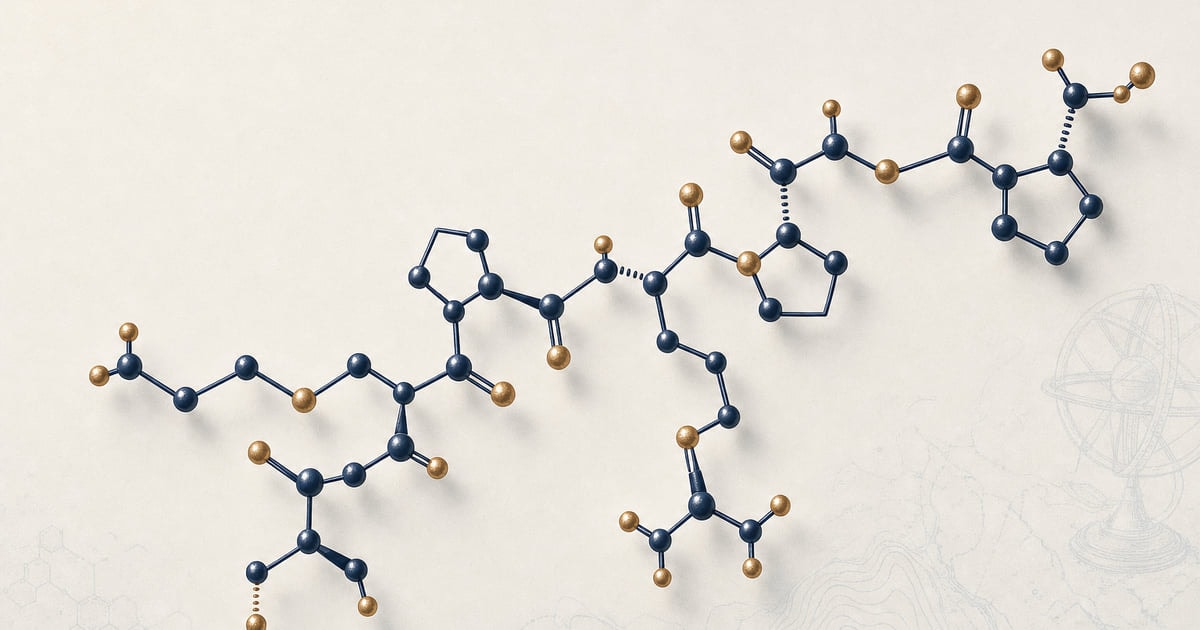
Selank carries two kinds of borrowed authority at once.
It is a registered medicine in Russia, which is true, and which is not the same thing as being a registered medicine anywhere the FDA, the European agencies, or the major Asian regulators would recognize. And the Russian medicine is a nasal spray, while the vial sold to researchers in the West is an injection, a different route than any of the published evidence describes.
Read carefully, Selank is a real Russian drug and an unstudied Western one, and both statements have to be held at the same time. This review separates the approval from the regulators that did not grant it, separates the studied route from the sold one, and follows a mechanism story that is more crowded than it first appears.
Research content. The article below summarizes published preclinical, mechanistic, and clinical research literature on Selank (the heptapeptide Thr-Lys-Pro-Arg-Pro-Gly-Pro). The compound is sold by Peerless Peptides for laboratory research use only and is not approved by the FDA for human or veterinary administration.
Last reviewed: June 12, 2026 by Peerless Research.
Summary
Selank is a synthetic seven-amino-acid peptide, a stabilized copy of the natural immune fragment tuftsin with a Pro-Gly-Pro tail. It was designed at the Institute of Molecular Genetics in Moscow, the same laboratory and the same template that produced its sibling peptide Semax. Russia's Ministry of Health registered it in 2009 as an intranasal solution for generalized anxiety disorder. It is not approved by the FDA or any other Western regulator.
Two gaps run through everything written about it. The first is regulatory: the Russian approval is real but does not carry the weight of an FDA or European review, and the regulators usually treated as most rigorous have not evaluated it. The second is physical: every Russian study used the nose, while the product sold for research in the West is injected, which means the safety and activity on record were observed by a route the sold material does not use. The mechanism literature, meanwhile, describes four parallel effects rather than one, which is less a unified explanation than a list of possibilities.
Note: the research below was conducted in rat models, in vitro systems, and small Russian clinical studies of an intranasal drug product. The compound is sold here for research use only, and nothing below is a statement about its use. This article is a literature review, not a recommendation of use.
Identity and Chemistry: A Stabilized Antibody Fragment
Selank is a linear seven-residue peptide with the sequence Thr-Lys-Pro-Arg-Pro-Gly-Pro (single-letter TKPRPGP). Its molecular formula is C₃₃H₅₇N₁₁O₉, molecular weight about 752 daltons, CAS number 129954-34-3, PubChem CID 11765600. Full identifiers and per-batch certificates are on the Selank product page.
One chemistry correction belongs at the front, because vendors get it wrong routinely: Selank ends in a free carboxylic acid, not an amide. Many catalog listings render the sequence with an amide C-terminus, but the molecular formula fixes the question, an amide would carry a different formula, and the correct terminus is the free acid. A certificate of analysis should match.
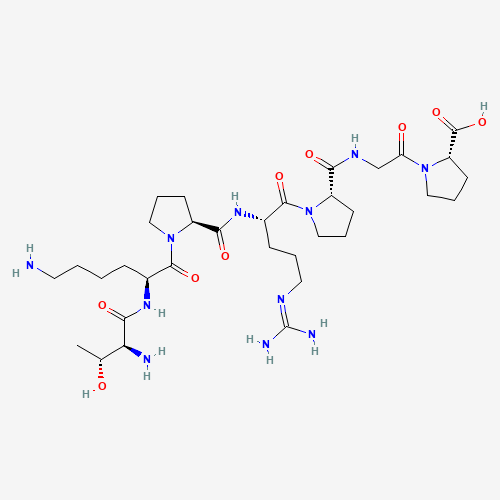
The first four residues are tuftsin, a natural tetrapeptide discovered in 1970 and named for Tufts University, where it was identified. Tuftsin is not a brain peptide. It is cleaved from the heavy chain of immunoglobulin G, the most abundant class of antibody, and its documented activity is immune: it stimulates the phagocytic cells that engulf pathogens. On its own it is short-lived, broken down quickly by enzymes. The Moscow laboratory's move was to append a Pro-Gly-Pro tail, the same stabilizing motif it used on Semax, which makes the peptide far more resistant to the enzymes that would otherwise degrade it.
That stability is a genuine feature of the chemistry. With three of its seven residues being proline, most of the internal bonds are ones common proteases cannot cut, and the proline-rich architecture also resists the misfolding that complicates synthesis of other peptides. Usefully for quality control, the molecule lacks the residues that create the dominant degradation problems elsewhere in this category, there is no methionine to oxidize and no asparagine to deamidate, so its main analytical liabilities are subtler: chiral purity at the threonine, which can racemize, and a truncated impurity missing that first threonine. Confirming the former takes a chiral amino-acid analysis that most commodity certificates omit.
The practical point is that Selank's certificate should read differently from that of a methionine- or asparagine-containing peptide: the questions that matter here are the threonine's chirality and the level of the truncated impurity missing that first residue, not an oxidation or deamidation percentage. A certificate that reports those two checks is testing the molecule's actual liabilities rather than the generic ones. A separately sold, acetylated version (N-acetyl-Selank) is a distinct analog and should not be conflated with Selank on a label.
Mechanism: Four Pathways, None Decisive
The most honest way to describe Selank's mechanism is as a short list of separately reported effects, because that is what the literature contains.
The best-characterized axis is enzyme inhibition. Two 2001 studies reported that Selank slows the breakdown of enkephalins, the body's own opioid-like signaling peptides, by inhibiting the enzymes that degrade them[1][2]. This is an indirect mechanism: the peptide does not bind opioid receptors itself; it lets the body's enkephalins linger. The second axis is transcriptional. A 2016 study using a panel of GABA-related genes reported that Selank altered their expression in neural cells and rat brain[4]. This is the finding most often overstated in marketing, where Selank is described as a direct modulator of the GABA-A receptor, the target of benzodiazepine drugs. The published work shows a change in gene expression, not direct binding to that receptor, and the two are not the same claim. A third axis is neurotrophic: an intranasal dose was reported to raise brain-derived neurotrophic factor, or BDNF, in rat hippocampus, first the messenger RNA and then the protein[3]. A fourth, less developed, involves changes in the turnover of monoamines such as serotonin and dopamine, and varies by rodent strain.
Two features of this list matter more than any single entry. The first is that none of the four is decisive in the way a clean mechanism would be, there is no demonstration that removing a single target abolishes the effect. The second is conceptual. The parent molecule, tuftsin, is an immune peptide; Selank's claimed activity is in the brain. Appending a stabilizing tail to an antibody fragment and arriving at effects on anxiety-related behavior is not a result that follows obviously from the parent's biology, and the multi-pathway account that fills the gap reads more like several indirect effects than one explanation. None of this is a reason to dismiss the findings, since each rests on a real experiment, but it is a reason to distrust any single-sentence summary of how Selank works, including the ones that put a receptor's name in the sentence.
Preclinical and Clinical Evidence: Small, Old, and Intranasal
The animal literature is moderate in size and consistent in direction, with the rodent BDNF and gene-expression studies above as its mechanistic core, supplemented by behavioral work in standard models of chronic stress. As with the rest of this category, the gap between a behavioral readout in a stressed rodent and a human outcome is wide.
The human record is where the caution concentrates. Selank's clinical evidence is almost entirely Russian, older, and small. The principal study, published in 2008, compared Selank against medazepam, a benzodiazepine, in 62 patients with anxiety and asthenia over two weeks[5]. Its design carries the usual limitations of the Russian neuropeptide literature: it was open-label, it had no placebo arm, it was conducted at a single center, and it was not preregistered.
An active-comparator design without a placebo can show that two treatments move together, but it cannot separate either one from the natural course of the condition or from a patient's expectation, which is the comparison a modern anxiety trial is built to make. Across all indexed studies, the total human exposure on record is on the order of a few hundred patients, one to two orders of magnitude below what a modern anxiety drug would need to win a Western approval. There are no registered United States or European trials.
And then the route. Every one of these studies, and the bioavailability figures that support the Russian product, used intranasal delivery, drops in the nose. That choice was deliberate: the nasal route was selected to bypass the digestive enzymes that would destroy the peptide and to take advantage of a direct nose-to-brain pathway. The material sold for research in the West, by contrast, is an injectable. Injection routes the molecule through exactly the barriers the intranasal design was built to avoid, and there is no published human pharmacokinetic or efficacy study of injected Selank at all. The evidence and the sold product do not share a route.
The Provenance That Vendor Copy Collapses
It is worth separating four things that marketing tends to fuse into a single claim of legitimacy.
There is the discovery: the Moscow laboratory synthesized the peptide in the 1990s. There is the approved product: the Russian Ministry of Health registered a specific formulation, a 0.15% intranasal solution made by a specific Russian manufacturer. There is the studied route: intranasal, in every clinical and most preclinical work. And there is the sold route: subcutaneous injectable vials, produced for the research-chemical market by contract manufacturers that are not the Russian registrant.
Each layer is real, and each is different from the others. The legitimacy that "Russian-approved" is meant to convey attaches to the second layer, a nasal-spray product, made by one company, evaluated under one country's standards. It does not transfer cleanly to an injectable vial from a different supply chain sold in a different country for a different stated purpose. The contract manufacturers that supply the Western research market work from the published sequence rather than the Russian registrant's process, so even the chemistry is a reconstruction of the molecule rather than the registered article itself. Naming the four layers is not a rhetorical flourish; it is the difference between an accurate account and a borrowed one.
The Sibling, and Why It Is Not a Stack
Selank is almost always discussed alongside Semax, frequently as a pair to be used together. The pairing is a misunderstanding.
The two peptides share an origin. Both were designed at the Institute of Molecular Genetics in Moscow, by the same group, using the same Pro-Gly-Pro stabilizing tail attached to a fragment of a known biological peptide. The difference is the fragment: Selank is built on tuftsin, a piece of an antibody, while Semax is built on a piece of the hormone ACTH. They have different sequences, different proposed mechanisms, and different Russian registrations, and the two molecules are compared directly in our Selank vs Semax review, with the single-compound treatment of the other in our Semax literature review.
What the shared laboratory does not establish is any basis for combining them. They are siblings by design history, not a validated combination, and the published literature contains no controlled study of taking them together. The "power couple" framing that recurs across vendor and clinic copy is a marketing construction, not a research finding.
A second disambiguation is necessary because the error is everywhere: Selank is not a Khavinson bioregulator. That program came from a different institute in a different Russian city, Saint Petersburg, with a different and more contested scientific framework, surveyed in our Khavinson bioregulators review. The shared label "Russian peptides" hides the fact that these are two unrelated research lineages.
Research Limitations
Several limitations frame how the Selank evidence should be weighted.
The first is the citation concentration. The large majority of the Selank literature carries an author from the originating Moscow institute, and the corpus is both small by international standards and structurally fragile, its founding figures are aging or deceased, and independent replication outside Russia is thin. A body of work reproduced mainly within the group that produced it carries less weight than a distributed one. The most-cited paper in the field has only a few dozen citations, a shallow footprint for a molecule first made three decades ago, and substantial mechanism work from a laboratory with no Russian authors is nearly absent.
The second is the double translation gap, which is the molecule's defining problem and is described above: a non-Western approval that does not transfer, set on top of a sold route that the evidence never studied. Both gaps apply at once, and most accounts name neither.
The third is the overstated receptor story. The leap from "alters the expression of GABA-related genes" to "acts like a benzodiazepine" is a real overreach in the popular framing; the data support the former, not the latter, and the distinction is not cosmetic.
The fourth is the thinness and age of the clinical record. A few hundred patients, in open-label studies without placebo controls, from a single research tradition, is not a basis on which a modern regulator would act, and no one has run the trials that would change that.
None of this makes the molecule inert. Its chemistry is unusually stable and well defined, and the enzyme-inhibition and gene-expression findings are real laboratory results. The limitations describe how far those rodent and small-clinical findings can be carried toward a human claim, which on the current record is not far.
Regulatory Context
As of June 2026, Selank is not approved by the FDA for any indication, nor by the European Medicines Agency or the regulators of the UK, Canada, or Australia. Its only marketing authorization is Russian: the Ministry of Health registered it in 2009, as a 0.15% intranasal solution for generalized anxiety disorder, manufactured by a Russian company. That is a real registration, made under a regulatory system whose evidence standards differ from the FDA's, and it is third-party regulatory history rather than any claim by Peerless.
Its United States status is the most unusual in this catalog, and the reason is a non-event. Selank was placed on the 503A Category 2 list in 2023 and removed from it in September 2024 when the nominators withdrew. But unlike its catalog neighbors, it was then never put to a Pharmacy Compounding Advisory Committee vote, not at the committee's late-2024 meetings, where several related peptides were considered and rejected, and not on the July 2026 docket, where its sibling Semax was reviewed and recommended for the bulks list. It was also left out of the April 2026 reclassification that moved a group of peptides at once. The mechanics of these categories are explained in our 503A vs 503B compounding primer. The result is a genuine limbo: removed from the do-not-compound list but never affirmatively authorized or rejected, a door technically open with nothing moving to open it. Removal from that list does not make the compound lawful for human use; it remains an unapproved new drug.
In sport, Selank is not specifically named on the World Anti-Doping Agency Prohibited List, because Russian Ministry of Health registration does not meet the agency's threshold for an approving authority; it would fall under the catch-all for non-approved substances if at all. It was named explicitly in the 2020 federal plea by a US compounding pharmacy that distributed unapproved peptides, which places it within the enforcement record alongside Semax.
References
-
Zolotarev YA, Dolotov OV, Inozemtseva LS, et al. Degradation of the anxiolytic peptide Selank by enkephalin-degrading enzymes. Biochemistry (Mosc) / Dokl Biol Sci. 2001. PMID: 11550013.
-
Kost NV, Sokolov OY, Gabaeva MV, et al. Semax and selank inhibit the enkephalin-degrading enzymes of human serum. Bioorg Khim. 2001;27(3):180-183. PMID: 11443939.
-
Inozemtseva LS, Karpenko EA, Dolotov OV, et al. Intranasal administration of the peptide Selank regulates BDNF expression in the rat hippocampus in vivo. Dokl Biol Sci. 2008;421:241-243. PMID: 18841804.
-
Volkova A, Shadrina M, Kolomin T, et al. Selank administration affects the expression of some genes involved in GABAergic neurotransmission. Front Pharmacol. 2016;7:31. PMID: 26924987.
-
Zozulya AA, Neznamov GG, Siuniakov TS, et al. Efficacy and possible mechanisms of action of a new peptide anxiolytic Selank in the therapy of generalized anxiety disorders and neurasthenia. Zh Nevrol Psikhiatr Im S S Korsakova. 2008;108(4):38-48. PMID: 18454096.
-
Russian Federation Ministry of Health drug-register entry for Selank (0.15% intranasal solution), registered 2009; manufacturer JSC Peptogen; indication generalized anxiety disorder.
Not intended to diagnose, treat, cure, mitigate, or prevent any disease. Sold for research, laboratory, or analytical purposes only.
Research Compounds Referenced
The compounds discussed in this article are sold by Peerless Peptides for laboratory research use only. They are not FDA-approved for human or veterinary administration. Per-batch Certificates of Analysis are available.
- Selank: Synthetic heptapeptide Thr-Lys-Pro-Arg-Pro-Gly-Pro, tuftsin analog.PDP entry →
Frequently Asked Questions
- What is Selank?
- Selank is a synthetic seven-amino-acid peptide (Thr-Lys-Pro-Arg-Pro-Gly-Pro) designed at the Institute of Molecular Genetics in Moscow. Its first four residues are a copy of tuftsin, a natural fragment of an antibody, and a Pro-Gly-Pro tail is added for stability, the same design template the same laboratory used for Semax. It is registered as a drug in Russia and sold there as a nasal spray, but it is not approved by the FDA. It is sold by Peerless Peptides for laboratory research use only and is not approved for human or veterinary use.
- What is Selank used for in research?
- In Russia, the Ministry of Health has registered Selank for generalized anxiety disorder, and the published research literature centers on anxiety-related behavior, on its effect on brain-derived neurotrophic factor, and on an enzyme-inhibition mechanism, almost all in rat models or small Russian clinical studies. That Russian registration is third-party regulatory history, not a statement by Peerless. In the United States it has no approved use and is sold strictly for laboratory research; the research record is summarized below and is thinner than the registration implies.
- Is Selank FDA approved?
- No. Selank is registered as a drug by the Russian Ministry of Health but is not approved by the FDA, the European Medicines Agency, the UK, Canada, or Australia. Its US regulatory status is unusual: it was removed from the 503A Category 2 list in September 2024 but, unlike its catalog neighbors, was never put to a Pharmacy Compounding Advisory Committee vote and is not on the July 2026 docket, neither authorized nor rejected. It is sold here for research use only.
- How is Selank different from Semax?
- They are siblings, not a pair to be combined. Selank and Semax were designed at the same Moscow laboratory using the same Pro-Gly-Pro stabilizing tail, but on different parent fragments: Selank on tuftsin (a piece of an antibody) and Semax on a piece of the hormone ACTH. They have different sequences, different proposed mechanisms, and different Russian registrations. The common 'Selank and Semax' pairing is a marketing artifact; the shared laboratory does not make them a combination, and the literature provides no basis for co-administration.
- What does the research on Selank show?
- The mechanism work describes several parallel effects in rodents, inhibition of an enkephalin-degrading enzyme, changes in the expression of genes related to GABA signaling, and increases in brain-derived neurotrophic factor, rather than one clean target. The human evidence is a small set of older, open-label Russian studies, the largest with 62 participants. And all of it used the intranasal route, while the material sold in the West is injected. The honest reading is modest, multi-pathway biology and a thin clinical record studied by a route the sold product does not use.