
Peerless Research·semax
Semax: A Literature Review of the Russian ACTH Analog
Semax (MEHFPGP) is a Russian-registered ACTH(4-7) analog and the survivor of a dead Western neuropeptide class. A cited literature review.
Semax is a Russian answer to a question the West gave up on.
In the 1960s and 70s, pharmacologists discovered that a short fragment of the stress hormone ACTH carried its effects on behavior without its effects on the adrenal gland, and for two decades several groups tried to turn that fragment into a drug. They failed. The most developed Western candidate was abandoned after trials in Alzheimer's disease, autism, and chemotherapy-induced nerve damage. One Soviet laboratory took the same idea, added a small stabilizing tail, and registered the result as a medicine that is still sold in Russia today.
Reading Semax honestly means reading that history, because the molecule's reputation rests on a Russian clinical record that Western-standard trials have never reproduced, and on a class of drugs that has a long habit of not working.
Research content. The article below summarizes published preclinical, mechanistic, and clinical research literature on Semax (the heptapeptide Met-Glu-His-Phe-Pro-Gly-Pro). The compound is sold by Peerless Peptides for laboratory research use only and is not approved by the FDA for human or veterinary administration.
Last reviewed: June 12, 2026 by Peerless Research.
Summary
Semax is a synthetic seven-amino-acid peptide built from residues four through seven of the hormone ACTH plus a Pro-Gly-Pro stabilizing extension. It was designed in the 1980s at the Institute of Molecular Genetics in Moscow, the same laboratory and the same design template that produced its sibling peptide Selank. Russia's Ministry of Health registered it as a drug in the 1990s for cognitive disorders, optic-nerve disease, and acute ischemic stroke, and it is sold there as an intranasal solution. It is not approved by the FDA or any other Western regulator.
The molecule sits on two uncomfortable facts. First, it is the surviving member of a drug class the West pursued for decades and abandoned. Second, its strongest human evidence, in acute stroke, comes from older Russian trials whose methods fall short of modern standards, in a therapeutic area where well-run Western trials of similar drugs have failed almost without exception.
The animal mechanism work is real and partly replicated outside Russia. The leap from that mechanism to a human benefit is exactly the leap the evidence does not support.
Note: the research below was conducted in rat models, in vitro systems, and Russian clinical studies of an intranasal drug product. The compound is sold here for research use only, and nothing below is a statement about its use. This article is a literature review, not a recommendation of use.
Identity and Chemistry: A Fragment With a Tail
Semax is a linear seven-residue peptide with the sequence Met-Glu-His-Phe-Pro-Gly-Pro (single-letter MEHFPGP). Its molecular formula is C₃₇H₅₁N₉O₁₀S, molecular weight about 814 daltons, CAS number 80714-61-0, PubChem CID 122178. Full identifiers and per-batch certificates are on the Semax product page.
Its first four residues, Met-Glu-His-Phe, are residues four through seven of adrenocorticotropic hormone, the pituitary hormone that drives cortisol release. The decisive point is what the molecule leaves out. The portion of ACTH that engages the adrenal receptor sits further along the chain, so a fragment that stops at residue seven keeps the part associated with effects on behavior and drops the part associated with the adrenal axis[6].
Semax is, by design, non-corticotropic; importing the full hormone's biology into claims about the fragment is a basic error. The added Pro-Gly-Pro tail is a stabilizing motif, the same one used on the sibling peptide Selank, intended to slow breakdown by peptidases.
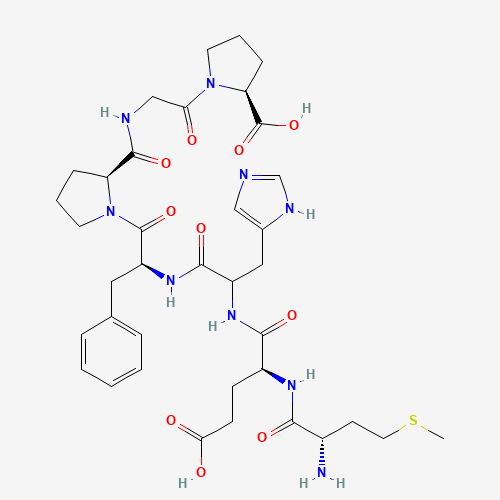
Two chemistry details matter for anyone evaluating a certificate of analysis. The N-terminal methionine is the molecule's weak point: its sulfur-containing side chain oxidizes readily on exposure to air, light, or trace copper, adding sixteen mass units. The complication is that the histidine at position three can also pick up the same sixteen-unit change, so a simple mass reading cannot tell the two apart; distinguishing them requires tandem mass spectrometry that localizes the modification to a residue. Most commodity certificates report a single purity number and a nominal mass, neither of which resolves the oxidized fraction. A certificate that deconvolutes the parent peak from the plus-sixteen satellite and reports the oxidized percentage is testing for the molecule's real failure mode, and storage that limits oxygen, light, and metal contact is the corresponding handling discipline. Separately, a modified version sold as N-acetyl-Semax-amidate is a distinct, more stable analog rather than Semax itself, and the two should not be conflated on a label.
Mechanism: A Real Signal, a Crowded Pathway
Of all the Russian neuropeptides, Semax has the most concrete mechanistic anchor, and it is worth stating precisely because it is so often overstated.
The central finding is that Semax raises brain-derived neurotrophic factor, or BDNF, a protein involved in neuronal growth and plasticity. In intact rats, a single intranasal dose increased hippocampal BDNF protein and sharply increased the messenger RNA for BDNF and for its receptor, TrkB[2]. This result is unusually well supported for the category: it was reproduced across brain regions by other Russian groups and, importantly, corroborated by a German laboratory, one of the few instances of independent Western replication anywhere in the Russian-neuropeptide literature. A companion study reported a specific, high-affinity binding site for the peptide in the basal forebrain, which gives the mechanism a more defined target than most peptides in this class can claim[3].
Two caveats keep that finding in proportion. First, the effect is not cleanly attributable to the intact peptide, because the Pro-Gly-Pro tail is itself liberated as a metabolite and reproduces part of the activity on its own, which blurs the question of what is doing the work. Second, the broader mechanistic account is multi-pathway: beyond BDNF, the literature describes weak melanocortin-receptor engagement inherited from the ACTH fragment and a separate dopaminergic and serotonergic component reported by a pharmacology group independent of the originating laboratory[4]. A molecule that acts a little through several systems is harder to pin down than one with a single clean target, and multi-pathway accounts often point to indirect effects.
The most important caveat is editorial. "Raises BDNF" is routinely compressed, in marketing copy, into a claim about human memory or focus. The published result is an increase in a growth-factor transcript in rat brain at a specific dose and route. It does not, on its own, establish anything about cognition in people, and the shortcut from one to the other is exactly the inference the evidence does not license.
Preclinical Evidence, and a Dead Western Lineage
The animal literature is genuinely sizable, and a stroke-model study illustrates both its sophistication and its limits: a genome-wide analysis of gene expression after experimental cerebral artery occlusion in rats reported broad transcriptional changes associated with the peptide[5]. As a description of what the molecule does to a rodent brain under ischemic stress, this is real data. As evidence of human benefit, it is several inferential steps removed.
The more revealing context is historical, and it is the piece almost no account of Semax includes. The idea behind the molecule is not Russian in origin. In the 1960s and 70s the Dutch pharmacologist David de Wied established that the fragment of ACTH spanning roughly residues four through ten carried the hormone's behavioral activity without its adrenal activity, and that fragment became the target of a sustained Western drug-development effort.
The pharmaceutical company Organon advanced a close variant, designated Org 2766, into clinical programs for Alzheimer's disease, autism, and the nerve damage caused by chemotherapy. The program was abandoned; no drug emerged from it. The de Wied work itself ran for the better part of two decades and built a substantial animal literature on learning and memory; the fragment's activity in rodents was never the sticking point. Turning that activity into a measurable human benefit was.
That history is the single most useful frame for reading Semax. The West evaluated several molecules in this exact class and approved none of them, which tells us the category is hard even with major pharmaceutical backing. Russia kept one molecule alive through a different regulatory system. The survival of Semax is a fact about Russian drug regulation and a persistent research community, not independent evidence that the class works where the others did not.
Clinical Evidence: A Russian Record, Held to a Russian Standard
Semax's human evidence is almost entirely Russian, and its flagship indication is acute ischemic stroke. The anchor study compared a Semax group against a non-randomized, non-contemporaneous historical control group in hemispheric stroke, reporting better outcomes for the treated patients[1]. The design is the problem: it was open-label, the control was not a true randomized comparator, the outcome scales were Russian-standard rather than the internationally used stroke scales, and the work issued from the same research network that developed the molecule. There are no registered trials of Semax with international endpoints, and the ClinicalTrials.gov registry contains no Semax-specific studies at all.
This matters most because of the company the molecule keeps. Acute-stroke neuroprotectant drugs, agents meant to protect brain tissue during a stroke rather than dissolve the clot, are one of the great graveyards of modern pharmacology. NXY-059 failed a large Phase 3 program; citicoline failed its confirmatory trial; tirilazad and lubeluzole failed; edaravone is approved for stroke in Japan but, in the United States, only for amyotrophic lateral sclerosis, because regulators did not accept the stroke case. The closest Western-evaluated comparator to the Russian neuropeptides, a porcine-brain-derived peptide preparation studied for decades, has accumulated a trial record that systematic reviewers have judged too heterogeneous to support a guideline recommendation.
The pattern across these programs is consistent. Agents that reduce damage in a controlled rodent stroke model rarely repeat the result in the messier reality of human stroke, where timing, dose, and the sheer variability of real strokes swamp a modest effect. Semax's Russian data sit on the wrong side of that pattern, produced by methods that would struggle to distinguish a small benefit from none.
That record is the base rate Semax inherits. It does not prove the molecule is inert; the most defensible reading is that it occupies the same ambiguous zone as its closest comparator, real but modest biology that adequately powered modern trials have never been run to confirm or refute. The Russian registration reflects a regulatory judgment made decades ago under different standards, not a result that would clear a contemporary Western review.
The Selank Sibling, and Why It Is Not a Stack
Semax is frequently paired with Selank, and the pairing is a misunderstanding worth correcting.
The two peptides come from the same place. Both were designed at the Institute of Molecular Genetics in Moscow, in the same era, by the same group, using the same Pro-Gly-Pro stabilizing tail grafted onto a fragment of a known biological peptide. The difference is the parent: Semax is built on a fragment of ACTH, while Selank is built on a fragment of the immune peptide tuftsin. They have different sequences, different proposed mechanisms, and different Russian registrations, and their relationship is the institutional one of having been made by the same laboratory on the same template. The two molecules are compared at length in our Selank vs Semax review, and Selank has its own single-compound treatment in our Selank literature review.
What the shared origin does not establish is any basis for taking them together. They are siblings by design history, not a combination validated by evidence, and the published literature contains no controlled study of their co-administration. The common assumption that two peptides from one lab belong together is a provenance artifact, not a research finding.
One further disambiguation is necessary, because the error is everywhere. Semax and Selank are not part of the Khavinson bioregulator program. That program came from a different institute in a different city, Saint Petersburg, with a different scientific framework, covered in our Khavinson bioregulators review. The shared label "Russian peptides" collapses two distinct research lineages that have little in common beyond their country of origin.
Research Limitations
Several limitations frame how the Semax evidence should be weighted.
The first is the citation concentration. On the order of seventy to eighty-five percent of the Semax literature carries an author from the originating Moscow institute, one of the most concentrated bodies of work in this category. The independent German replication of the BDNF finding is a genuine and important exception, but the corpus as a whole is close to a single-network literature, and a result reproduced mainly within the group that produced it carries less weight than a distributed one. The concentration reaches into the clinic as well: the neurologist who led the principal Russian stroke studies of the molecule later served as the country's Minister of Health, an unusually direct overlap between the people who studied the drug and the institutions that register and recommend it.
The second is the dead-lineage problem. The molecule belongs to a drug class that the West developed and abandoned, and its survival is a regulatory and institutional fact rather than evidence that it succeeded where the others failed.
The third is the clinical methodology. The Russian stroke evidence is open-label, historically controlled, and scaled to Russian rather than international endpoints, in a therapeutic area defined by the systematic failure of better-run trials of similar agents. The base rate for this class is poor, and Semax has not been tested against it.
The fourth is the route mismatch. The Russian evidence describes an intranasal product at low doses; the material sold for research in the West is an injectable at far higher doses. Safety and activity observed by one route do not transfer to the other, and claims should carry their route.
None of this makes the molecule inert. The BDNF mechanism is real and partly replicated, and the chemistry is well defined. The limitations describe how far that animal-model mechanism can be carried toward a human claim, which on the current record is not far at all.
Regulatory Context
As of June 2026, Semax is not approved by the FDA for any indication, and is not approved by the European Medicines Agency or the regulators of the UK, Canada, or Australia. Its regulatory life is almost entirely Russian. The Russian Ministry of Health registered it in 1994 for cognitive disorders and optic-nerve disease, as a low-concentration intranasal solution, and again in 1998 for acute ischemic stroke at a higher concentration; it carries a Russian drug-register code, sits on the country's list of vital and essential drugs, and appears in the Russian stroke standard of care. Those are real registrations, made under a regulatory system whose standards for this kind of evidence differ from the FDA's, and they are third-party regulatory history rather than any claim by Peerless.
Within the United States compounding framework, Semax was placed on the 503A Category 2 list in 2023 and reclassified out of it in the April 2026 action that moved a group of peptides at once. It was reviewed by the Pharmacy Compounding Advisory Committee on July 24, 2026, with proposed indications listed as cerebral ischemia, migraine, and trigeminal neuralgia; of those, the cerebral-ischemia proposal maps onto the strongest Russian evidence and the others are weaker. The Committee recommended Semax for the 503A bulks list, 8 to 5 with one abstention. FDA's own review staff had proposed against addition, pointing to a single uncontrolled 1996 study in which the compound did not resolve pain for most trigeminal-neuralgia subjects, which is the weakest of the three proposed indications and consistent with the assessment above. The mechanics of these categories are explained in our 503A vs 503B compounding primer, and the full docket outcome in our report on the July 2026 PCAC vote.
A committee recommendation is not an approval, and removal from a do-not-compound list does not make the compound lawful for human use; it remains an unapproved new drug. Its docket cohort includes the Khavinson tetrapeptide reviewed in our Epitalon literature review, which shared the July 2026 date but, again, not the laboratory.
In sport, Semax is not specifically named on the World Anti-Doping Agency Prohibited List, because Russian Ministry of Health registration does not meet the agency's threshold for an approving regulatory authority; it would fall under the catch-all for non-approved substances if at all. It was, however, named explicitly in the 2020 federal plea by a US compounding pharmacy that distributed unapproved peptides, which places it squarely within the enforcement record.
References
-
Gusev EI, Skvortsova VI, Miasoedov NF, et al. Effectiveness of semax in acute period of hemispheric ischemic stroke (a clinical and electrophysiological study). Zh Nevrol Psikhiatr Im S S Korsakova. 1997;97(6):26-34. PMID: 11517472.
-
Dolotov OV, Karpenko EA, Inozemtseva LS, et al. Semax, an analog of adrenocorticotropin (4-10), binds specifically and increases levels of brain-derived neurotrophic factor protein in rat basal forebrain. Brain Res. 2006;1117(1):54-60. PMID: 16996037.
-
Dolotov OV, Eremin KO, Grivennikov IA, et al. Semax, an ACTH(4-10) analogue, binds to a specific site in the rat basal forebrain. J Neurochem. 2006. PMID: 16635254.
-
Eremin KO, Kudrin VS, Saransaari P, et al. Semax, an ACTH(4-10) analogue with nootropic properties, activates dopaminergic and serotoninergic brain systems in rodents. Neurochem Res. 2005;30(12):1493-1500. PMID: 16362768.
-
Medvedeva EV, Dmitrieva VG, Povarova OV, et al. Effect of semax and its C-terminal fragment Pro-Gly-Pro on the expression of neurotrophins and their receptors in a rat model of cerebral ischemia. Mol Neurobiol / genome-wide transcriptome analysis. 2014. PMID: 24661604.
-
Adan RA, Cone RD, Burbach JP, Gispen WH. Differential effects of melanocortin peptides on neural melanocortin receptors. Mol Pharmacol. 1994;46(6):1182-1190. PMID: 7895772.
-
Russian Federation Ministry of Health drug-register entry for Semax (intranasal solution), register code P N000812/01; first registration 1994, stroke indication added 1998; included on the Russian list of vital and essential drugs (2011).
Not intended to diagnose, treat, cure, mitigate, or prevent any disease. Sold for research, laboratory, or analytical purposes only.
Research Compounds Referenced
The compounds discussed in this article are sold by Peerless Peptides for laboratory research use only. They are not FDA-approved for human or veterinary administration. Per-batch Certificates of Analysis are available.
- Semax: Synthetic heptapeptide Met-Glu-His-Phe-Pro-Gly-Pro, ACTH(4-7) analog with C-terminal Pro-Gly-Pro extension.PDP entry →
Frequently Asked Questions
- What is Semax?
- Semax is a synthetic seven-amino-acid peptide (Met-Glu-His-Phe-Pro-Gly-Pro) designed at the Institute of Molecular Genetics in Moscow in the 1980s. Its first four residues are a fragment of the stress hormone ACTH, and a Pro-Gly-Pro tail is added for stability. It is registered as a drug in Russia and sold there as an intranasal solution, but it is not approved by the FDA. It is sold by Peerless Peptides for laboratory research use only and is not approved for human or veterinary use.
- What is Semax used for in research?
- In Russia, the Ministry of Health has registered Semax for cognitive disorders, optic-nerve disease, and acute ischemic stroke, and the published research literature centers on those areas plus its effect on brain-derived neurotrophic factor in animal models. That Russian registration is third-party regulatory history, not a statement by Peerless. In the United States the peptide has no approved use and is sold strictly for laboratory research; the research record is summarized below and is weaker by modern Western trial standards than the registration implies.
- Is Semax FDA approved?
- No. Semax is registered as a drug by the Russian Ministry of Health but is not approved by the FDA, the European Medicines Agency, the UK, Canada, or Australia. It was reclassified within the US 503A compounding framework in April 2026 and was reviewed by the FDA Pharmacy Compounding Advisory Committee on July 24, 2026, with proposed indications of cerebral ischemia, migraine, and trigeminal neuralgia. The Committee recommended it for the 503A bulks list, 8 to 5 with one abstention, against FDA staff's written position that it not be added. A committee recommendation is advisory and is not an approval; notice-and-comment rulemaking would still be required. It is sold here for research use only.
- How is Semax different from Selank?
- They are siblings, not a pair to be combined. Semax and Selank were designed at the same Moscow laboratory using the same Pro-Gly-Pro stabilizing tail, but on different parent fragments: Semax on a piece of ACTH, Selank on a piece of the immune peptide tuftsin. They have different sequences, different proposed mechanisms, and different Russian registrations. The shared laboratory and design template do not make them a combination, and the published literature provides no basis for co-administration.
- What does the research on Semax show?
- The most reproducible finding is that Semax raises brain-derived neurotrophic factor and related signaling in rat brain at specific intranasal doses, a result that has been replicated outside Russia. The human evidence is almost entirely Russian, methodologically older and less rigorous than modern Western trials, and the broader class of acute-stroke neuroprotectant drugs has a long record of failing to translate. The honest reading is real but modest biology attached to a clinical record that Western-standard trials have never confirmed.