

Quality Standards
American Owned
Mixed, bottled, and tested in the USA
Third-Party Tested
Independently tested for purity and quality
>99% Purity
Exceptional purity you can trust
Also Screened For
Endotoxins + Heavy Metals
Beyond the identity, purity & sterility panel.
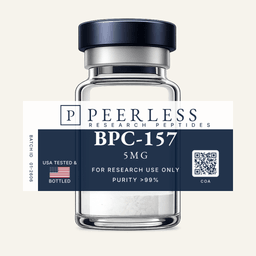
BPC-157
Body Protection Compound 157, synthetic pentadecapeptide more info
Available for laboratory research use only.
Quality Standards
American Owned
Mixed, bottled, and tested in the USA
Third-Party Tested
Independently tested for purity and quality
>99% Purity
Exceptional purity you can trust
Also Screened For
Endotoxins + Heavy Metals
Beyond the identity, purity & sterility panel.
Vial size
Choose your supply
3 vials· 30mg total
Save $9.00 (5% off)
Total
$171.00
Volume pricing applies to your total vials, not just this product. Mix or match any vials in your cart to reach the next tier.
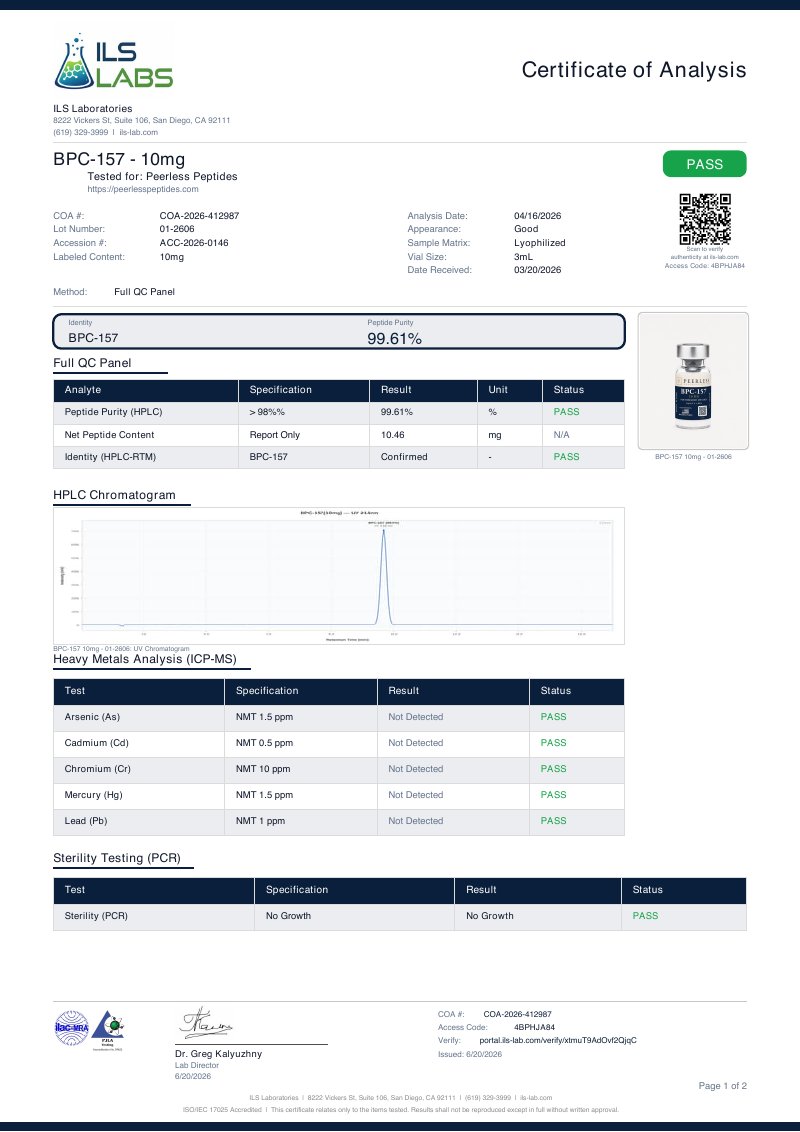
Independent Lab Results
The most comprehensive testing panel in research peptide commerce. Every batch is independently verified by ILS Laboratories — an ISO/IEC 17025 and PJLA-accredited facility in San Diego, CA.
- Identity
- Purity (HPLC)
- Endotoxin (USP <85>)
- Sterility screen (PCR)
- Heavy metals (ICP-MS per USP <233>)
Biochemical Profile
- CAS Number
- 137525-51-0
- Molecular Formula
- C62H98N16O22
- Molecular Weight
- 1419.54 g/mol
- Purity
- >99% (HPLC-UV (214-220 nm))
- PubChem CID
- 9941957
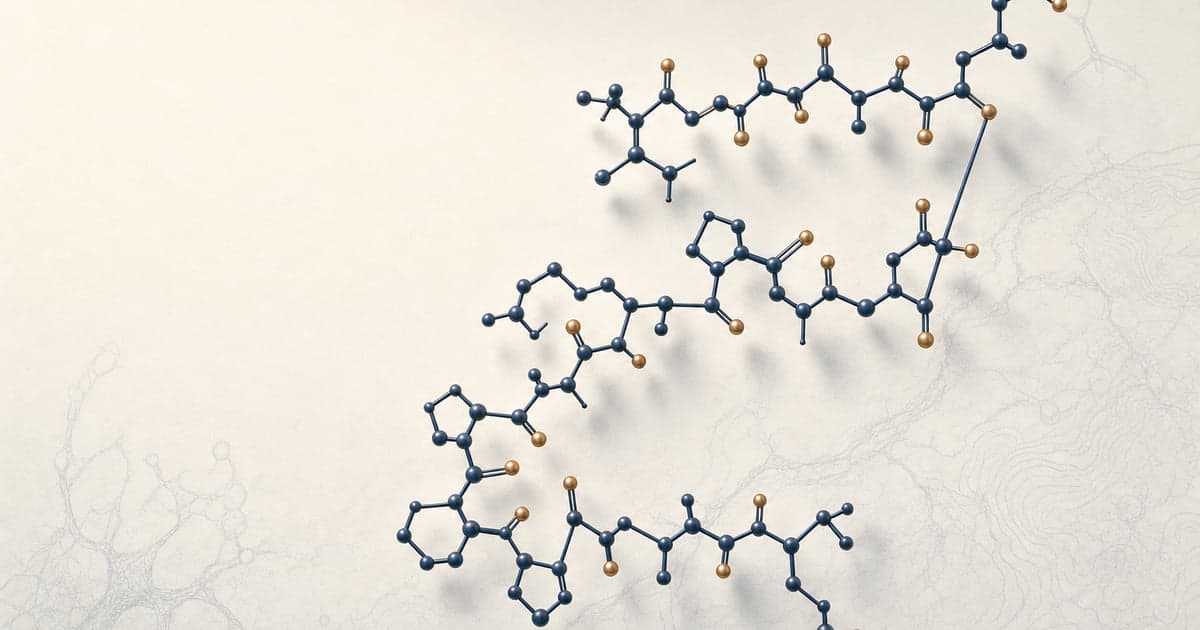
- Amino Acid Sequence
- Gly-Glu-Pro-Pro-Pro-Gly-Lys-Pro-Ala-Asp-Asp-Ala-Gly-Leu-Val
Receptor Targets and Signaling Pathway Context
BPC-157 has been investigated as a modulator of nitric oxide (NO) signaling and as an upstream effector in the VEGFR2-Akt-eNOS angiogenesis pathway across rodent models[1]. In rat gastric mucosal injury preparations, BPC-157 administration has been associated with changes in NO synthase regulation, prostaglandin pathway interactions, and dopaminergic system modulation in various pathophysiological stressors[2].
In vascular research, BPC-157 has been characterized as a modulator of VEGFR2 (vascular endothelial growth factor receptor 2) phosphorylation. The mechanism work mapping this pathway came from the Chang research group at Chang Gung University, Taiwan, which is the only non-Zagreb laboratory to have published substantive original mechanism research on BPC-157[3]. The Chang group's follow-up work reported observations on growth-hormone-receptor signaling in cultured rat tendon fibroblasts after BPC-157 administration[4].
The receptor-binding profile of BPC-157 has not been characterized in human tissue. No specific high-affinity receptor has been identified in the published peer-reviewed literature, and current mechanism proposals are drawn from observed effects in preclinical models rather than direct receptor pharmacology.
The only independent pharmacokinetic study of BPC-157 (Xu et al., 2022) reported plasma half-lives of approximately 15 minutes (intravenous rat), 5 minutes (intravenous beagle dog), and 20-30 minutes (intramuscular)[5]. Bioavailability ranged from 14-19% in rats and 45-51% in dogs. No drug accumulation was observed across 7 days of repeated dosing; plasma BPC-157 was mathematically eliminated by 12 hours after each injection. These pharmacokinetic findings are independent of the Zagreb research group.
Human pharmacokinetic data on BPC-157 remain limited. Two registered clinical trials exist: NCT02637284 (Phase I, sponsored by PharmaCotherapia d.o.o., a Croatian entity associated with the Sikirić group; commenced 2015, never published)[6] and NCT07437547 (Phase 2 acute hamstring strain, sponsored by Hudson Biotech, recruiting as of February 2026)[7]. NCT07437547 is the first BPC-157 trial registered outside the Sikirić research orbit in 33 years.
Research Applications
Gastrointestinal Research
Gastrointestinal research models account for the largest body of published BPC-157 literature. Rat preparations of gastric ulceration, NSAID-induced gastrointestinal lesions, intestinal anastomosis, and inflammatory bowel injury have been the most frequently used models, beginning with the Sikirić group's 1993 foundational characterization[8].
A development-stage preparation of BPC-157 designated PL14736 was the subject of early-phase clinical investigation as a candidate for inflammatory bowel disease, with supporting preclinical data reported on rat colocutaneous fistula models[9]. The PL14736 development program did not advance to Phase 2/3 efficacy trials in the peer-reviewed record.
The broader 2018 Zagreb review by Sikirić and colleagues framed BPC-157 as a 'novel cytoprotective mediator' across gastric mucosal preparations[10]. Across 33 years since the foundational 1993 paper, no Phase 2 or Phase 3 efficacy data on BPC-157 in any gastrointestinal indication has been published in the peer-reviewed clinical literature.
Tendon and Ligament Research
Tendon-injury preparations have been a sustained focus in the BPC-157 literature and are the area where independent (non-Zagreb) original mechanism work has been concentrated. The Chang research group at Chang Gung University, Taiwan, reported observations on cell survival, fibroblast migration markers, and Vinculin/F-actin distribution in cultured tendon explants and in vivo rat Achilles transection preparations[3].
The same Chang group's 2014 follow-up paper reported growth-hormone-receptor signaling effects in cultured tendon fibroblasts following BPC-157 administration in vitro[4]. These two papers are the most-cited non-Zagreb primary mechanism contributions to the BPC-157 literature.
A 2025 systematic review of orthopaedic sports-medicine research involving BPC-157 (Vasireddi et al.) identified the absence of human randomized clinical trials and noted that the reported tendon-related findings derive almost entirely from rodent preparations conducted by a small number of collaborating laboratories[11]. As of May 2026, NCT07437547 (Phase 2 acute hamstring strain, Hudson Biotech) is the first registered human tendon-or-muscle-injury efficacy trial of BPC-157[7].
Wound and Skin Research
Rat skin wound and burn preparations have been used to investigate BPC-157 across the dermatology research literature, with reported observations including effects on re-epithelialization rate and angiogenesis markers in standardized excisional wound models. The foundational dermatology studies share authorship with the Sikirić group's broader BPC-157 research program.
Renke et al. (2026) reviewed therapeutic-peptide research in aesthetic, metabolic, and endocrine conditions and included a section on BPC-157 dermatology preparations; the authors characterized the available literature as predominantly preclinical with limited human exposure data[12].
As with other research domains in the BPC-157 literature, controlled human trials of any dermatologic indication have not been published as of May 2026. Independent replication of dermal-wound findings by laboratories outside the Zagreb research program remains limited.
Musculoskeletal and Muscle Research
BPC-157 has been examined in rat muscle-injury preparations, with the most-cited preclinical paper specifically addressing muscle recovery under conditions of systemic corticosteroid administration[13]. The Pevec study reported observations on gastrocnemius muscle structure and functional measurements in rat preparations following crush injury, in animals receiving and not receiving systemic dexamethasone.
A 2025 narrative review of musculoskeletal-healing research involving BPC-157 (McGuire et al.) summarized the rodent preclinical literature and identified the absence of randomized controlled human trials in the published record[14]. The review noted that the reported preclinical findings span muscle-fiber preparations, tendon-bone junction preparations, and ligament models, with the majority of work concentrated in rat anatomy.
The Hudson Biotech NCT07437547 Phase 2 hamstring trial (recruiting February 2026, n=120 estimated) is the first registered acute-muscle-injury efficacy trial of BPC-157[7]. Results have not been published.
Neurological and Central Nervous System Research
Rat models of traumatic brain injury and central nervous system stress have been used to investigate BPC-157, with reported outcome measures including dopaminergic receptor activity, serotonergic pathway markers, and gross neurological scoring in head-injury preparations. Some of this work has examined effects on the dopamine-glutamate axis in rat models of amphetamine-induced behavioral sensitization.
A separate line of CNS research has examined BPC-157 in rat preparations of corticosteroid- and stress-induced central nervous system perturbation, including rat models of severe electrolyte disturbance with associated neurological symptoms[15].
As with the broader BPC-157 literature, controlled human trials of any neurological indication have not been published as of May 2026. The reported observations are limited to rat preparations conducted predominantly by collaborators of the Sikirić research group at the University of Zagreb. Independent replication outside of the originating program remains limited.
Independent Replication and Clinical Status
Approximately 87% of the ~200 BPC-157 papers indexed on PubMed have Sikirić as first or senior author (~173 of 200), and approximately 81% have co-author Seiwerth (~161 of 200). The first peer-reviewed synthesis review of BPC-157 by a non-Zagreb research group is Józwiak et al. (2025), published in Pharmaceuticals, which examined angiogenesis and nitric-oxide mechanism proposals across the published literature[16].
A 2024 open-label pilot study in n=12 women with interstitial cystitis reported intravesical BPC-157 administration without a control arm or blinding[17]. A 2025 intravenous safety pilot in n=2 reported preliminary tolerability observations[18]. No randomized, placebo-controlled, peer-reviewed efficacy study in any indication has been published.
The BPC-157 regulatory status as of May 2026: FDA removed BPC-157 from 503A Category 2 (Do-Not-Compound) effective April 22, 2026, though removal does not confer Category 1 status or compoundability. The Pharmacy Compounding Advisory Committee (PCAC) has scheduled a review on July 23, 2026 (the FDA docket lists a proposed ulcerative-colitis indication). Australia's TGA has scheduled BPC-157 as Schedule 9 (Prohibited Substance) effective July 1, 2026; the World Anti-Doping Agency lists BPC-157 under S0 (Non-Approved Substances), banned at all times with no Therapeutic Use Exemption pathway. The Hudson Biotech NCT07437547 hamstring trial (Phase 2, recruiting) is the first BPC-157 trial registered outside the Sikirić research orbit in 33 years[7].
Research Literature
Published literature reviews from the Peerless research desk that reference BPC-157.
Handling & Storage
- Storage (lyophilized)
- -20°C, dry, dark, 24-36 months
- Storage (in solution)
- 2-8°C, use within 28 days
- Shelf Life
- 24-36 months lyophilized
Research References
- [1] Sikirić P, Seiwerth S, Rucman R, et al. Stable gastric pentadecapeptide BPC 157-NO-system relation. Curr Pharm Des. 2014;20(7):1126-1135. PMID:23755725
- [2] Sikirić P, Seiwerth S, Rucman R, et al. Toxicity by NSAIDs. Counteraction by stable gastric pentadecapeptide BPC 157. Curr Pharm Des. 2013;19(1):76-83. PMID:22300085
- [3] Chang CH, Tsai WC, Lin MS, Hsu YH, Pang JHS. The promoting effect of pentadecapeptide BPC 157 on tendon healing involves tendon outgrowth, cell survival, and cell migration. J Appl Physiol. 2011;110(3):774-780. doi:10.1152/japplphysiol.00945.2010PMID:21030672
- [4] Chang CH, Tsai WC, Hsu YH, Pang JHS. Pentadecapeptide BPC 157 enhances the growth hormone receptor expression in tendon fibroblasts. Molecules. 2014;19(11):19066-19077. PMID:25415472
- [5] Xu T, Zhang Z, et al. Pharmacokinetics, bioavailability, and tissue distribution of body protection compound 157 (BPC 157) in rats and beagle dogs. Front Pharmacol. 2022;13:1052033. PMID:36588717
- [6] PharmaCotherapia d.o.o. A Phase I, pilot study in healthy volunteers to assess the safety and pharmacokinetics of PCO-02 (active ingredient BPC-157). ClinicalTrials.gov Identifier: NCT02637284. Phase I, n=42; status uncertain; never published (verified 2026-05-19).
- [7] Hudson Biotech. BPC 157 for Acute Hamstring Muscle Strain Repair. ClinicalTrials.gov Identifier: NCT07437547. Phase 2, n=120 estimated, status: recruiting since February 2026 (verified 2026-05-19). Primary endpoints: time to return to sport, MRI hamstring injury volume.
- [8] Sikirić P, Petek M, Rucman R, et al. A new gastric juice peptide, BPC. An overview of the stomach-stress-organoprotection hypothesis and beneficial effects of BPC. J Physiol Paris. 1993;87(5):313-327. doi:10.1016/0928-4257(93)90038-uPMID:8298609
- [9] Klicek R, Sever M, Radic B, et al. Pentadecapeptide BPC 157, in clinical trials as a therapy for inflammatory bowel disease (PL14736), is effective in the colocutaneous fistula rat model. Fundam Clin Pharmacol. 2008;22(5):553-564. doi:10.1111/j.1472-8206.2008.00611.x
- [10] Sikirić P, Seiwerth S, Brcic L, et al. Stable gastric pentadecapeptide BPC 157 as a novel cytoprotective mediator. Curr Pharm Des. 2018;24(18):1990-2001. PMID:29879879
- [11] Vasireddi N, et al. BPC 157 in orthopaedic sports medicine: a systematic review. HSS J. 2025. PMID:40756949
- [12] Renke F, et al. Therapeutic peptides in aesthetic, metabolic and endocrine conditions: BPC 157 review section. Int J Mol Sci. 2026. PMID:42123471
- [13] Pevec D, Novinscak T, Brcic L, et al. Impact of pentadecapeptide BPC 157 on muscle healing impaired by systemic corticosteroid application. Med Sci Monit. 2010;16(3):BR81-BR88. PMID:20190676
- [14] McGuire JR, et al. BPC 157 in musculoskeletal research: a narrative review. Curr Rev Musculoskelet Med. 2025. PMID:40789979
- [15] Grubisic V, et al. BPC 157 in severe electrolyte disturbance models in rats. Curr Neuropharmacol. 2026. PMID:41832718
- [16] Józwiak K, et al. Angiogenesis and nitric oxide targeting mechanisms of BPC 157: a non-Zagreb synthesis review. Pharmaceuticals. 2025;18(2):185. PMID:40005999
- [17] Lee KS, Walker T, Ayadi A. Intravesical BPC-157 in interstitial cystitis: an open-label observational pilot in 12 female subjects. 2024. PMID:39325560
- [18] Lee KS, Burgess J. Intravenous BPC-157 safety and tolerability pilot in n=2 subjects. 2025. PMID:40131143
Scientific Journal Author
Predrag Sikirić, MD, PhD
Department of Pharmacology, University of Zagreb School of Medicine
Landmark Publications
- Sikirić P, Petek M, Rucman R, et al. A new gastric juice peptide, BPC. J Physiol Paris. 1993;87(5):313-327. (PMID 8298609)
- Sikirić P, Seiwerth S, Rucman R, et al. Stable gastric pentadecapeptide BPC 157-NO-system relation. Curr Pharm Des. 2014;20(7):1126-1135. (PMID 23755725)
- Sikirić P, Seiwerth S, Brcic L, et al. Stable gastric pentadecapeptide BPC 157 as a novel cytoprotective mediator. Curr Pharm Des. 2018;24(18):1990-2001. (PMID 29879879)
Dr. Sikirić is independently cited here as the originating researcher of BPC-157 at the University of Zagreb. There is no affiliation or commercial relationship between Dr. Sikirić, the University of Zagreb, or any associated commercial entity, and Peerless Peptides.