

Quality Standards
American Owned
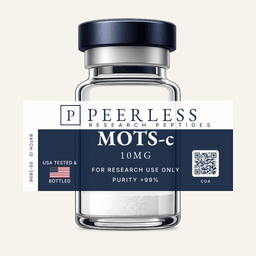
Mixed, bottled, and tested in the USA
Third-Party Tested
Independently tested for purity and quality
>99% Purity
Exceptional purity you can trust
Also Screened For
Endotoxins + Heavy Metals
Beyond the identity, purity & sterility panel.
MOTS-c
16-amino-acid mitochondrial-derived peptide encoded by the mtDNA 12S rRNA gene (MT-RNR1) more info
Available for laboratory research use only.
Quality Standards
American Owned
Mixed, bottled, and tested in the USA
Third-Party Tested
Independently tested for purity and quality
>99% Purity
Exceptional purity you can trust
Also Screened For
Endotoxins + Heavy Metals
Beyond the identity, purity & sterility panel.
Vial size
Choose your supply
3 vials· 30mg total
Save $8.25 (5% off)
Total
$156.75
Volume pricing applies to your total vials, not just this product. Mix or match any vials in your cart to reach the next tier.
Independent Lab Results
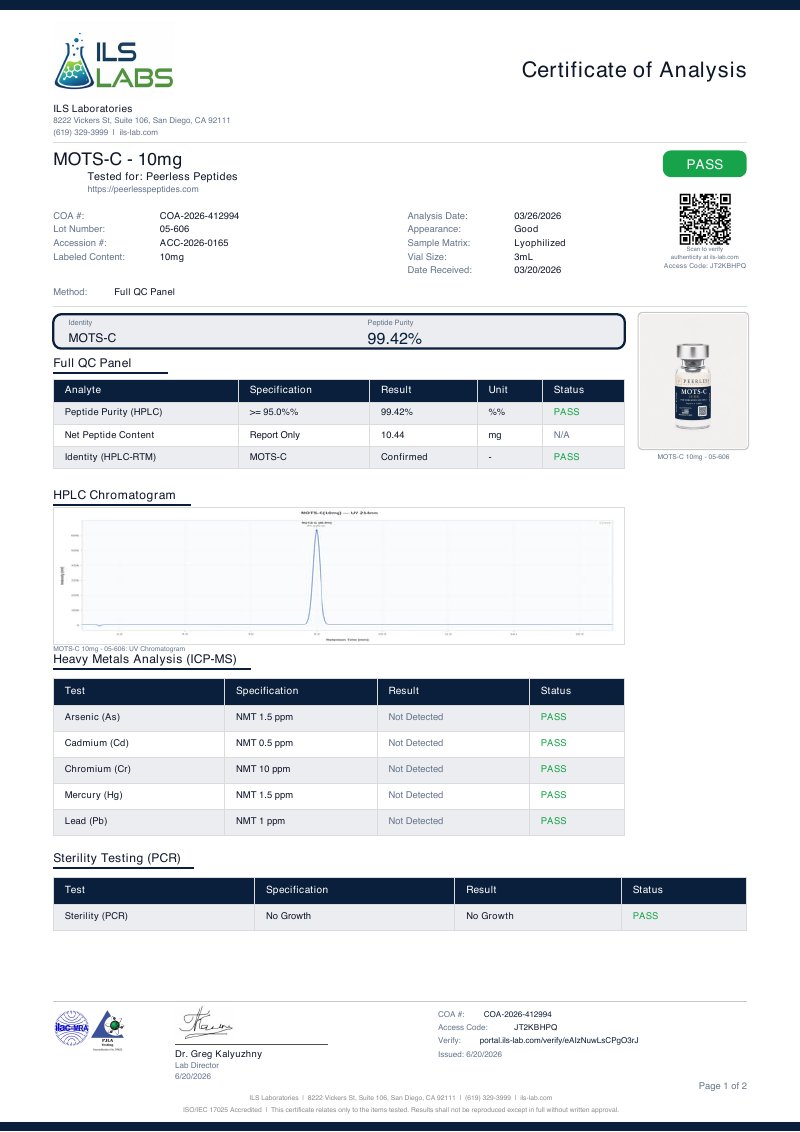
The most comprehensive testing panel in research peptide commerce. Every batch is independently verified by ILS Laboratories — an ISO/IEC 17025 and PJLA-accredited facility in San Diego, CA.
- Identity
- Purity (HPLC)
- Endotoxin (USP <85>)
- Sterility screen (PCR)
- Heavy metals (ICP-MS per USP <233>)
Biochemical Profile
- CAS Number
- 1627580-64-6
- Molecular Formula
- C101H152N28O22S2
- Molecular Weight
- 2174.6 g/mol
- Purity
- >99% (HPLC-UV (220 nm) with LC-MS deconvolution for the +16 Da methionine-oxidation satellite)
- PubChem CID
- 146675088
- Amino Acid Sequence
- Met-Arg-Trp-Gln-Glu-Met-Gly-Tyr-Ile-Phe-Tyr-Pro-Arg-Lys-Leu-Arg
Receptor Targets and Signaling Pathway Context
MOTS-c is encoded by an alternative open reading frame within the mitochondrial 12S ribosomal RNA gene (MT-RNR1), translated by mitoribosomes inside mitochondria, and released into circulation. This mtDNA-encoded origin is structurally unusual; most peptides in laboratory research commerce derive from nuclear-encoded proteins. The discovery paper by the Lee, Cohen, and de Cabo collaboration at USC characterized MOTS-c as a mitokine acting at the cellular level, with biochemical demonstration of folate-cycle inhibition at the AICAR transformylase (ATIC) step[1].
The canonical mechanism proposed by the Lee 2015 paper is indirect AMPK activation. MOTS-c was reported to inhibit the folate cycle, causing accumulation of AICAR (5-aminoimidazole-4-carboxamide ribonucleotide), an allosteric AMP-mimetic that directly activates 5' AMP-activated protein kinase. AMPK activation has been associated in the published preclinical literature with GLUT4-mediated glucose uptake in skeletal muscle preparations, suppression of hepatic gluconeogenesis, and autophagic responses[1]. MOTS-c is not unique in AMPK activation; metformin, AICAR itself, and exercise all activate the same kinase through distinct upstream routes.
A second mechanism layer was added by Kim and colleagues in 2018, who reported that under conditions of cellular stress MOTS-c translocates from cytoplasm to the nucleus, where it was associated with modulation of nuclear gene expression[2]. The nuclear-translocation finding adds a transcriptional-action layer to the simple mitokine framing and is the most-cited follow-up paper from the originating laboratory.
MOTS-c was characterized as exercise-inducible in human skeletal muscle by Reynolds and colleagues in 2021. Endogenous intramuscular MOTS-c rose approximately 12-fold and plasma MOTS-c approximately 50% in human cycling preparations; intraperitoneal MOTS-c administration was reported to extend treadmill running duration in 22-month-old mice[3]. The route of exogenous administration (intraperitoneal injection in aged mice) and the species and age of the model system are load-bearing context for the published causal claim.
The receptor-binding profile of MOTS-c has not been characterized in human tissue. The cellular import mechanism (the transporter that exports MOTS-c from mitochondria) has not been formally identified in the published peer-reviewed literature. Published human pharmacokinetic data for native MOTS-c (the form sold in laboratory research commerce) have not been reported; the only registered Phase 1 human trial used the CB4211 analog, a structurally distinct CohBar-developed derivative[4].
Research Applications
Mitochondrial Biology and Mitochondrial-Derived Peptide Research
MOTS-c belongs to the mitochondrial-derived peptide (MDP) family, a class of short peptides translated from alternative open reading frames within the mitochondrial genome. The MDP family also includes humanin (a 24-residue peptide encoded by MT-RNR2 and the first MDP identified, by Hashimoto and Nishimoto in 2001), the Small Humanin-Like Peptides 1-6 (SHLPs, also encoded within MT-RNR2 and characterized by Cobb and colleagues in 2016), and Gau (an antibacterial MDP)[1][2].
The Lee 2015 discovery paper used multiple cell-line preparations (C2C12 mouse myotubes, HepG2 hepatocytes, primary mouse hepatocytes), multiple in-vivo model systems (high-fat-diet C57BL/6 mice, db/db genetic obesity mice, aged-mouse cohorts), and direct biochemical demonstration of folate-cycle ATIC inhibition[1]. This breadth of model systems within a single paper is uncommon in the small-peptide literature and is one reason MOTS-c has a denser published evidence base than other peptides in laboratory research commerce.
The biological observation that MOTS-c is encoded by mitochondrial DNA is genuine and editorially distinctive. The inference that mtDNA encoding confers any specific therapeutic property is not supported by the published mechanism literature and is not made here. MOTS-c is presented as a research peptide whose biochemical pathway has been mapped in preclinical model systems.
AMPK Pathway and Glucose-Homeostasis Research Preparations
The canonical mechanism for MOTS-c is indirect AMPK activation via folate-cycle inhibition and downstream AICAR accumulation. AMPK is a heterotrimeric serine/threonine kinase activated by elevated AMP:ATP ratios and by allosteric AMP-mimetics; it sits upstream of multiple metabolic-research pathways in the published preclinical literature[1].
In rodent preparations of high-fat-diet obesity, the Lee 2015 paper reported observations on glucose tolerance, insulin tolerance, and hepatic glucose production following exogenous MOTS-c administration[1]. Ramanjaneya and colleagues subsequently reported in 2019 that serum MOTS-c levels were lower in adults with type 2 diabetes in a Qatar T2D cohort compared with non-diabetic controls, an independent (non-Lee/Cohen) replication observation in a human cross-sectional cohort[5]. Kumagai and colleagues at Juntendo University reported in 2022 that the K14Q (m.1382A>C) polymorphism, an Asian-specific mitochondrial DNA variant, produces a metabolically attenuated MOTS-c variant and that K14Q carriers showed elevated T2D prevalence among low-physical-activity Japanese males[6].
MOTS-c is not unique among AMPK activators. Metformin (Complex I inhibition), AICAR (direct allosteric), exercise itself, and caloric restriction all converge on AMPK through distinct upstream routes. The published preclinical literature does not establish that exogenous MOTS-c administration produces metabolic-research-relevant outcomes equivalent to those of other AMPK-pathway interventions.
Exercise Physiology Research
Reynolds and colleagues reported in 2021 that endogenous MOTS-c is exercise-inducible in human skeletal muscle, with intramuscular concentrations rising approximately 12-fold and plasma concentrations rising approximately 50% during cycling preparations[3]. The paper also reported that intraperitoneal MOTS-c administration was associated with extended treadmill running duration in 22-month-old mice. The Reynolds 2021 work is the most-cited independent replication of MOTS-c in an exercise-physiology context and was published in Nature Communications.
The authors of Reynolds 2021 used the phrasing 'exercise-induced regulator' rather than 'exercise mimetic.' The distinction is load-bearing. The correlational human observation (endogenous MOTS-c rises with cycling) and the causal mouse observation (intraperitoneal injection of exogenous MOTS-c in aged animals was associated with extended treadmill capacity) do not establish that exogenous administration in humans reproduces the effects of physical exercise. No published human trial has examined exogenous MOTS-c administration for physical-performance outcomes.
Hyatt and colleagues at Appalachian State University reported independent human exercise replication of the Reynolds correlational findings, observing rises in endogenous MOTS-c with exercise in a separate human cohort[7]. The exercise-physiology line of research is the strongest area of multi-laboratory replication in the MOTS-c published literature.
Bone and Osteoporosis-Research Preparations
Bone-density preclinical work has been a sustained focus in the MOTS-c published literature and is one of the two proposed indications on the July 23, 2026 PCAC docket. Ming and colleagues reported in 2016 that MOTS-c administration was associated with AMPK-dependent osteoclast suppression in an ovariectomy rat model of post-menopausal bone loss[8]. Lu and colleagues at Shandong University reported in 2019 on ovariectomy bone-model observations in mice, with reported observations on bone mineral density readouts following MOTS-c administration[9].
The Shandong Lu 2019 paper is an independent (non-Lee/Cohen) replication in a different rodent species and was published in International Journal of Molecular Sciences[9]. The bone-research line of preclinical work has the advantage of a narrower mechanistic framing than the metabolic-research line: AMPK-dependent osteoclast suppression is biochemically tractable and the readouts (bone mineral density, histomorphometric measures) are quantitatively reproducible across rodent ovariectomy preparations.
No Phase 2 or Phase 3 human osteoporosis trial of MOTS-c has been reported in the peer-reviewed clinical literature as of May 2026. The osteoporosis indication is one of two proposed indications under PCAC review on the July 23, 2026 docket.
Aging and Longevity-Research Preparations
Aging-research preparations have used MOTS-c in models of age-related physical decline. The Reynolds 2021 Nature Communications paper reported that 22-month-old C57BL/6 mice administered MOTS-c by intraperitoneal injection showed extended treadmill running duration relative to vehicle-injected aged controls[3]. The age-of-model distinction (22-month-old aged mice) is the load-bearing observational context for the causal claim.
In human cross-sectional cohort data, the Fuku, Cohen, and J-MICC investigators reported that the K14Q (m.1382A>C) polymorphism, which produces a metabolically attenuated MOTS-c variant, tracks with elevated type 2 diabetes prevalence among low-physical-activity Japanese males in the J-MICC cohort[10]. The genetic-cohort finding adds a human-genetics-level layer to the rodent-model preclinical work.
The term 'longevity peptide' is sometimes used in vendor copy across the small-peptide commerce category. The published primary literature on MOTS-c has not characterized exogenous administration as a longevity intervention in any species, and no Phase 2/3 human trial has examined chronic-administration outcomes at the timescales relevant to lifespan or healthspan research questions.
Replication, Clinical Status, and the July 23, 2026 PCAC Review
Independent (non-Lee/Cohen) replication of the major MOTS-c mechanism findings has been reported by Ramanjaneya et al. 2019 (Qatar T2D cohort, serum MOTS-c levels in adults with type 2 diabetes)[5], Kumagai et al. 2022 (Juntendo K14Q polymorphism characterization)[6], Hyatt et al. 2022 (Appalachian State human exercise correlation)[7], and Lu et al. 2019 (Shandong ovariectomy bone-density model)[9]. The Lee/Cohen first-or-senior authorship share of the foundational mechanism corpus is approximately 40-55%; the independent replication breadth is multi-continent (USA, Qatar, Japan, China, and New Zealand contributors).
Clinical translation ran through CohBar Inc. (formerly NASDAQ:CWBR), the USC spinout that licensed UCLA MOTS-c IP. CohBar advanced CB4211, a structurally distinct MOTS-c analog, through a Phase 1a/1b trial in non-alcoholic steatohepatitis and obesity (NCT03998514, n=20 in Phase 1b, subcutaneous daily dosing for 28 days). The trial met its primary safety endpoint in August 2021 with reported biomarker observations including ALT and AST changes versus placebo and a subset of participants with greater than 30% liver-fat reduction[4]. Persistent injection-site reactions led to temporary suspension; CohBar did not advance CB4211 to Phase 2 after reformulation attempts. CohBar dissolved in November 2023 following Nasdaq rejection of a Morphogenesis reverse-merger listing. CB4211 is structurally distinct from native MOTS-c (the form sold for laboratory research), and the Phase 1b biomarker observations apply to the analog, not to native MOTS-c.
MOTS-c is on the July 23, 2026 PCAC (Pharmacy Compounding Advisory Committee) Day 1 docket for both free-base and acetate forms, with proposed indications of obesity and osteoporosis. Public-comment docket FDA-2025-N-6895 closed July 22, 2026; meeting docket FDA-2026-N-2979 (Federal Register doc 2026-07361). MOTS-c was removed from FDA 503A Category 2 (Do-Not-Compound) effective April 22, 2026 via the 12-peptide nominator withdrawal. A single academic single-site recruiting trial (NCT07505745) is the first registered human trial of native MOTS-c rather than the CB4211 analog[11]. The World Anti-Doping Agency named MOTS-c under S4.4.1 (Activators of AMP-activated protein kinase) effective January 1, 2024, prohibited at all times in all sports, with no Therapeutic Use Exemption pathway. MOTS-c was not named in the 2020 Tailor Made plea or the April 2026 Watkins indictment.
Handling & Storage
- Storage (lyophilized)
- -20°C, dry, dark, argon-flushed amber vials, 18-24 months
- Storage (in solution)
- 2-8°C, use within 30 days
- Shelf Life
- 18-24 months lyophilized
Research References
- [1] Lee C, Zeng J, Drew BG, Sallam T, Martin-Montalvo A, Wan J, Kim SJ, Mehta H, Hevener AL, de Cabo R, Cohen P. The mitochondrial-derived peptide MOTS-c promotes metabolic homeostasis and reduces obesity and insulin resistance. Cell Metab. 2015;21(3):443-454. doi:10.1016/j.cmet.2015.02.009PMID:25738459
- [2] Kim KH, Son JM, Benayoun BA, Lee C. The mitochondrial-encoded peptide MOTS-c translocates to the nucleus to regulate nuclear gene expression in response to metabolic stress. Cell Metab. 2018;28(3):516-524. doi:10.1016/j.cmet.2018.06.008PMID:29983246
- [3] Reynolds JC, Lai RW, Woodhead JST, Joly JH, Mitchell CJ, Cameron-Smith D, Lu R, Cohen P, Graham NA, Benayoun BA, Merry TL, Lee C. MOTS-c is an exercise-induced mitochondrial-encoded regulator of age-dependent physical decline and muscle homeostasis. Nat Commun. 2021;12(1):470. doi:10.1038/s41467-020-20790-0PMID:33473109
- [4] CohBar, Inc. A Phase 1a/1b safety, tolerability, and pharmacokinetic trial of CB4211 (MOTS-c analog) in healthy obese subjects and in subjects with non-alcoholic steatohepatitis (NASH). ClinicalTrials.gov Identifier: NCT03998514. Phase 1a/1b, n=20 in Phase 1b, primary safety endpoint met August 2021; not advanced to Phase 2 on formulation grounds. Sponsor dissolved November 2023.
- [5] Ramanjaneya M, Bettahi I, Jerobin J, Chandra P, Abi Khalil C, Skarulis M, Atkin SL, Abou-Samra AB. Mitochondrial-derived peptides are down regulated in diabetes subjects. Front Endocrinol (Lausanne). 2019;10:331. doi:10.3389/fendo.2019.00331PMID:31214116
- [6] Kumagai H, Coelho AR, Wan J, Mehta HH, Yen K, Huang A, Zempo H, Fuku N, Maeda S, Oliveira PJ, Cohen P, Kim SJ. MOTS-c reduces myostatin and muscle atrophy signaling. Am J Physiol Endocrinol Metab. 2022;320(4):E680-E690. PMID:34728329
- [7] Hyatt JK. MOTS-c increases in skeletal muscle following long-term physical activity and acute exercise: a brief report. Physiol Rep. 2022;10(2):e15161. doi:10.14814/phy2.15161PMID:35075810
- [8] Ming W, Lu G, Xin S, Huanyu L, Yinghao J, Xiaoying L, Chengming X, Banjun R, Li W, Zifan L. Mitochondria related peptide MOTS-c suppresses ovariectomy-induced bone loss via AMPK activation. Biochem Biophys Res Commun. 2016;476(4):412-419. doi:10.1016/j.bbrc.2016.05.135PMID:27237975
- [9] Lu H, Tang S, Xue C, Liu Y, Wang J, Zhang W, Luo W, Chen J. Mitochondrial-derived peptide MOTS-c increases adipose thermogenic activation to promote cold adaptation. Int J Mol Sci. 2019;20(10):2456. doi:10.3390/ijms20102456PMID:31109009
- [10] Fuku N, Pareja-Galeano H, Zempo H, Alis R, Arai Y, Lucia A, Hirose N. The mitochondrial-derived peptide MOTS-c: a player in exceptional longevity? Aging Cell. 2015;14(6):921-923. doi:10.1111/acel.12389PMID:26289118
- [11] Academic single-site investigators. MOTS-c for Improving Insulin Sensitivity in Adults With Insulin Resistance. ClinicalTrials.gov Identifier: NCT07505745. Status: recruiting (verified 2026-05-19). First registered human trial of native MOTS-c rather than the CB4211 analog.
- [12] Cobb LJ, Lee C, Xiao J, Yen K, Wong RG, Nakamura HK, Mehta HH, Gao Q, Ashur C, Huffman DM, Wan J, Muzumdar R, Barzilai N, Cohen P. Naturally occurring mitochondrial-derived peptides are age-dependent regulators of apoptosis, insulin sensitivity, and inflammatory markers. Aging (Albany NY). 2016;8(4):796-809. doi:10.18632/aging.100943PMID:27070352
- [13] Hashimoto Y, Niikura T, Tajima H, Yasukawa T, Sudo H, Ito Y, Kita Y, Kawasumi M, Kouyama K, Doyu M, Sobue G, Koide T, Tsuji S, Lang J, Kurokawa K, Nishimoto I. A rescue factor abolishing neuronal cell death by a wide spectrum of familial Alzheimer's disease genes and Abeta. Proc Natl Acad Sci USA. 2001;98(11):6336-6341. doi:10.1073/pnas.101133498PMID:11371646
- [14] Merry TL, Chan A, Woodhead JST, Reynolds JC, Kumagai H, Kim SJ, Lee C. Mitochondrial-derived peptides in energy metabolism research. Am J Physiol Endocrinol Metab. 2020;319(4):E659-E666. doi:10.1152/ajpendo.00249.2020PMID:32776825
- [15] U.S. Food and Drug Administration. Pharmacy Compounding Advisory Committee (PCAC) Meeting Notice; Federal Register Doc 2026-07361; Meeting Docket FDA-2026-N-2979; Public-Comment Docket FDA-2025-N-6895 (closed July 22, 2026). Day 1 (July 23, 2026) cohort: BPC-157, KPV, MOTS-c, TB-500. Proposed MOTS-c indications: obesity and osteoporosis (free-base and acetate forms).
- [16] World Anti-Doping Agency. The 2024 Prohibited List, International Standard. Section S4.4.1: Activators of AMP-activated protein kinase (AMPK), including AICAR, BAM15, and MOTS-c. Effective January 1, 2024. Prohibited at all times, all sports, no Therapeutic Use Exemption pathway.
Scientific Journal Author
Changhan David Lee, PhD
Leonard Davis School of Gerontology, University of Southern California
Landmark Publications
- Lee C, Zeng J, Drew BG, Sallam T, Martin-Montalvo A, Wan J, Kim SJ, Mehta H, Hevener AL, de Cabo R, Cohen P. The mitochondrial-derived peptide MOTS-c [...]. Cell Metab. 2015;21(3):443-454. (PMID 25738459)
- Kim KH, Son JM, Benayoun BA, Lee C. The mitochondrial-encoded peptide MOTS-c translocates to the nucleus to regulate nuclear gene expression in response to metabolic stress. Cell Metab. 2018;28(3):516-524. (PMID 29983246)
- Reynolds JC, Lai RW, Woodhead JST, et al. MOTS-c is an exercise-induced mitochondrial-encoded regulator of age-dependent physical decline and muscle homeostasis. Nat Commun. 2021;12(1):470. (PMID 33473109)
Dr. Lee is independently cited here as the co-discoverer of MOTS-c at the University of Southern California Leonard Davis School of Gerontology. There is no affiliation or commercial relationship between Dr. Lee, the University of Southern California, the dissolved CohBar Inc. entity, or any associated commercial successor, and Peerless Peptides.