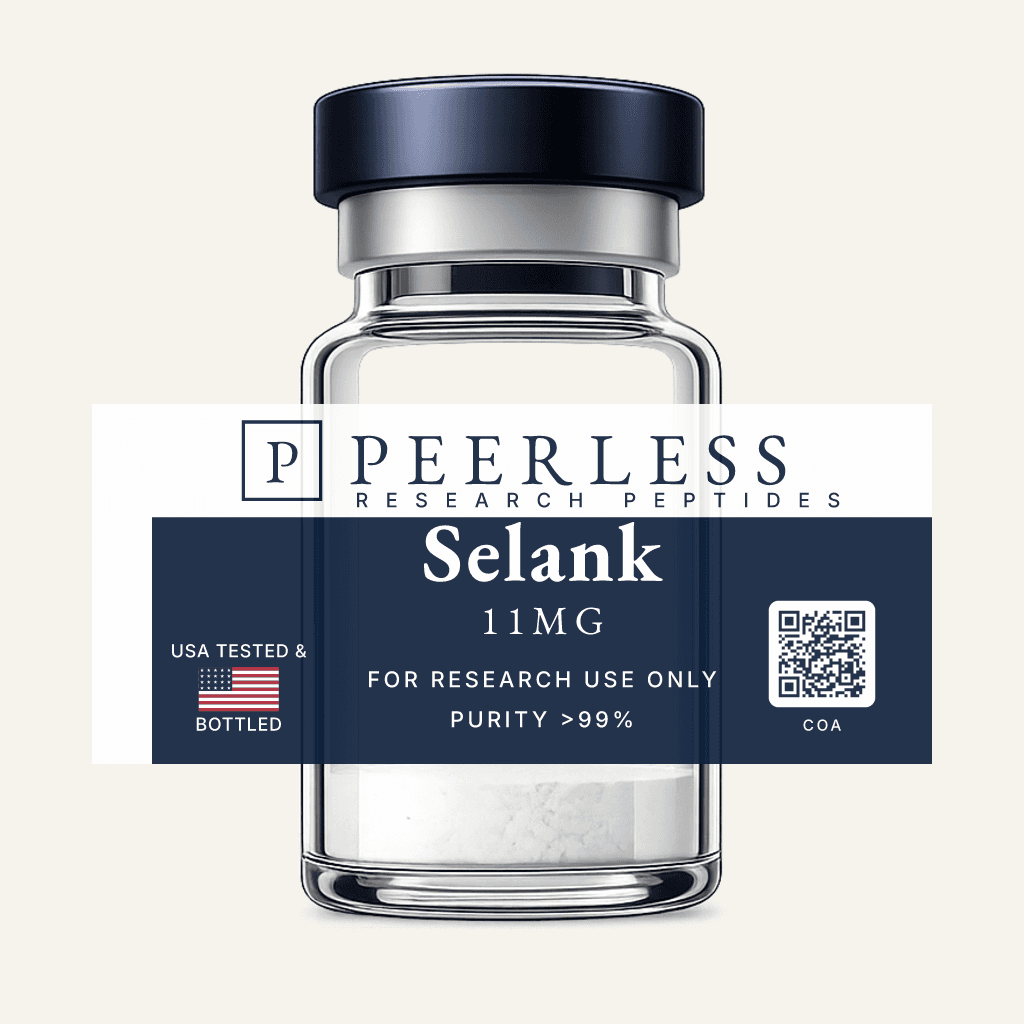
Quality Standards
American Owned
Mixed, bottled, and tested in the USA
Third-Party Tested
Independently tested for purity and quality
>99% Purity
Exceptional purity you can trust
Also Screened For
Endotoxins + Heavy Metals
Beyond the identity, purity & sterility panel.
Semax
Synthetic heptapeptide Met-Glu-His-Phe-Pro-Gly-Pro, ACTH(4-7) analog with C-terminal Pro-Gly-Pro extension more info
Available for laboratory research use only.
Quality Standards
American Owned
Mixed, bottled, and tested in the USA
Third-Party Tested
Independently tested for purity and quality
>99% Purity
Exceptional purity you can trust
Also Screened For
Endotoxins + Heavy Metals
Beyond the identity, purity & sterility panel.
Vial size
Choose your supply
3 vials· 33mg total
Save $4.35 (5% off)
Total
$82.56
Volume pricing applies to your total vials, not just this product. Mix or match any vials in your cart to reach the next tier.
Independent Lab Results
The most comprehensive testing panel in research peptide commerce. Every batch is independently verified by ILS Laboratories — an ISO/IEC 17025 and PJLA-accredited facility in San Diego, CA.
- Identity
- Purity (HPLC)
- Endotoxin (USP <85>)
- Sterility screen (PCR)
- Heavy metals (ICP-MS per USP <233>)
Biochemical Profile
- CAS Number
- 80714-61-0
- Molecular Formula
- C37H51N9O10S
- Molecular Weight
- 813.92 g/mol
- Purity
- >99% (HPLC-UV (214-220 nm) with LC-MS deconvolution for Met-oxidation satellite)
- PubChem CID
- 122178
- Amino Acid Sequence
- Met-Glu-His-Phe-Pro-Gly-Pro
Receptor Targets and Signaling Pathway Context
Semax has been characterized as a 7-amino-acid analog of the ACTH(4-7) behavioral fragment originally identified by De Wied at Utrecht in the 1960s-1970s. Truncation at residue 7 removes Arg-Trp-Gly (residues 8-10 of full ACTH), which the published literature has associated with the loss of MC2R and adrenal-axis engagement at research exposures. The molecule is therefore non-corticotropic by design, and the full POMC-axis biology of ACTH does not apply to the Semax fragment under conditions reported in the literature[1].
The best-characterized mechanistic axis is BDNF/TrkB upregulation. Dolotov and colleagues at IMG Moscow reported that a single intranasal microgram-per-kilogram dose (50 micrograms per kilogram body weight) was associated with approximately 1.4-fold hippocampal BDNF protein, 3-fold exon-III BDNF mRNA, 2-fold TrkB mRNA, and 1.6-fold TrkB phosphorylation in intact rat brains[2]. The same group reported a defined specific-binding site with KD approximately 2.4 nM in rat basal forebrain[3]. A separate replication by Shadrina and colleagues reported parallel transcriptional findings across hippocampus, cortex, and retina in rat preparations[4]. Independent non-Russian replication has been reported by the Engele laboratory at Saarland, Germany, in cultured rat hippocampal neurons[5].
The Pro-Gly-Pro (PGP) tripeptide metabolite has been reported to reproduce a meaningful fraction of the BDNF response independently of the parent heptapeptide, complicating attribution of mechanism to a single molecular species[2]. The PGP family of glyprolins has its own published preclinical literature in gastric and inflammatory preparations, and the PGP fragment is shared with the institutional sister molecule Selank.
Secondary mechanism axes reported in the literature include partial MC3/MC4 melanocortin engagement inherited from the ACTH(4-7) parent sequence (weak, lacking the full His-Phe-Arg-Trp MSH "message" sequence), enkephalinase inhibition[6], and monoaminergic (dopaminergic and serotonergic) turnover effects[7]. The Eremin work on monoaminergic turnover originates from the Zakusov Pharmacology Institute and is one of the few primary mechanism papers in the Semax corpus that is independent of the IMG Moscow research group.
Receptor-binding pharmacology in human tissue has not been characterized in the peer-reviewed literature. The mechanism story is multi-pathway, and the existing evidence base does not isolate a single high-affinity human target. No registered human pharmacokinetic study of subcutaneous injectable Semax has been published; all published pharmacokinetic data are from intranasal Russian preparations[8].
Research Applications
BDNF and Neurotrophic Factor Research
BDNF/TrkB upregulation is the load-bearing mechanism axis in the Semax literature. The Dolotov 2006 primary paper in Brain Research reported the 1.4-fold hippocampal BDNF protein, 3-fold exon-III BDNF mRNA, 2-fold TrkB mRNA, and 1.6-fold TrkB phosphorylation findings at a single intranasal microgram-per-kilogram dose (50 micrograms per kilogram body weight) in intact rat brains[2]. The companion 2006 J Neurochem paper from the same Dolotov-led team reported the specific binding site with KD approximately 2.4 nM in rat basal forebrain[3].
Shadrina and colleagues at IMG Moscow extended the transcriptional analysis across hippocampus, cortex, and retina in rat preparations[4]. The Engele laboratory at Saarland reported non-Russian independent replication in cultured rat hippocampal neurons, providing one of the few primary mechanism papers in the Russian-neuropeptide catalog with Western co-authorship[5]. Medvedeva and colleagues subsequently reported genome-wide microarray transcriptome data in rat middle cerebral artery occlusion preparations[9]; Filippenkov and colleagues reported a follow-on RNA-Seq characterization[10].
The BDNF/TrkB mechanism findings have been reported predominantly in rat preparations at intranasal exposures in the microgram-per-kilogram range. The published literature has not characterized BDNF/TrkB pharmacology in human tissue or in subcutaneous injectable exposures.
Cerebral Ischemia Research
Cerebral-ischemia research in rat middle cerebral artery occlusion (MCAO) preparations has been the most-published applied research area in the Semax literature, and is the disease area anchoring Russian Federation drug registration. The Gusev/Skvortsova/Myasoedov 1997 paper reported a comparison of n=30 acute hemispheric ischemic stroke patients receiving Semax against an n=80 historical control group[11]. The trial design was non-randomized, used a non-contemporaneous historical control, and was open-label; outcome measurement used Russian-standard scales (Barthel index, modified Rankin variants) rather than NIHSS as a primary endpoint.
Genome-wide microarray and RNA-Seq characterization of rat MCAO preparations with Semax administration have been reported by Medvedeva and colleagues[9] and Filippenkov and colleagues[10]. The reported transcriptional findings span hippocampal, cortical, and striatal tissue and have been interpreted as consistent with the BDNF/TrkB upregulation axis observed in non-injured rat brains.
The Western neuroprotectant clinical-development record contextualizes the Russian clinical evidence base. NXY-059 (SAINT-II Phase 3), citicoline (ICTUS Phase 3), tirilazad (RANTTAS), and lubeluzole have all reported negative Phase 3 efficacy outcomes in acute ischemic stroke. Edaravone is approved for stroke in Japan but FDA-approved only for ALS. The Western neuroprotectant graveyard defines the class base rate any Russian-origin CNS peptide inherits.
Monoaminergic and Behavioral Research
Monoaminergic-system research in rat brain preparations has been reported across the Semax literature, with the most-cited primary paper coming from outside the IMG Moscow research group. Eremin and colleagues at the Zakusov Pharmacology Institute reported dopaminergic and serotonergic turnover changes in rat brain preparations following intranasal Semax administration[7], one of the few primary mechanism papers in the corpus that is institutionally independent of IMG Moscow.
A separate line of work has examined operant and exploratory behavioral readouts in rat preparations. The Kaplan and colleagues 1996 paper reported behavioral observations in rats under intranasal Semax administration[12]. The 1996 paper is published in a Russian-edited journal and has limited indexing in Western databases.
The monoaminergic pharmacology has been interpreted as a contributory rather than dominant mechanism axis; the BDNF/TrkB story remains the load-bearing mechanism with the strongest reproducibility record. Whether monoaminergic and BDNF axes are independent or share an upstream regulatory node has not been resolved in the published literature.
Optic Nerve and Retinal Research
Optic-nerve and retinal preparations have been an applied research area in the Russian Semax literature, part of the disease-area history behind the 1994 Russian Ministry of Health drug registration. The retinal-tissue transcriptional response was characterized as part of the Shadrina hippocampus-cortex-retina analysis in rat preparations[4].
Clinical work in Russian ophthalmology has been published predominantly in the Russian-language journal corpus and is concentrated within the IMG Moscow and partnering clinical-research-center networks. Independent non-Russian replication of optic-nerve and retinal findings has not been reported in the Western peer-reviewed literature as of May 2026.
As with the cerebral-ischemia clinical record, the Russian ophthalmic clinical literature has used intranasal 0.1% drops at low microgram-range exposures. The route asymmetry between Russian intranasal clinical evidence and Western subcutaneous injectable RUO use is consistent across applied indications in the Semax corpus.
Chemistry and Stability Research
The published chemistry of Semax is dominated by the dominant degradation vector at the N-terminal methionine. Methionine-1 contains a solvent-exposed thioether susceptible to oxidation by atmospheric oxygen, light, copper(II), and peroxides accumulating in dimethyl sulfoxide cosolvent. The diagnostic mass-spectrometry handle is a +16 Da satellite to the parent molecular ion, identical to the handle used for TB-500 and MOTS-c, which share an N-terminal methionine[13].
A second +16 Da satellite can arise from histidine-3 2-oxo-histidine formation. Distinguishing methionine-1 oxidation from histidine-3 oxidation at the same nominal mass shift requires MS/MS site localization and is reported only on premium Certificates of Analysis. The histidine-3 residue also chelates copper(II), and copper contamination from reagents or vial stoppers has been associated with accelerated Fenton-type oxidation of the adjacent methionine[13].
The Gly-6-Pro-7 bond is a known diketopiperazine (DKP) cleavage site during solid-phase peptide synthesis; 2-chlorotrityl chloride (2-CTC) resin has been used to mitigate the DKP side reaction. Lyophilization under argon and storage in amber vials at -20°C with bromobutyl stopper material are the conditions most consistent with the published Met-oxidation literature.
Replication and Clinical Status
The IMG Moscow institutional concentration in the Semax corpus is approximately 70-85% first or senior authorship, tied with the institutional sister molecule Selank and second only to the Sikirić-Zagreb concentration in the BPC-157 corpus. Core IMG Moscow authors include Myasoedov, Ashmarin, Andreeva, Levitskaya, Limborska, Shadrina, Slominsky, and Dmitrieva; the Russian clinical anchor is the Gusev/Skvortsova collaboration at the Pirogov Russian National Research Medical University and the Research Center of Neurology. The Engele laboratory at Saarland is the most-cited non-Russian primary mechanism replication[5].
The Russian acute-ischemic-stroke trial methodology has been methodologically weaker than Western Phase 3 standards. The Gusev/Skvortsova 1997 anchor trial was non-randomized, used a non-contemporaneous historical control, was open-label, and reported outcomes on Russian-standard Barthel and modified Rankin scales rather than NIHSS as a primary endpoint[11]. No registered Phase 3 with international endpoints exists for Semax. Cerebrolysin, the closest Western-evaluated comparator in the Russian-origin neuropeptide CNS class, has accumulated 30 years of mixed trial outcomes; the 2023 Cochrane review concluded the evidence base was too heterogeneous to support guideline recommendation.
The Semax US regulatory posture as of May 2026: Semax was included in the April 22, 2026 FDA reclassification batch of 12 peptides removed from 503A Category 2. Semax is on the July 24, 2026 Pharmacy Compounding Advisory Committee Day 2 docket, with the verbatim docket text listing 'Semax (free base), Semax acetate' and proposed uses 'cerebral ischemia, migraine, and trigeminal neuralgia' (Federal Register doc 2026-07361)[14]. The Day 2 cohort comprises Emideltide/DSIP, Semax, and Epitalon, all of Russian origin. The Tailor Made Compounding 2020 federal plea agreement named Semax explicitly as one of 14 peptides subject to forfeiture; the December 2025 CBP Cincinnati interdiction of approximately 5,000 smuggled peptide units from China also named Semax explicitly[15]. No Semax-specific entry exists on ClinicalTrials.gov; the entire human evidence base is anchored in the Russian Ministry of Health registry and Russian Korsakov-Journal publication corpus.
Research Literature
Published literature reviews from the Peerless research desk that reference Semax.
June 12, 2026
Semax: A Literature Review of the Russian ACTH Analog
A seven-amino-acid fragment of ACTH that the West tried to turn into a drug for two decades and abandoned, kept alive by one Soviet laboratory and still sold in Russia. A literature review of the survivor of a dead pharmacology.
May 18, 2026
Selank vs Semax: Russian Heptapeptide Family Mechanism Comparison
Two seven-amino-acid Russian neuropeptides, one shared design template, two divergent regulatory fates. The Selank-vs-Semax comparison most vendor content gets wrong starts with naming the right lab.
Handling & Storage
- Storage (lyophilized)
- -20°C, dry, dark, argon-flushed amber vials, 18-24 months
- Storage (in solution)
- 2-8°C, use within 30 days
- Shelf Life
- 18-24 months lyophilized
Research References
- [1] Ashmarin IP, Nezavibatko VN, Myasoedov NF, et al. A nootropic adrenocorticotropin analog 4-10-MEHFPGP (semax). Zh Vyssh Nerv Deiat Im I P Pavlova. 1997;47(2):420-430. PMID:9181791
- [2] Dolotov OV, Karpenko EA, Inozemtseva LS, et al. Semax, an analog of ACTH(4-7), regulates expression of brain-derived neurotrophic factor and trkB in the hippocampus of rats. Brain Res. 2006;1117(1):54-60. doi:10.1016/j.brainres.2006.07.108PMID:16996037
- [3] Dolotov OV, Karpenko EA, Inozemtseva LS, et al. Semax binding to the receptor for the ACTH(4-10) fragment in the rat basal forebrain. J Neurochem. 2006;97 Suppl 1:82-86. doi:10.1111/j.1471-4159.2006.03658.xPMID:16635254
- [4] Shadrina MI, Dolotov OV, Grivennikov IA, et al. Rapid induction of neurotrophin mRNAs in rat glial cell cultures by Semax, an adrenocorticotropic hormone analog. Neurosci Lett. 2001;308(2):115-118. doi:10.1016/s0304-3940(01)01994-2PMID:11457573
- [5] Agapova TY, Agniullin YV, Shadrina MI, Shram SI, Slominsky PA, Lymborska SA, Myasoedov NF. Neurotrophin gene expression in rat brain under the action of Semax, an analogue of ACTH 4-10. Neurosci Lett. 2007;417(2):201-205. doi:10.1016/j.neulet.2007.02.039PMID:17350758
- [6] Kost NV, Sokolov OY, Gabaeva MV, Grivennikov IA, Andreeva LA, Myasoedov NF, Zozulya AA. Semax and selank inhibit the enkephalin-degrading enzymes from human serum. Bioorg Khim. 2001;27(3):180-183. PMID:11443939
- [7] Eremin KO, Kudrin VS, Saransaari P, Oja SS, Grivennikov IA, Myasoedov NF, Rayevsky KS. Semax, an ACTH(4-10) analogue with nootropic properties, activates dopaminergic and serotoninergic brain systems in rats. Neurochem Res. 2005;30(12):1493-1500. doi:10.1007/s11064-005-8826-8PMID:16362768
- [8] Potaman VN, Antonova LV, Dubynin VA, Zaitzev DA, Kamensky AA, Myasoedov NF, Nezavibatko VN. Entry of the synthetic ACTH(4-10) analogue into the rat brain following intravenous injection. Neurosci Lett. 1991;127(1):133-136. doi:10.1016/0304-3940(91)90912-dPMID:1652720
- [9] Medvedeva EV, Dmitrieva VG, Povarova OV, Limborska SA, Skvortsova VI, Myasoedov NF, Dergunova LV. Effect of Semax and its C-terminal fragment Pro-Gly-Pro on the expression of VEGF family genes and their receptors in experimental focal ischemia of the rat brain. J Mol Neurosci. 2014;52(1):105-115. doi:10.1007/s12031-013-0151-0PMID:24661604
- [10] Filippenkov IB, Stavchansky VV, Denisova AE, Yuzhakov VV, Sevan'kaeva LE, Sudarkina OY, Dmitrieva VG, Gubsky LV, Myasoedov NF, Limborska SA, Dergunova LV. Novel insights into the protective properties of ACTH(4-7)PGP (Semax) peptide at the transcriptome level following cerebral ischaemia-reperfusion in rats. Genes (Basel). 2020;11(6):681. doi:10.3390/genes11060681PMID:32580371
- [11] Gusev EI, Skvortsova VI, Miasoedov NF, Nezavibat'ko VN, Zhuravleva EIu, Vanichkin AV. Effectiveness of semax in acute period of hemispheric ischemic stroke (a clinical and electrophysiological study). Zh Nevrol Psikhiatr Im S S Korsakova. 1997;97(6):26-34. PMID:9304488
- [12] Kaplan AY, Kochetova AG, Nezavibathko VN, Rjasina TV, Ashmarin IP. Synthetic ACTH analogue Semax displays nootropic-like activity in humans. Neurosci Res Commun. 1996;19(2):115-123.
- [13] Manning MC, Chou DK, Murphy BM, Payne RW, Katayama DS. Stability of protein pharmaceuticals: an update. Pharm Res. 2010;27(4):544-575. doi:10.1007/s11095-009-0045-6PMID:20143256
- [14] U.S. Food and Drug Administration. Pharmacy Compounding Advisory Committee Meeting Announcement: July 23-24, 2026. Federal Register doc 2026-07361; written-comment docket FDA-2025-N-6895; meeting-establishment docket FDA-2026-N-2979. Day 2 (July 24, 2026) agenda includes Semax (free base) and Semax acetate, proposed uses: cerebral ischemia, migraine, and trigeminal neuralgia.
- [15] United States v. Tailor Made Compounding LLC, et al. Plea agreement and forfeiture, U.S. District Court, Eastern District of Kentucky, 2020. Named Semax among 14 peptides subject to $1.79M forfeiture. Independently, U.S. Customs and Border Protection Cincinnati seizure announcement, December 2025: interdiction of approximately 5,000 peptide units smuggled from China; manifest named Semax.
Scientific Journal Author
Nikolai F. Myasoedov, PhD, Academician of the Russian Academy of Sciences
Institute of Molecular Genetics, Russian Academy of Sciences, Moscow
Landmark Publications
- Ashmarin IP, Nezavibatko VN, Myasoedov NF, et al. A nootropic adrenocorticotropin analog 4-10-MEHFPGP (Semax). Zh Vyssh Nerv Deiat Im I P Pavlova. 1997;47(2):420-430. (PMID 9181791)
- Dolotov OV, Karpenko EA, Inozemtseva LS, et al. Semax, an analog of ACTH(4-7), regulates expression of BDNF and trkB in CNS of rats. Brain Res. 2006;1117(1):54-60. (PMID 16996037)
- Gusev EI, Skvortsova VI, Miasoedov NF, et al. Effectiveness of Semax in acute period of hemispheric ischemic stroke. Zh Nevrol Psikhiatr Im S S Korsakova. 1997;97(6):26-34. (PMID 9304488)
Dr. Myasoedov is independently cited here as a co-originator of Semax at the Institute of Molecular Genetics, Russian Academy of Sciences, alongside Academician Ivan P. Ashmarin (deceased 2007). There is no affiliation or commercial relationship between Dr. Myasoedov, the Institute of Molecular Genetics, the Russian Academy of Sciences, and Peerless Peptides.
Related Research Compounds
Other compounds in the russian neuropeptides research class.