
Peerless Research·thymosin-alpha-1
Thymosin Alpha-1: A Literature Review of the Immunomodulatory Peptide
Thymosin Alpha-1 (thymalfasin) is approved in roughly 36 countries but not by the FDA, and its confirmatory trials have missed. A cited review.
Thymosin Alpha-1 is the only peptide in this catalog that a government has ever approved as a drug. It has been sold as thymalfasin since the mid-1990s, in something like thirty-six countries, mostly for chronic hepatitis B.
It is also not approved by the US Food and Drug Administration, the European Medicines Agency, or any other regulator usually considered stringent, and the gap between those two facts is the whole story.
The unusual thing about this molecule is that its problem is not the mechanism. The mechanism is real, well mapped, and independently confirmed. The problem is that the confirmatory trials, the large ones designed to settle the question, have missed. This review separates the international approval record from the regulatory absences, follows the clinical evidence to its actual endpoints, and traces a research lineage that connects this peptide to another in the catalog.
Research content. The article below summarizes published preclinical, mechanistic, and clinical research literature on Thymosin Alpha-1 (thymalfasin, marketed internationally as thymalfasin). The compound is sold by Peerless Peptides for laboratory research use only and is not approved by the FDA for human or veterinary administration.
Last reviewed: June 11, 2026 by Peerless Research.
Summary
Thymosin Alpha-1 is a synthetic 28-amino-acid peptide, an acetylated copy of a fragment of the nuclear protein prothymosin alpha. It is the most studied molecule in this catalog, with a published literature in the low thousands of papers and an unusually healthy spread of authorship. Its mechanism, engagement of Toll-like receptors 2 and 9 on dendritic cells, is genetically confirmed and independently replicated, which sets it apart from peptides whose mechanisms rest on a single laboratory's inference.
The clinical and regulatory record is where the caution lives. Marketed as thymalfasin, the peptide is approved in roughly thirty to thirty-seven countries, but not by the FDA, the EMA, the UK, Japan, Canada, or Australia, the regulators usually treated as most rigorous. Its sponsor did run formal United States trials, and they failed: two Phase 3 hepatitis C trials missed their endpoint in the 2000s, and a large confirmatory sepsis trial missed in 2025. The honest reading is a well-understood molecule with a wide but selective approval footprint and a confirmatory trial record that has not closed.
Note: the research described below was conducted in cell systems, animal models, and human clinical trials of the marketed drug product. The compound is sold here for laboratory research use only, and nothing below is a statement about its use. This article is a literature review, not a recommendation of use.
Identity and Chemistry: A Fragment of a Nuclear Protein
Thymosin Alpha-1 is a linear 28-residue peptide, acetylated at its N-terminus, with the sequence Ac-Ser-Asp-Ala-Ala-Val-Asp-Thr-Ser-Ser-Glu-Ile-Thr-Thr-Lys-Asp-Leu-Lys-Glu-Lys-Lys-Glu-Val-Glu-Glu-Ala-Glu-Asn (Ac-SDAAVDTSSEITTKDLKEKKEVEEEAEN). Its molecular formula is C₁₂₉H₂₁₅N₃₃O₅₅, molecular weight about 3,108 daltons, CAS number 62304-98-7, PubChem CID 16130571, and its international nonproprietary name is thymalfasin. Full identifiers and per-batch certificates are on the Thymosin Alpha-1 product page.
One sequence detail is worth flagging because commercial sources get it wrong: the correct C-terminal run is Glu-Glu-Glu (…EVEEEAEN), not the Val-Glu-Glu rendering (…EVVEEAEN) that circulates in some vendor and secondary listings. A certificate of analysis should be checked against the canonical sequence.
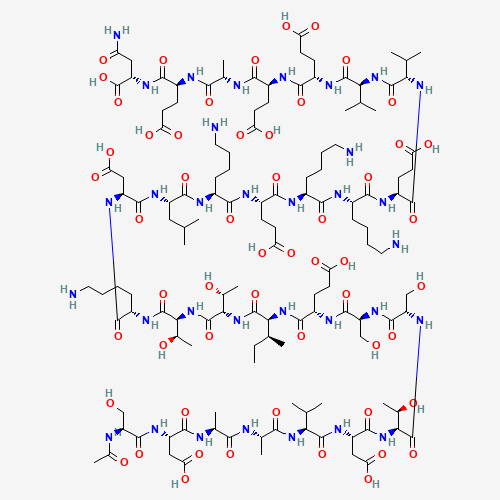
The provenance is the cleanest in this catalog. Thymosin Alpha-1 is not a designed analog or a peptide of uncertain origin; it corresponds to residues 2 to 29 of prothymosin alpha, a 109-amino-acid nuclear protein encoded by the PTMA gene (UniProt P06454). The parent protein is involved in chromatin remodeling and cell survival, and during cellular stress the enzyme caspase-3 cleaves it to release the Thymosin Alpha-1 fragment, which then acts outside the cell as a signaling peptide. Where some research peptides have a parent protein that was never sequenced, this one is a defined fragment of a well-characterized human protein.
The peptide was isolated and sequenced by Allan Goldstein and colleagues in 1977[1], from a crude thymic preparation first described in the early 1970s. That detail matters later, because the same researcher sequenced a second peptide in this catalog four years afterward.
Chemically, Thymosin Alpha-1 contains no aromatic residues, so a valid purity reading is taken by HPLC at 214 to 220 nanometers, not 280. Its analytical weak points are well defined and, for anyone reading a certificate of analysis, worth knowing. The peptide carries four aspartate residues, each a potential aspartimide site, with the aspartate-threonine motif near the N-terminus the most reactive; aspartimide rearrangement produces isomers that share the parent mass and can hide inside the main HPLC peak.
The dominant degradation pathway, though, is deamidation at the C-terminal asparagine, which converts it to aspartate or an iso-aspartate form and adds a single mass unit. That change is invisible to a single-wavelength purity reading, and published impurity profiles attribute the majority of vendor-material impurities to it. A batch can therefore read as highly pure parent peptide on a routine certificate and still carry a substantial deamidated fraction. High-resolution mass analysis that resolves the one-dalton shift is the diagnostic that actually matters for this molecule, and a certificate that quantifies the deamidated isoform is testing for the right failure mode rather than the convenient one.
Mechanism: The Best-Characterized in the Catalog
Most research peptides reach the market on a mechanism inferred from a handful of papers. Thymosin Alpha-1 is the exception, and the difference is instructive.
The core finding is that Thymosin Alpha-1 engages Toll-like receptors, the pattern-recognition receptors of the innate immune system. The landmark paper, from an Italian group led by Luigina Romani and working independently of the peptide's discoverer, reported that Thymosin Alpha-1 activated dendritic cells through Toll-like receptor signaling, biasing them toward a Th1 program[3].
A follow-up from the same group described a second, opposite arm: through a separate dendritic-cell population, the peptide induced the enzyme indoleamine 2,3-dioxygenase and a regulatory, tolerogenic response[4]. The authors called the molecule a "regulator of regulators," because it appeared to push the immune system toward activation and toward tolerance at once. A third study mapped a Toll-like receptor 9 pathway driving a type-I interferon response[5].
Two features make this body of work stronger than the catalog norm. First, the central pathways were confirmed genetically, in mice lacking the relevant receptors or the shared adaptor protein, rather than by inference from a downstream readout. Second, the mechanism program was carried by laboratories independent of the discoverer; the discoverer is not an author on the landmark paper. The published corpus runs to the low thousands of papers with the discoverer credited on a minority of them, a healthier distribution than the single-laboratory concentrations seen elsewhere in this category.
Much of the modern mechanistic work came from an Italian academic consortium centered at Perugia and Rome, which extended the Toll-like-receptor account across antifungal, antiviral, and tolerance-related settings over two decades. That independent program is the reason the mechanism can be described with more confidence than the molecule's clinical effect.
The receptor class itself is, separately, a validated drug target, which sharpens rather than rescues the picture. Agonists of the same Toll-like receptor family appear in approved products: a hepatitis B vaccine adjuvanted with a Toll-like receptor 9 agonist was approved in the United States in 2017, and the Toll-like receptor 7 agonist imiquimod has been a topical drug for decades. The pathway Thymosin Alpha-1 engages is real, druggable, and already exploited by approved medicines. That makes the molecule's own failure to convert in confirmatory trials harder, not easier, to blame on the biology.
The point of this section is not that a strong mechanism implies a useful drug. It is the opposite. Thymosin Alpha-1 is the cleanest available demonstration that a well-mapped, independently confirmed mechanism can sit atop a clinical record that has not converted.
Clinical Evidence: Approved Abroad, Missed at Home
The clinical picture has two halves that are easy to conflate and important to keep apart: an older body of international evidence that supports the foreign approvals, and a more recent body of rigorous trials that have missed.
The international approvals rest largely on chronic hepatitis B. A multicenter Phase 3 trial published in 1999 reported a benefit for Thymosin Alpha-1 in chronic hepatitis B[6], and that evidence, with supporting meta-analyses, anchored the thymalfasin registrations across Asia, Latin America, and parts of Europe. The qualification is chronological: this work predates the modern hepatitis B nucleoside and nucleotide analogs and the direct-acting antivirals that reshaped hepatitis C treatment. Measured against the current standard of care, the hepatitis evidence is dated, and the hepatitis C rationale in particular has been overtaken by drugs with sustained virologic response rates above ninety percent.
The more telling evidence is in sepsis, because it is recent and well powered. A Phase 2 trial published in 2013 enrolled 361 patients and reported a reduction in mortality that pointed in a favorable direction but did not reach statistical significance[7]. That signal justified a confirmatory trial, and the confirmatory trial is the one that matters: published in 2025, it enrolled 1,089 patients and missed its primary endpoint of 28-day mortality outright, with a hazard ratio of 0.99 and a p-value of 0.93[8]. A result that close to no effect, at that sample size, is a clear negative.
Across its full history the molecule has accumulated one of the larger clinical-trial footprints of any peptide in this category, on the order of fifty registered studies spanning hepatitis B and C, cancer as a chemotherapy adjunct, sepsis, and, more recently, COVID-19. Breadth is not depth, however, and the pattern that emerges from the well-controlled trials is more uniform than the range of indications suggests.
The United States record is the part that distinguishes Thymosin Alpha-1 from every other peptide here. Most research peptides can say no sponsor ever ran a serious United States program. This one cannot. Its sponsor ran two Phase 3 hepatitis C trials in 2007 and 2008; both missed the primary endpoint of sustained virologic response, and the sponsor discontinued United States development.
A separate observational and trial literature in COVID-19 accumulated during 2020 to 2022 and resolved to nothing: a pooled analysis found no mortality benefit. The pattern across indications is consistent. Where the trials were adequately powered and confirmatory, they missed.
The Goldstein Continuity, and Why It Is Not a Pairing
The 1977 sequencing date connects this molecule to another in the catalog, and the connection is worth stating precisely because it is so easily misused.
Allan Goldstein, who sequenced Thymosin Alpha-1 in 1977, also sequenced thymosin beta-4 in 1981, at the same university[2]. Thymosin beta-4 is the parent of the research compound TB-500. The commercial vehicle Goldstein founded in 1982 to develop Thymosin Alpha-1 was later renamed and pivoted to develop the beta-4 molecule instead, so a single corporate lineage runs underneath both peptides. Two of the molecules in this catalog trace to one researcher's fifty-year program, and naming that lineage is simply accurate history.
What the shared name does not establish is any relationship of use. Thymosin Alpha-1 and thymosin beta-4 are different molecules: 28 residues versus 43, an immunomodulatory Toll-like-receptor mechanism versus intracellular actin sequestration, a wide foreign approval record versus a uniformly negative one. They are siblings by nomenclature and by the history of one laboratory, not by chemistry or function. The common assumption that two "thymosins" belong together as a combination is a naming artifact, and the published literature provides no basis for treating them as a pair.
Research Limitations
Several limitations frame how the Thymosin Alpha-1 evidence should be weighted.
The first is the country-count problem. The line that the molecule is "approved in dozens of countries" is true and, on its own, misleading. The set of approving jurisdictions and the set of absent ones are both informative, and the absent set, the FDA, the EMA, the UK, Japan, Canada, and Australia, is precisely the group of regulators usually treated as most demanding. A count of approvals is not a regulatory verdict, and an honest account names both lists.
The second is the confirmatory-trial record. The international approvals lean on older evidence; the modern, adequately powered trials, two Phase 3 hepatitis C studies and a large Phase 3 sepsis study, missed their primary endpoints. The molecule cannot use the defense, available to most research peptides, that it was never properly tested. It was tested, and the confirmatory results are negative.
The third is the gap between mechanism and outcome. This is the molecule's distinctive lesson. The receptor biology is genuinely well established and independently confirmed, and it has still not produced a positive confirmatory clinical result. Mechanistic strength is not evidence of clinical effect, and Thymosin Alpha-1 is the catalog's clearest example of the distance between the two.
The fourth is the dating of the supporting indications. Hepatitis C has been reshaped by direct-acting antivirals; hepatitis B by modern nucleoside and nucleotide analogs; the COVID-19 literature resolved to a null. The indications that built the international approval footprint are, in 2026, substantially historical.
None of this bears on the chemistry of the peptide itself, which is well defined. The limitations describe the strength of the human evidence and the meaning of the approval record, both of which run weaker than the headline "approved in dozens of countries" suggests.
Regulatory Context
As of June 2026, no Thymosin Alpha-1 product is approved by the FDA for any indication. The molecule's regulatory position is genuinely unusual, so the details matter.
Internationally, it is approved as thymalfasin in roughly thirty to thirty-seven countries, first in China in 1995, which remains its largest market by a wide margin, and subsequently across much of Asia, Latin America, the Middle East, Eastern Europe, and, in Western Europe, Italy, where it has been marketed since 2000. The approved indications vary by market and include chronic hepatitis B, adjunctive use alongside chemotherapy, and, in some registrations, sepsis and use as a vaccine adjuvant in immunocompromised or elderly populations. Those are real marketing authorizations. At the same time it is not approved by the FDA, the European Medicines Agency, the UK MHRA, Japan's PMDA, Health Canada, Australia's TGA, or Swissmedic. In the United States the molecule has received several orphan-drug designations over the years, including for melanoma and hepatocellular carcinoma, but a designation is an incentive status rather than an approval, and none converted to one.
Within the United States compounding framework, Thymosin Alpha-1 followed a different path from the tissue-repair peptides. It was placed on the 503A Category 2 list in 2023 and removed in September 2024 when the nominators withdrew, and then the Pharmacy Compounding Advisory Committee voted against adding it to the compounding list on December 4, 2024. That makes its status adjudicated rather than pending: unlike the peptides on the July 2026 advisory-committee docket, the compounding question for Thymosin Alpha-1 has already been answered in the negative. The basis for the vote is worth noting, because it was not a finding of clinical harm. The agency's own briefing acknowledged the absence of significant adverse events attributable to the peptide in the populations where it is approved; the concerns it raised were about the immunogenicity and impurity profile of compounded material specifically. The mechanics of these categories are explained in our 503A vs 503B compounding primer. Removal from a do-not-compound list is not an approval, and a committee vote against listing is the opposite of one.
In sport, Thymosin Alpha-1 occupies a quieter position than its catalog neighbors. It is not specifically named on the World Anti-Doping Agency Prohibited List, where the actin-binding thymosin beta-4 and the growth-hormone secretagogues are named explicitly. Finally, the commercial center of the molecule has shifted decisively east. Its longtime sponsor, SciClone, was a United-States-listed company for most of its history; a China-led investor consortium took it private in 2017 in a deal valued at around six hundred million dollars, and the successor entity relisted on the Hong Kong Stock Exchange in 2021. The bulk of thymalfasin's sales are now in China, and the molecule the United States research market sells is the same chemical entity whose commercial story moved overseas.
References
-
Goldstein AL, Low TLK, McAdoo M, et al. Thymosin alpha1: isolation and sequence analysis of an immunologically active thymic polypeptide. Proc Natl Acad Sci USA. 1977;74(2):725-729. PMID: 265536.
-
Low TLK, Hu SK, Goldstein AL. Complete amino acid sequence of bovine thymosin β4. Proc Natl Acad Sci USA. 1981;78(2):1162-1166. PMID: 6940133.
-
Romani L, Bistoni F, Gaziano R, et al. Thymosin alpha1 activates dendritic cells for antifungal Th1 resistance through Toll-like receptor signaling. Blood. 2004;103(11):4232-4239. PMID: 14982877.
-
Romani L, Bistoni F, Perruccio K, et al. Thymosin alpha1 activates dendritic cell tryptophan catabolism and establishes a regulatory environment for balance of inflammation and tolerance. Blood. 2006;108(7):2265-2274. PMID: 16741252.
-
Bozza S, Gaziano R, Bonifazi P, et al. Thymosin alpha1 activates the TLR9/MyD88/IRF7-dependent pathway and induces type-I interferon responses. Int Immunol. 2007;19(11):1261-1270. PMID: 17804687.
-
Mutchnick MG, Lindsay KL, Schiff ER, et al. Thymosin alpha1 treatment of chronic hepatitis B: results of a phase III multicentre, randomized, double-blind and placebo-controlled study. J Viral Hepat. 1999;6(5):397-403. PMID: 10607256.
-
Wu J, Zhou L, Liu J, et al. The efficacy of thymosin alpha 1 for severe sepsis (ETASS): a multicenter, single-blind, randomized and controlled trial. Crit Care. 2013;17(1):R8. PMID: 23327199.
-
Multicentre randomized double-blind placebo-controlled trial of thymosin alpha 1 in patients with severe sepsis (TESTS). BMJ. 2025. PMID: 39814420.
Not intended to diagnose, treat, cure, mitigate, or prevent any disease. Sold for research, laboratory, or analytical purposes only.
Research Compounds Referenced
The compounds discussed in this article are sold by Peerless Peptides for laboratory research use only. They are not FDA-approved for human or veterinary administration. Per-batch Certificates of Analysis are available.
- Thymosin Alpha-1: 28-amino-acid N-acetylated synthetic peptide derived from prothymosin alpha (UniProt P06454).PDP entry →
Frequently Asked Questions
- What is Thymosin Alpha-1?
- Thymosin Alpha-1 (also called thymalfasin) is a synthetic 28-amino-acid peptide, an acetylated copy of a fragment of the human nuclear protein prothymosin alpha that is released during cellular stress. It is classed as an immunomodulatory peptide and acts on Toll-like receptors. Marketed internationally as thymalfasin, it is the most extensively studied peptide in this catalog. It is sold by Peerless Peptides for laboratory research use only and is not approved by the FDA for human or veterinary use.
- Is Thymosin Alpha-1 FDA approved?
- No. Thymosin Alpha-1 is approved as a drug, under the generic name thymalfasin, in roughly thirty to thirty-seven countries, including China, Italy, Russia, and much of Asia, Latin America, and the Middle East, primarily for chronic hepatitis B. It is not approved by the US FDA, nor by the European Medicines Agency, the UK MHRA, Japan's PMDA, Health Canada, or Australia's TGA. A country count is not a regulatory verdict, and the regulators usually considered most stringent are the ones absent from the approval list. It is sold here for laboratory research use only.
- How is Thymosin Alpha-1 different from Thymosin Beta-4?
- They share a name root and almost nothing else. Thymosin Alpha-1 is a 28-amino-acid immunomodulatory peptide that acts on Toll-like receptors; thymosin beta-4 is a 43-amino-acid actin-sequestering protein, the parent of TB-500. The connection is historical: the same researcher, Allan Goldstein, sequenced Thymosin Alpha-1 in 1977 and thymosin beta-4 in 1981. Their sequences, mechanisms, and regulatory records are different, and the shared 'thymosin' name does not make them a related pair of compounds.
- What did the clinical trials on Thymosin Alpha-1 show?
- The international hepatitis B approvals rest on trials from the 1990s that preceded the modern antiviral era. In the United States, the sponsor ran two Phase 3 hepatitis C trials in 2007 and 2008; both missed their primary endpoint, and US development was discontinued. In sepsis, a 2013 Phase 2 trial reported a directionally favorable but non-significant result, and the larger confirmatory Phase 3 trial published in 2025 (n=1,089) missed its 28-day mortality endpoint. Every adequately powered confirmatory Phase 3 trial has missed its pre-specified primary endpoint.
- What does the research on Thymosin Alpha-1 show?
- The mechanism is the best characterized of any peptide in this catalog: Thymosin Alpha-1 engages Toll-like receptors 2 and 9 on dendritic cells, an effect confirmed in knockout-mouse models and reproduced by laboratories independent of the original discoverer. What the mechanism has not delivered is a confirmatory clinical result; the molecule is approved abroad on older evidence while its modern Phase 3 trials have missed. The research picture is a well-understood mechanism attached to an unconvincing late-stage trial record.