
Quality Standards
American Owned
Mixed, bottled, and tested in the USA
Third-Party Tested
Independently tested for purity and quality
>99% Purity
Exceptional purity you can trust
Also Screened For
Endotoxins + Heavy Metals
Beyond the identity, purity & sterility panel.
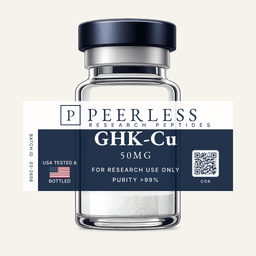
GHK-Cu
Glycyl-L-histidyl-L-lysine copper(II) complex, ATCUN-motif tripeptide more info
Available for laboratory research use only.
Quality Standards
American Owned
Mixed, bottled, and tested in the USA
Third-Party Tested
Independently tested for purity and quality
>99% Purity
Exceptional purity you can trust
Also Screened For
Endotoxins + Heavy Metals
Beyond the identity, purity & sterility panel.
Vial size
Choose your supply
3 vials· 150mg total
Save $7.50 (5% off)
Total
$142.50
Volume pricing applies to your total vials, not just this product. Mix or match any vials in your cart to reach the next tier.
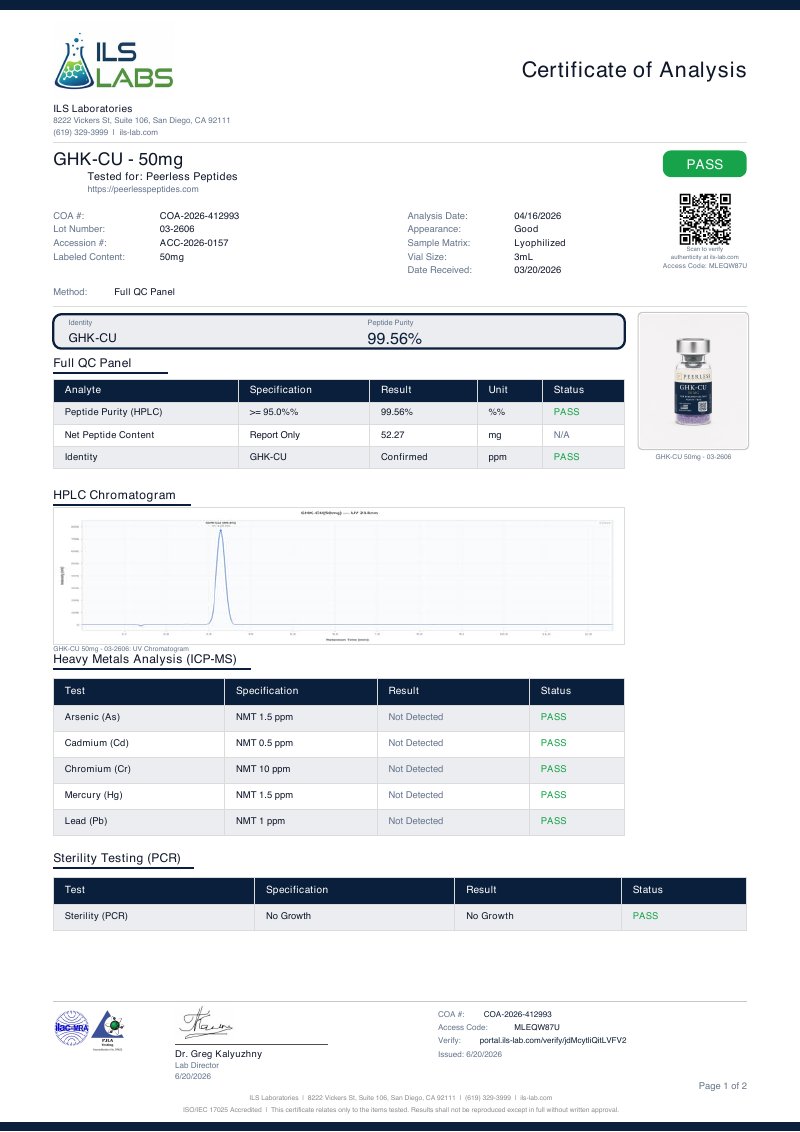
Independent Lab Results
The most comprehensive testing panel in research peptide commerce. Every batch is independently verified by ILS Laboratories — an ISO/IEC 17025 and PJLA-accredited facility in San Diego, CA.
- Identity
- Purity (HPLC)
- Endotoxin (USP <85>)
- Sterility screen (PCR)
- Heavy metals (ICP-MS per USP <233>)
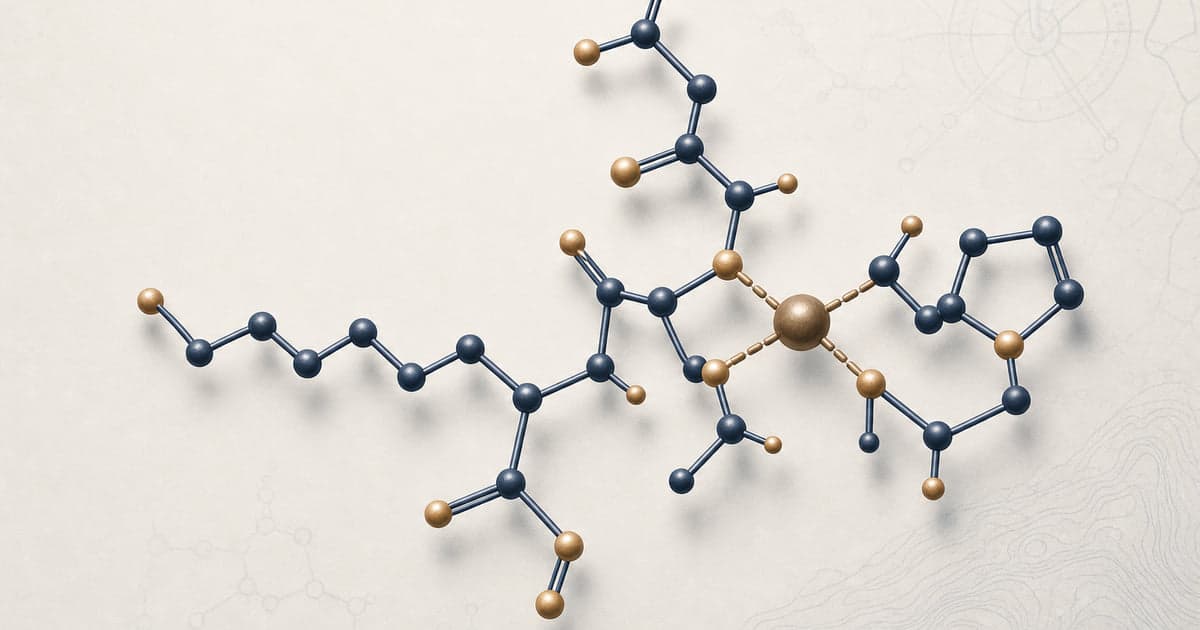
Biochemical Profile
- CAS Number
- 89030-95-5
- Molecular Formula
- C14H22CuN6O4
- Molecular Weight
- 402.9 g/mol
- Purity
- >99% (RP-HPLC at 220 nm and 280 nm; ICP-MS Cu content)
- PubChem CID
- 378611
- Amino Acid Sequence
- Gly-His-Lys (1:1 Cu(II) coordination complex)
Copper Coordination Chemistry and Signaling Pathway Context
GHK-Cu presents an ATCUN-style (amino-terminal Cu(II)/Ni(II) binding) coordination site. Three nitrogen donors (the N-terminal alpha-amine of glycine-1, the deprotonated backbone amide nitrogen of the Gly-His peptide bond, and the imidazole N-delta of histidine-2) occupy a distorted square-planar geometry with an equatorial water or apical lysine-3 carboxylate as the fourth ligand. Reported log K values of approximately 16.44 at physiological pH place GHK among the strongest Cu(II) chelators of any short peptide and are sufficient for the tripeptide to extract Cu(II) from the N-terminal binding site of serum albumin in vitro[1].
The coordination geometry damps Cu(II)/Cu(I) redox cycling, which has been associated in physical-chemistry studies with suppression of Fenton-type hydroxyl-radical chemistry that free Cu(II) would otherwise catalyze[2]. This is the chemical basis for the framing of GHK-Cu as a redox-buffered copper carrier. Direct biochemical demonstrations of Cu transfer from GHK to specific apo-cuproenzymes (lysyl oxidase, Cu/Zn superoxide dismutase, cytochrome c oxidase) inside cells have not been established by stopped-flow or Cu-isotope tracer methods in the indexed primary literature.
In fibroblast culture, the Reims group at Faculté de Médecine (Maquart, Borel, Siméon, Wegrowski, Hornebeck) reported observations on collagen synthesis with peak responses near 10^-9 M and onset near 10^-12 to 10^-11 M[3]. This corpus is the strongest non-Pickart mechanism literature on GHK-Cu and identified the GHK triplet within the alpha-2(I) chain of collagen, supporting a model in which protease activity at sites of tissue injury liberates GHK from internal collagen sequences in situ. Subsequent Reims-group reports characterized observations on matrix metalloproteinase-2 expression by dermal fibroblasts in vitro and on dermatan sulfate, chondroitin sulfate, and decorin modulation in rat wound chambers[4][5].
GHK is not encoded as a stand-alone gene. The Gly-His-Lys triplet appears as an internal motif in albumin (UniProt P02768), collagen alpha-2(I) chain (P08123), SPARC/osteonectin (P09486), and thrombospondin-1 (P07996). Plasma concentration was reported by Pickart-era measurements as approximately 200 ng/mL at age 20 and approximately 80 ng/mL by age 60, although no independent modern replication of these figures has been located.
The receptor-binding profile of GHK-Cu has not been characterized in any human tissue by direct pharmacology. No specific high-affinity receptor has been identified in the indexed peer-reviewed literature. No published pharmacokinetic study of subcutaneous GHK-Cu in any species has been located. As of May 2026, the only registered drug-development trial of GHK-Cu in the indexed registry is NCT07437586 (CuHeal, Hudson Biotech, Phase 2 topical gel for acute skin wound re-epithelialization), the first credible drug-development pathway entry GHK-Cu has seen since the failed 1994 Phase III Iamin program[6].
Research Applications
Topical Cosmetic and Wound Research
Topical-route evidence is the strongest column in the GHK-Cu literature and is structurally distinct from the in vitro and rodent injection work. The Mulder et al. 1994 multicenter randomized vehicle-controlled trial of topical Iamin Gel (GHK-Cu) in diabetic neuropathic plantar ulcers reported a median area-closure rate of 98.5% in the GHK-Cu arm compared with 60.8% in the vehicle arm, with ulcer infection rates of 7% versus 34%[7]. The trial was evaluator-blinded and industry-sponsored by ProCyte Corporation.
A conference abstract from Leyden et al. presented at the American Academy of Dermatology 60th Annual Meeting in February 2002 reported observations from a 12-week vehicle-controlled split-face study in 71 women with photoaging, including changes in skin density and fine-line measurement versus vehicle[8]. This trial was never published in a peer-reviewed journal and is cited in marketing copy more often than methodological scrutiny would warrant.
Miller et al. (2006) provides a clean methodological counterweight in the indexed literature. A split-face study in 25 patients after CO2-laser facial resurfacing reported no statistically significant benefit in blinded objective measures of erythema resolution, wrinkle measurement, or overall skin-quality scoring at any timepoint, while patient-satisfaction scores were higher in the GHK-Cu arm[9]. Honest editorial framing of the topical-route dossier requires both Mulder 1994 and Miller 2006 to be cited.
Extracellular Matrix and Fibroblast Research
The Reims group at Faculté de Médecine (CNRS URA 84) authored the strongest non-Pickart mechanism corpus on GHK-Cu, beginning with Maquart, Pickart, Laurent, Gillery, Monboisse, and Borel in FEBS Letters in 1988, which reported observations on collagen synthesis in dermal fibroblast culture with onset near 10^-12 to 10^-11 M and peak response near 10^-9 M[3]. The same paper identified the GHK triplet within the alpha-2(I) chain of human type I collagen, supporting the model that proteolytic activity at sites of tissue injury liberates GHK in situ.
Subsequent work from the same group examined matrix metalloproteinase-2 expression by cultured dermal fibroblasts, with the copper requirement explicitly demonstrated by Cu-depletion controls[4]. A separate report from Siméon, Wegrowski, Bontemps, and Maquart in the Journal of Investigative Dermatology characterized observations on dermatan sulfate, chondroitin sulfate, and decorin modulation in rat wound-chamber preparations[5].
The Reims-group corpus stands out for two reasons. First, it constitutes an independent (non-Pickart) mechanism literature on a peptide whose marketing literature is otherwise heavily Pickart-authored. Second, it operates at picomolar to nanomolar in vitro concentrations far below the micromolar doses used in the Pickart 2014 cMap reanalysis discussed in the Replication & Status section.
Hair Follicle and Cosmetic-Adjacent Research
Hair-follicle research on GHK-Cu has been concentrated in topical and in vitro contexts. Foundational ProCyte-era work developed the Tricomin topical hair-loss product line using a related copper-peptide chemistry. Subsequent in vitro work has examined dermal papilla cell proliferation markers and hair-follicle organ-culture preparations.
Independent peer-reviewed randomized controlled trials of injected GHK-Cu in any human hair-loss indication have not been published in the indexed literature as of May 2026. The Skin Biology DTC retail catalog, which has operated continuously since 1994 under the Pickart family (Loren Pickart through his death in December 2023, subsequently Genevieve Pickart), is the only continuous commercial channel for these GHK-Cu hair preparations, and these products are sold as topical cosmetics, not as injectables.
Editorial framing in the hair-loss context must distinguish topical cosmetic preparations of GHK-Cu (where a small in vitro and topical-trial literature exists) from any injectable use case (where no published peer-reviewed RCT exists). The cosmetic-to-injectable evidence gap is a recurring feature of the GHK-Cu literature.
Bone, Nerve, and Scaffold Research
Bone-repair and nerve-regeneration research on GHK-Cu is preclinical and is heavily concentrated in scaffold-dopant contexts rather than free injectable preparations. Pohunkova et al. (1996) incorporated GHK-Cu into ceramic and collagen scaffolds in rabbit bone-defect models[10]. More recent work has examined 3D-printed silk scaffolds doped with GHK-Cu in rodent calvarial-defect preparations, with reported observations on VEGF and FGF-2 induction at the implant site.
Nerve-regeneration research has used GHK-Cu-loaded collagen nerve-guide conduits in rat sciatic-nerve transection preparations. Reported outcome measures include axon count, Schwann cell proliferation markers, and regeneration distance across the conduit. In vitro work has examined NGF, NT-3, and NT-4 induction in cultured neural cells. Most of this literature is cited via Pickart-authored review articles rather than primary papers indexed independently in PubMed.
No published RCTs of injectable GHK-Cu in any human bone, nerve, or central nervous system indication have been located in the indexed literature as of May 2026. The accurate ceiling for this section of the GHK-Cu literature is observations in rodent scaffold preparations.
Anti-Tumor and Oxidative-Stress Research
Hong et al. (2012) examined GHK (the free tripeptide, not the Cu complex) at 1 to 10 nM in SH-SY5Y neuroblastoma, U937 lymphoma, and breast cancer cell lines, reporting observations on gene-expression markers associated with apoptosis signaling pathways[11]. In vivo xenograft tumor-regression studies, syngeneic tumor preparations, and any human oncology trial of GHK-Cu have not been published in the indexed peer-reviewed literature as of May 2026.
Oxidative-stress research on GHK-Cu has been characterized in Pickart-authored review articles, with the most-cited being Pickart, Vasquez-Soltero, and Margolina (2012) on prevention of oxidative stress and degenerative conditions of aging[12]. The reviews summarize a literature spanning Cu(II)/Cu(I) redox cycling damping at the GHK coordination site, modulation of free-radical generation in cell-free preparations, and reported observations on superoxide-dismutase mimicry by Cu-bound short peptides.
The editorial frame here is that the underlying coordination chemistry of GHK-Cu is well-characterized in physical-chemistry primary literature, while the leap from coordination-chemistry observations to organism-scale anti-tumor or anti-aging readouts in injectable contexts is the substantive scientific gap.
Methodology Critique, Replication, and Clinical Status
The most-cited transcriptomic claim in GHK-Cu marketing copy derives from Pickart, Vasquez-Soltero, and Margolina (2014), a secondary computational reanalysis of Broad Institute Connectivity Map (build 02) microarray data, not a primary RNA-seq or microarray experiment[13]. The reanalyzed dataset consisted of three Affymetrix HT Human Genome U133A profiles (two PC3 prostate-cancer epithelial and one MCF7 ER+ breast-cancer epithelial), neither of which is a primary fibroblast or keratinocyte line. The GHK concentration applied was 1 micromolar (free peptide, not GHK-Cu), three to four orders of magnitude above the picomolar to nanomolar Reims-group fibroblast range[3]. A 50% expression-change threshold was applied without FDR or Bonferroni correction and was described by the authors as providing the best correlation with their biological data; 31.2% of the 13,424 covered genes met the threshold, yielding approximately 4,192 gene changes. This single 2014 reanalysis has been recycled across Pickart's 2017 Brain Sciences and 2018 International Journal of Molecular Sciences review articles[14][15] and has not been independently replicated by a non-Pickart group on a skin-relevant cell line with modern RNA-seq.
ProCyte's regulatory arc bears editorial attention. The 1994 511-patient Phase III Iamin gel trial in diabetic neuropathic ulcers failed to beat control, ending the drug-approval path; ProCyte pivoted to a 1996 FDA Class I medical-device clearance for Iamin Gel. References to GHK-Cu as 'FDA-approved' on consumer websites trace to this 1996 device clearance, not a drug approval. ProCyte was acquired by PhotoMedex (closing March 2005, stock-for-stock at approximately $24.4 million), not by OMP/Obagi or Procter & Gamble as some commerce lore has claimed.
GHK-Cu's current regulatory posture is structurally distinct from BPC-157 and TB-500. FDA removed GHK-Cu from 503A Category 1 and Category 2 effective April 22, 2026, by procedural nominator withdrawal. GHK-Cu is NOT on the July 23-24, 2026 Pharmacy Compounding Advisory Committee docket and has been grouped for a separate February 2027 PCAC review with LL-37, Dihexa Acetate, PEG-MGF, and Melanotan II. GHK-Cu is not explicitly named on the 2026 WADA Prohibited List. Australia's TGA has not scheduled GHK-Cu under the Poisons Standard (unlike BPC-157). The April 1, 2026 federal indictment of Justin Bradley Watkins (1:26-cr-00015-DBB, District of Utah) specifically named GHK and GHK-Cu among the misbranded peptides at issue, indicating that the cosmetic-ingredient regulatory track does NOT shield bad-actor injectable distribution from federal enforcement.
Research Literature
Published literature reviews from the Peerless research desk that reference GHK-Cu.
Handling & Storage
- Storage (lyophilized)
- -20°C, sealed amber vial with desiccant, dark; 18-24 months
- Storage (in solution)
- 2-8°C, single-use aliquots only; freeze-thaw cycling reduces potency
- Shelf Life
- 18-24 months lyophilized
Research References
- [1] Sigel H, Martin RB. Coordinating properties of the amide bond. Stability and structure of metal ion complexes of peptides and related ligands. Chem Rev. 1982;82(4):385-426. doi:10.1021/cr00050a003
- [2] Beck WT, et al. The redox chemistry of the Cu(II)-glycylhistidyllysine complex: implications for biological activity. J Inorg Biochem. 2007;101(1):131-138. PMID:17017991
- [3] Maquart FX, Pickart L, Laurent M, Gillery P, Monboisse JC, Borel JP. Stimulation of collagen synthesis in fibroblast cultures by the tripeptide-copper complex glycyl-L-histidyl-L-lysine-Cu2+. FEBS Lett. 1988;238(2):343-346. PMID:3169264
- [4] Simeon A, Emonard H, Hornebeck W, Maquart FX. The tripeptide-copper complex glycyl-L-histidyl-L-lysine-Cu2+ stimulates matrix metalloproteinase-2 expression by fibroblast cultures. Life Sci. 2000;67(18):2257-2265. PMID:11045606
- [5] Simeon A, Wegrowski Y, Bontemps Y, Maquart FX. Expression of glycosaminoglycans and small proteoglycans in wounds: modulation by the tripeptide-copper complex glycyl-L-histidyl-L-lysine-Cu(2+). J Invest Dermatol. 2000;115(6):962-968. PMID:11121126
- [6] Hudson Biotech. Topical GHK-Cu (Copper(II)-Peptide Complex) Gel to Accelerate Re-Epithelialization of Standardized Acute Skin Wounds (CuHeal). ClinicalTrials.gov Identifier: NCT07437586. Phase 2, n=60 estimated, status: recruiting (verified 2026-05-19). Primary endpoint: time to complete re-epithelialization.
- [7] Mulder GD, Patt LM, Sanders L, Rosenstock J, Altman MI, Hanley ME, Duncan GW. Enhanced healing of ulcers in patients with diabetes by topical treatment with glycyl-l-histidyl-l-lysine copper. Wound Repair Regen. 1994;2(4):259-269. PMID:17147644
- [8] Leyden J, Stephens T, Finkey MB, Barkovic S. Skin care benefits of copper peptide containing facial cream. AAD 60th Annual Meeting; February 2002; New Orleans, LA. Conference abstract; not peer-reviewed published.
- [9] Miller TR, Wagner JD, Baack BR, Eisbach KJ. Effects of topical copper tripeptide complex on CO2 laser-resurfaced skin. Arch Facial Plast Surg. 2006;8(4):252-259. PMID:16847171
- [10] Pohunkova H, Stehlik J, Vachal J, Cech O, Adam M. Morphological features of bone healing under the effect of collagen-graft-glycosaminoglycan copolymer supplemented with the tripeptide Gly-His-Lys. Biomaterials. 1996;17(16):1567-1574. PMID:8842363
- [11] Hong Y, Downey T, Eu KW, Koh PK, Cheah PY. A 'metastasis-prone' signature for early-stage mismatch-repair proficient sporadic colorectal cancer patients and its implications for possible therapeutics: GHK and other compounds. Clin Exp Metastasis. 2012;29(5):527-535. PMID:22407310
- [12] Pickart L, Vasquez-Soltero JM, Margolina A. The human tripeptide GHK-Cu in prevention of oxidative stress and degenerative conditions of aging: implications for cognitive health. Oxid Med Cell Longev. 2012;2012:324832. PMID:22666519
- [13] Pickart L, Vasquez-Soltero JM, Margolina A. GHK and DNA: resetting the human genome to health. Biomed Res Int. 2014;2014:151479. PMID:25302294
- [14] Pickart L, Vasquez-Soltero JM, Margolina A. The effect of the human peptide GHK on gene expression relevant to nervous system function and cognitive decline. Brain Sci. 2017;7(2):20. PMID:28212278
- [15] Pickart L, Margolina A. Regenerative and protective actions of the GHK-Cu peptide in the light of the new gene data. Int J Mol Sci. 2018;19(7):1987. PMID:29986520
- [16] Pickart L. The human tri-peptide GHK and tissue remodeling. J Biomater Sci Polym Ed. 2008;19(8):969-988. PMID:18644225
- [17] Pickart L, Thaler MM. Tripeptide in human serum which prolongs survival of normal liver cells and stimulates growth in neoplastic liver. Nat New Biol. 1973;243(124):85-87. PMID:4349963
Scientific Journal Author
Loren Pickart, PhD
Landmark Publications
- Pickart L, Thaler MM. Tripeptide in human serum which prolongs survival of normal liver cells and stimulates growth in neoplastic liver. Nat New Biol. 1973;243(124):85-87. (PMID 4349963)
- Maquart FX, Pickart L, Laurent M, Gillery P, Monboisse JC, Borel JP. Stimulation of collagen synthesis in fibroblast cultures by the tripeptide-copper complex glycyl-L-histidyl-L-lysine-Cu2+. FEBS Lett. 1988;238(2):343-346. (PMID 3169264)
- Pickart L, Vasquez-Soltero JM, Margolina A. GHK and DNA: resetting the human genome to health. Biomed Res Int. 2014;2014:151479. (PMID 25302294)
Dr. Pickart is independently cited as the originating researcher of GHK and the GHK-Cu complex, with the 1973 isolation work conducted at the University of California, San Francisco. Dr. Pickart had a direct commercial interest in GHK-Cu through Skin Biology (a topical-cosmetic DTC retailer founded in 1994 and continuing operation under Genevieve Pickart after his death in December 2023) and through ProCyte Corporation (founded in 1985 and acquired by PhotoMedex in March 2005). This commercial relationship was visible in his published affiliations. There is no affiliation, financial relationship, or endorsement between Dr. Pickart, the Pickart family, Skin Biology, ProCyte, PhotoMedex, the University of California, San Francisco, and Peerless Peptides.