
Peerless Research·ghk-cu
GHK-Cu: A Literature Review of the Copper Tripeptide, by Route
GHK-Cu (copper tripeptide): the copper chemistry, the topical-vs-injectable evidence split, the 4,000-gene methodology critique, and the regulatory record.
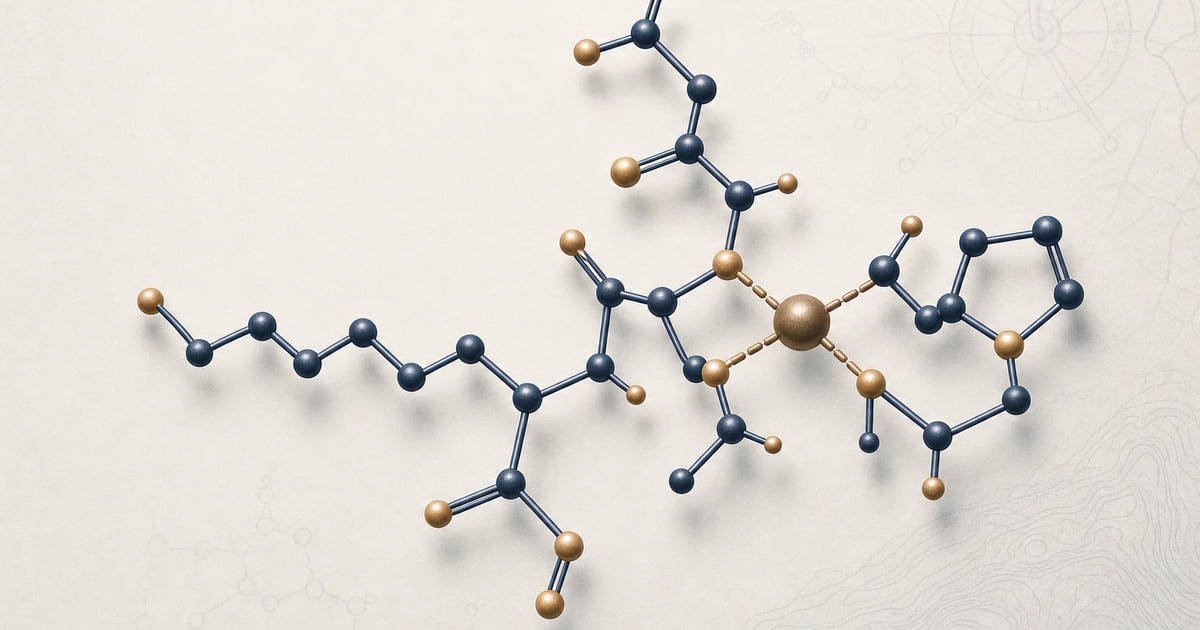
Most research peptides share a common evidence problem: the literature is thin, animal-only, and produced by a single laboratory. GHK-Cu has the opposite problem. Its evidence is real, decades deep, and partly independent. It is just attached to the wrong route.
The studies people cite were run on skin; the route buyers ask about is injection. This review keeps those two columns separate, because almost every confident claim made about GHK-Cu online quietly moves a finding from one to the other.
GHK-Cu is the copper complex of a three-amino-acid peptide, glycyl-L-histidyl-L-lysine. It has a cleaner discovery story than any other peptide in this category, a copper-coordination chemistry that is genuinely well characterized, a topical-cosmetic record that includes a randomized human trial, and a parallel thirty-year life as a registered cosmetic ingredient. It also carries a marketing claim, the "4,000 genes" figure, that rests on far less than its circulation suggests. This article maps the chemistry, weighs the evidence one route at a time, and sets the regulatory record straight.
Research content. The article below summarizes published in vitro, animal-model, and topical-clinical research literature on GHK-Cu. The compound is sold by Peerless Peptides for laboratory research use only and is not approved by the FDA for human or veterinary administration.
Last reviewed: June 4, 2026 by Peerless Research.
Summary
GHK-Cu is studied as a copper-delivery and matrix-signaling peptide. Its topical-cosmetic dossier is the strongest in the research-peptide field and includes a 1994 randomized, vehicle-controlled wound-healing trial, a 2006 controlled trial that found no objective benefit, and a multi-decade body of independent cell-culture mechanism work. Its injectable dossier, by contrast, is animal-model and in-vitro only, with no human randomized trials and no published subcutaneous pharmacokinetics in any species. The widely repeated claim that GHK reprograms more than four thousand genes derives from a single 2014 reanalysis of three cancer-cell-line microarray profiles and has not been independently replicated.
Across the United States regulatory record, GHK-Cu occupies two tracks at once: a long-established cosmetic-ingredient track and a research-use-only injectable track that the FDA has handled with unusual ambiguity. The appropriate reading of the molecule is route-segmented throughout. A finding under one route does not transfer to the other.
Note: the research described below was conducted in in vitro, animal-model, and topical-clinical systems. Human safety and efficacy of injectable GHK-Cu have not been established. This article is a literature review, not a recommendation of use.
Identity and Chemistry: One Name, Three Molecules
The first discipline GHK-Cu demands is nomenclatural. The catalog name "GHK-Cu" is used for three chemically distinct species with materially different molecular weights, and conflating them is the most common identity error in the field.
| Species | Sequence | Formula | Mol. weight | CAS |
|---|---|---|---|---|
| GHK (free peptide) | Gly-His-Lys | C14H24N6O4 | 340.4 | 49557-75-7 |
| GHK-Cu (1:1 complex) | Gly-His-Lys + Cu(II) | C14H22CuN6O4 | ~402.9 | 89030-95-5 |
| Prezatide copper acetate | 2x Gly-His-Lys + Cu(II) + 2 acetate | C32H54CuN12O12 | ~862 | 130120-57-9 |
Prezatide copper acetate is the defined drug substance that was the active ingredient in the 1996 Iamin device. The free peptide and the neutral 1:1 complex differ in weight by about sixty grams per mole. Because of this, copper-content stoichiometry on a certificate of analysis, not the catalog label, is the only reliable identity check, and copper quantification by ICP-MS or atomic absorption is the single most diagnostic test that lower-tier suppliers tend to omit.
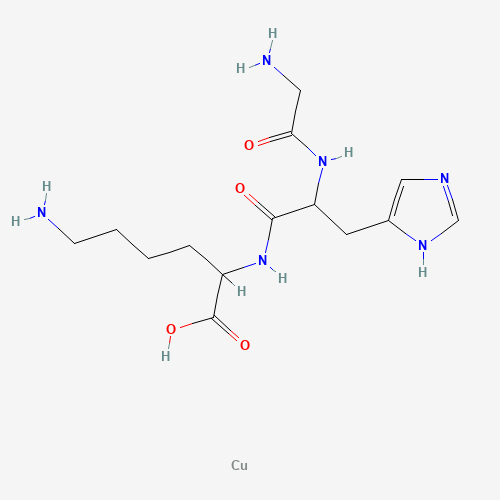
GHK is not encoded as a stand-alone gene. There is no dedicated protein entry for the tripeptide. Instead, the Gly-His-Lys sequence occurs as an internal motif within several human proteins, including albumin, the alpha-2 chain of type I collagen, SPARC, and thrombospondin-1, and the working model is that proteases liberate the fragment from these parents at sites of tissue injury.
Loren Pickart isolated the tripeptide from human plasma in 1973 and originally described it as a serum factor that prolonged the survival of cultured liver cells[1]. The dermal-regeneration identity that dominates the molecule's reputation today came later. Compared with research peptides whose claimed parent protein has never been sequenced, GHK has the most solid origin paper trail in the category.
The copper chemistry is where the marketing and the science align most cleanly. GHK presents an amino-terminal copper-binding motif, often abbreviated ATCUN, in which copper(II) is held in an approximately square-planar pocket by three nitrogen donors: the terminal amine of the glycine, the deprotonated backbone amide nitrogen of the glycine-histidine bond, and the imidazole nitrogen of the histidine. The lysine side chain is not a primary copper donor; it stays protonated across physiological pH and is what keeps the complex water-soluble and positively charged.
The binding constant is high, with a reported log K near 16, placing GHK among the stronger copper(II) chelators of any short peptide, strong enough that GHK can take copper from the corresponding site on albumin. The same geometry damps the copper(II) to copper(I) redox cycling that would otherwise drive Fenton-type radical chemistry, which is the structural basis for the "non-toxic copper carrier" description. What remains less directly demonstrated is the downstream step: handoff of that copper to specific cuproenzymes inside cells is largely inferred from phenotypes rather than measured by tracer or stopped-flow methods. The carrier chemistry is solid; the delivery step is a reasonable inference with a real evidence gap.
Topical-Route Evidence: The Strong Column
The topical and cosmetic literature is where GHK-Cu earns its reputation, and it is genuinely the strongest route-specific evidence base among research peptides.
The anchor human study is a 1994 multicenter, randomized, evaluator-blinded, vehicle-controlled trial by Mulder and colleagues, published in Wound Repair and Regeneration, which tested a topical GHK-Cu gel against vehicle in diabetic neuropathic foot ulcers after debridement. The treated arm reported substantially greater wound-area closure and a lower infection rate than vehicle. It is the single cleanest human data point in the corpus, and it carries two important qualifications: it was industry-sponsored, and it preceded a much larger 511-patient Phase III program that failed to beat control, the failure that ended the drug-approval path and forced the pivot to a device clearance discussed below.
The cosmetic side is often anchored to a 2002 facial-cream study by Leyden and colleagues, which reported improvements in skin density and fine-line appearance over twelve weeks. This study is cited across long-form GHK-Cu marketing as though it were a peer-reviewed randomized trial. It was presented as a conference abstract and, as of this review, was never published in a peer-reviewed journal. It should be weighted as a conference communication, not as a published trial.
The necessary counterweight is a 2006 split-face study by Miller and colleagues in patients recovering from carbon-dioxide laser resurfacing[2]. On blinded objective measures of erythema resolution, wrinkle depth, and overall quality, the GHK-Cu side showed no significant benefit over control, although patient-reported satisfaction was higher on the treated side. Editorial honesty requires that this null result travel alongside the positive trials rather than being quietly dropped, and a great deal of GHK-Cu marketing drops it.
Underneath the clinical studies sits the strongest part of the dossier: an independent mechanism literature led from the Reims faculty of medicine in France, which is what most distinguishes GHK-Cu from single-laboratory research peptides. In cultured fibroblasts, this group reported that GHK-Cu stimulated collagen synthesis across a low-concentration window beginning in the picomolar-to-nanomolar range and peaking around one nanomolar, independent of any change in cell number[3]. Follow-up work documented modulation of dermal glycosaminoglycans and the small proteoglycan decorin in wound-chamber models[4], and upregulation of matrix metalloproteinase-2 by dermal fibroblasts with a demonstrated copper requirement[5]. These are not Pickart-authored studies, and they make GHK-Cu's basic fibroblast-signaling story qualitatively different from a citation monoculture. They do not, however, establish anything about systemic route, injection dose, or human outcomes.
Injectable-Route Evidence: The Thin Column
The route that research customers most often ask about is the route the literature least supports. There are no published randomized controlled trials of injectable GHK-Cu in humans for any indication, and there are no published pharmacokinetic studies of subcutaneous GHK-Cu in any species. What exists is preclinical and scattered across organ systems.
| Research area | What the literature contains |
|---|---|
| Bone | GHK-Cu incorporated as a dopant into ceramic, collagen, and printed scaffolds in rabbit and rodent defect models. A scaffold additive, not a free injectable, and no human fracture or bone-density trials. |
| Nerve | GHK-Cu-loaded collagen nerve guides reported increased axon counts and Schwann-cell activity in rat sciatic-transection models; neurotrophic-factor induction in cultured neural cells. |
| Cardiovascular | Largely angiogenesis-adjacent cell work; an animal-model review reported that systemic injection was associated with faster wound closure at distant sites, without dedicated cardiac-injury models in the indexed literature. |
| Cancer cell biology | In cultured prostate, leukemia, and breast cancer lines, GHK shifted apoptosis-pathway gene expression at nanomolar concentrations. The step from a cell-line gene-expression shift to an anti-cancer effect is an extrapolation, not a primary finding. |
The honest ceiling for the injectable literature is "promising in animal and cell systems, unbridged to humans." None of the topical or cosmetic findings above can be carried across to subcutaneous use, and the move that does so, silently, is the single most common error in secondary GHK-Cu writing.
The "4,000 Genes" Claim: A Methodology Review
No discussion of GHK-Cu is complete without the genome-scale claim, because it underwrites most of the wide-ranging mechanism language that circulates in commerce. The statement that GHK "resets" or modulates more than four thousand human genes is real in the narrow sense that someone performed the calculation. It is far weaker than its repetition implies.
The primary source is a 2014 paper by Pickart and Margolina in BioMed Research International[6]. The authors did not run a microarray or sequencing experiment. They performed a secondary computational reanalysis of the Broad Institute Connectivity Map, a public database of cell-line expression responses to small molecules. Several features matter for how much weight the figure can carry. The analysis rested on three microarray profiles, two from an androgen-independent prostate cancer line and one from a breast cancer line, none of them a primary skin fibroblast or keratinocyte despite the dermal framing. The peptide concentration in the database was one micromolar of free GHK, roughly a thousandfold above the nanomolar window in which the foundational collagen-synthesis work reported activity. The cutoff for counting a gene as affected was a fifty-percent change, a threshold the authors described as giving the best correspondence with their expected biology, selected after the fact, with no false-discovery correction, fold-change distribution, or replicate-level statistics reported.
Applying that threshold yielded roughly four thousand two hundred genes, and the round-number variants in circulation are all rescalings of that one figure. The same dataset was recycled, without re-derivation, into later reviews in 2017[7] and 2018[8].
The appropriate verdict is that the claim is stretched rather than fabricated. A contemporary genomics reviewer would not accept a re-mining of three cancer-cell-line profiles at a post-hoc uncorrected threshold as a genome-wide regulatory finding in normal tissue. What the critique does not say is that GHK-Cu has no biology. The fibroblast collagen-synthesis and matrix-remodeling mechanism has independent support from the Reims work above. The specific thing that is overstated is the leap from a wound-healing and fibroblast-signaling peptide to a master regulator of roughly a third of the human genome.
Commercial Context, and Why "FDA-Approved" Is Wrong
GHK-Cu's commercial history is unusually entangled with its scientific record, and two facts are load-bearing for any accurate account.
The first concerns the discoverer. Loren Pickart, who isolated GHK in 1973, also founded ProCyte Corporation in the mid-1980s and later ran the direct-to-consumer retailer Skin Biology, which sold copper-peptide products continuously from 1994 until well after his death in December 2023. His commercial stake in the molecule was therefore real and substantial. It differs from some other research-peptide cases in two respects that are worth stating plainly: the discovery predated the commercial vehicles by roughly a decade, and his Skin Biology affiliation has been visible rather than concealed. A meaningful independent literature, the Reims mechanism corpus and a broad cosmetic-science record, exists that he did not author. The defensible observation is narrow: the originator and primary expositor of the wide-mechanism review papers also sold the compound, and declared no conflict of interest on those papers despite the affiliation. That is documentable, and it is different from a hidden conflict.
The second fact corrects a pervasive error. GHK-Cu is frequently described online as "FDA-approved," usually with reference to Iamin. The drug-development path actually failed: after a licensing deal collapsed in the early 1990s, the 511-patient Phase III trial in 1994 did not beat control. What followed in 1996 was a Class I medical-device clearance for the topical gel, a far lower regulatory bar than drug approval and a different legal category entirely. Separately, GHK-Cu has long been a permitted cosmetic ingredient under the INCI name Copper Tripeptide-1, present in mainstream commercial skincare and assessed as safe for cosmetic use by the relevant review panel. Neither the device clearance nor the cosmetic-ingredient status is a drug approval, and injectable GHK-Cu has none.
Research Limitations
Four limitations frame how the GHK-Cu evidence should be weighted.
First, the route gap is the central one. The strong evidence is topical and cosmetic; the questions buyers bring are usually about injection; and no published work bridges the two. Every claim should carry its route.
Second, the copper-delivery mechanism is partly inferred. The carrier chemistry is well measured, but direct demonstration of copper transfer from GHK to specific apo-cuproenzymes inside cells is largely absent from the primary literature.
Third, the genome-scale claim does not meet a modern genomics standard, for the reasons detailed above, and it has not been independently reproduced on a skin-relevant cell type with current methods.
Fourth, the cosmetic-to-systemic conflation is endemic in secondary sources. Industry-sponsored topical trials and conference abstracts are routinely cited as though they validated injectable use. They do not.
None of these is a claim that GHK-Cu is inert. The molecule has the cleanest discovery story and the best-characterized chemistry in its category, and a real topical-clinical and independent-mechanism record. The limitations describe the reach of that evidence, not its absence. Assertions about systemic effect or human outcome from injection should be weighted accordingly.
Regulatory Context
As of June 2026, no GHK-Cu product is FDA-approved as a drug. Within the 503A compounding framework, GHK-Cu received a treatment unique among the 2023 peptide actions: on September 29, 2023, injectable GHK-Cu was placed in Category 2, the tier flagged for significant safety concern, while non-injectable GHK-Cu was simultaneously listed in Category 1, under evaluation and temporarily compoundable. No other peptide in that wave received a route-split. On April 22, 2026, GHK-Cu was removed from both categories after the underlying nominations were withdrawn. That removal is procedural. It is not a finding that GHK-Cu is safe, and it is not an authorization to compound. The mechanics of these categories are set out in our 503A vs 503B compounding primer.
The most underappreciated data point is an absence. GHK-Cu was not on the July 23 to 24, 2026 Pharmacy Compounding Advisory Committee docket that covered its frequent shelf-neighbors, including the tissue-repair peptides BPC-157 and TB-500, both of which the Committee recommended for the Section 503A bulks list on July 23 (see our report on that vote); GHK-Cu is instead grouped for a separate review tranche before the end of February 2027 alongside cathelicidin, dihexa, PEG-MGF, and melanotan II. A plausible reading is that the molecule's thirty-year cosmetic-ingredient track makes molecule-level enforcement awkward, so attention falls on route and intended use rather than on the compound itself. That interpretation is consistent with the enforcement record. The April 2026 federal indictment of a physician for selling misbranded peptides named GHK and GHK-Cu specifically, alongside a list of other research compounds, which is a direct reminder that the cosmetic legitimacy of the topical ingredient does not shield injectable distribution from enforcement.
On the anti-doping side, GHK-Cu is not named on the 2026 World Anti-Doping Agency Prohibited List, although its growth-factor and tissue-remodeling framing plausibly falls under the non-approved-substance and peptide-hormone catch-all categories; no publicly indexed sanction specific to GHK-Cu has been recorded as of this writing. Finally, after roughly three decades without a drug-development program, GHK-Cu has re-entered formal clinical research: a Phase 2, randomized, vehicle-controlled trial of a topical GHK-Cu gel for acute wound re-epithelialization (NCT07437586) is recruiting, sponsored by the same group running parallel trials on several other research peptides. Its result will not speak to injectable use, but it is the first credible drug-development entry the molecule has seen since the 1994 failure.
References
-
Pickart L, Thaler MM. Tripeptide in human serum which prolongs survival of normal liver cells and stimulates growth in neoplastic liver. Nat New Biol. 1973;243(124):85-87. PMID: 4349963.
-
Miller TR, Wagner JD, Baack BR, Eisbach KJ. Effects of topical copper tripeptide complex on CO2 laser-resurfaced skin. Arch Facial Plast Surg. 2006;8(4):252-259. PMID: 16847171.
-
Maquart FX, Pickart L, Laurent M, Gillery P, Monboisse JC, Borel JP. Stimulation of collagen synthesis in fibroblast cultures by the tripeptide-copper complex glycyl-L-histidyl-L-lysine-Cu2+. FEBS Lett. 1988;238(2):343-346. PMID: 3169264.
-
Siméon A, Wegrowski Y, Bontemps Y, Maquart FX. Expression of glycosaminoglycans and small proteoglycans in wounds: modulation by the tripeptide-copper complex glycyl-L-histidyl-L-lysine-Cu2+. J Invest Dermatol. 2000;115(6):962-968. PMID: 11121126.
-
Siméon A, Emonard H, Hornebeck W, Maquart FX. The tripeptide-copper complex glycyl-L-histidyl-L-lysine-Cu2+ stimulates matrix metalloproteinase-2 expression by fibroblast cultures. Life Sci. 2000;67(18):2257-2265. PMID: 11045606.
-
Pickart L, Vasquez-Soltero JM, Margolina A. GHK and DNA: resetting the human genome to health. Biomed Res Int. 2014;2014:151479. PMID: 25302294. DOI: 10.1155/2014/151479.
-
Pickart L, Vasquez-Soltero JM, Margolina A. The effect of the human peptide GHK on gene expression relevant to nervous system function and cognitive decline. Brain Sci. 2017;7(2):20. PMID: 28212278. DOI: 10.3390/brainsci7020020.
-
Pickart L, Margolina A. Regenerative and protective actions of the GHK-Cu peptide in the light of the new gene data. Int J Mol Sci. 2018;19(7):1987. PMID: 29986520. DOI: 10.3390/ijms19071987.
-
Mulder GD, Patt LM, Sanders L, Rosenstock J, Altman MI, Hanley ME, Duncan GW. Enhanced healing of ulcers in patients with diabetes by topical treatment with glycyl-L-histidyl-L-lysine copper. Wound Repair Regen. 1994;2(4):259-269. PMID: 17147644.
-
Leyden J, Stephens T, Finkey MB, Barkovic S. Skin care benefits of copper peptide containing facial cream. Dermatology conference presentation, circa 2002; not published in a peer-reviewed journal.
-
Topical GHK-Cu (copper-peptide complex) gel to accelerate re-epithelialization of standardized acute skin wounds (CuHeal). ClinicalTrials.gov Identifier: NCT07437586. Phase 2, recruiting 2026.
Not intended to diagnose, treat, cure, mitigate, or prevent any disease. Sold for research, laboratory, or analytical purposes only.
Research Compounds Referenced
The compounds discussed in this article are sold by Peerless Peptides for laboratory research use only. They are not FDA-approved for human or veterinary administration. Per-batch Certificates of Analysis are available.
- GHK-Cu: Glycyl-L-histidyl-L-lysine copper(II) complex, ATCUN-motif tripeptide.PDP entry →
Frequently Asked Questions
- What is GHK-Cu?
- GHK-Cu is a copper complex of the tripeptide glycyl-L-histidyl-L-lysine (GHK, sequence Gly-His-Lys). The GHK tripeptide is not produced as a stand-alone gene product; the Gly-His-Lys sequence occurs internally within human proteins including albumin and the alpha-2 chain of type I collagen, and is liberated by proteolysis at sites of tissue injury. Bound to copper(II) through an amino-terminal coordination motif, it is studied as a copper-delivery and extracellular-matrix-signaling molecule. It is sold by Peerless Peptides for laboratory research use only and is not approved by the FDA for human or veterinary use.
- Is GHK-Cu FDA approved?
- No. No GHK-Cu product is FDA-approved as a drug for any indication. A frequent point of confusion: a topical GHK-Cu gel (Iamin) received a Class I medical-device clearance in 1996, which is a regulatory pathway distinct from drug approval, and which followed a 511-patient Phase III drug trial that did not beat its control in 1994. GHK-Cu separately has long-standing status as a cosmetic ingredient under the INCI name Copper Tripeptide-1, which is again not a drug approval. Injectable GHK-Cu is an unapproved drug sold for research use only.
- What does the research on GHK-Cu show?
- The evidence is strongly route-dependent. The topical-cosmetic literature is the most developed: a 1994 randomized vehicle-controlled trial in diabetic foot ulcers reported faster closure, and a separate body of cell-culture work from a French group documents stimulation of collagen synthesis and matrix remodeling. A 2006 split-face trial after laser resurfacing found no significant objective benefit, an important counterweight. The injectable and systemic literature is animal-model and in-vitro only; no human randomized trials and no subcutaneous pharmacokinetic studies have been published.
- What is the '4,000 genes' claim about GHK-Cu?
- Marketing materials often state that GHK modulates more than 4,000 human genes. That figure traces to a single 2014 computational paper that reanalyzed a public microarray database. The analysis used three cancer-cell-line expression profiles (two prostate, one breast), a free-peptide concentration far above the nanomolar range used in the foundational mechanism work, and a 50-percent change threshold selected after the fact with no statistical correction reported. It has not been independently replicated on a skin-relevant cell type. The underlying fibroblast biology has independent support; the genome-wide expansion of it does not.
- Is GHK-Cu on the FDA do-not-compound list?
- Not currently. In September 2023 the FDA placed injectable GHK-Cu in 503A Category 2 while simultaneously listing non-injectable GHK-Cu in Category 1, a route-split unique among the peptides in that action. In April 2026 it was removed from both categories after the nominations were withdrawn, a procedural change that is not a finding of safety and not an authorization to compound. GHK-Cu is not on the July 2026 Pharmacy Compounding Advisory Committee docket; it is grouped for a separate review tranche in 2027.