
Peerless Research·testagen
Testagen: A Literature Review of the KEDG Tetrapeptide
Testagen (Lys-Glu-Asp-Gly) is named for the testes, but its indexed literature is thyroid and thymus morphology in birds. A cited review.

Testagen is a four-amino-acid peptide with a name that makes a promise. The prefix points at the testes, and most of the material written about the compound follows that pointer toward androgens and male physiology.
The indexed literature points somewhere else entirely. Searches of PubMed for the peptide's sequence paired with testis, testes, testicular, testosterone, or androgen return nothing at all. What the record does contain is thyroid gland morphology, thymus morphology, and a set of hormone measurements taken in chickens whose pituitary glands had been surgically removed.
This review works through what has actually been published on Lys-Glu-Asp-Gly: the chemistry, the in vitro binding work, the bird program that constitutes the entire in vivo record, and a registry entry for a completely different product that shares the name and probably explains how the androgen association took hold.
Research content. The article below summarizes published preclinical and mechanistic research literature on Testagen (Lys-Glu-Asp-Gly). The compound is not approved by the FDA for human or veterinary administration, and nothing below is a statement about its use.
Last reviewed: August 5, 2026 by Peerless Research.
Summary
Testagen is a synthetic tetrapeptide from the Khavinson short-peptide bioregulator program, the same Saint Petersburg program that produced Epitalon and Pinealon. Its published record runs to roughly nine indexed papers, which is small even by the standards of that catalog.
The in vitro work reports that the peptide enters cells and cell nuclei and that it binds histone proteins, the latter demonstrated in wheat rather than in an animal system. The in vivo work is a single program in hypophysectomized birds, reporting thyroid and thymus outcomes, with one author on every paper. There are no human trials, no mammalian in vivo studies in the index, and no verifiable CAS registry number.
The gap between what the name suggests and what the literature contains is the most useful thing to know about this compound.
Note: the research described below was conducted in cell systems, plant proteins, and bird models. Nothing below is a statement about use in humans. This article is a literature review, not a recommendation of use.
Identity and Chemistry
Testagen is a linear tetrapeptide with the sequence Lys-Glu-Asp-Gly (single-letter KEDG), written in full as H-Lys-Glu-Asp-Gly-OH. Its molecular formula is C₁₇H₂₉N₅O₉ and its molecular weight is approximately 447.4 daltons, which makes it one of the smaller molecules in the bioregulator catalog. It carries one basic residue at the N-terminus and two acidic residues in the middle, giving it the charged, highly polar character common to the Khavinson short peptides.
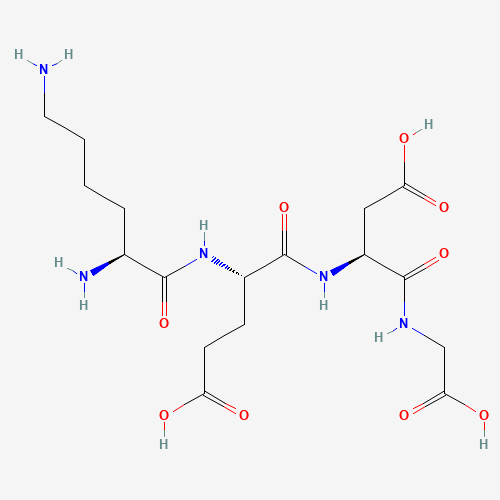
The identifier record is unusually sparse, and the sparseness is itself informative. The compound resolves in PubChem as CID 123863700, but only when queried by the explicit H-Lys-Glu-Asp-Gly-OH form; name lookups for "testagen" and for "Lys-Glu-Asp-Gly" both fail to resolve. The PubChem entry carries exactly one synonym, an auto-generated patent-database identifier, and no CAS registry number.
Vendor listings commonly assign the CAS number 1026993-38-3 to the compound. That number does not resolve in PubChem, and a lookup against the CAS Common Chemistry database returns no record. A certificate of analysis quoting it is quoting an identifier that cannot be checked against either public authority, which is worth noting for anyone attempting to verify material identity from paperwork alone.
For comparison, a well-characterized peptide of similar commercial visibility carries a registered CAS number, an assigned international nonproprietary name, and dozens of database synonyms. Testagen has one synonym and it was generated by a machine.
The Naming Problem
The published papers do not explain where the name came from, and what they do say cuts against the obvious reading.
The in vivo papers describe the peptide as having been "synthesized on the basis of amino acid composition of pituitary cytomedins," and elsewhere as designed from "peptide complexes of the anterior and posterior pituitary lobes"[1]. The stated tissue of origin in the primary literature is therefore the pituitary gland, not the testes. In those same papers Testagen is administered alongside Ala-Glu-Asp-Gly, the tetrapeptide sold as Epitalon, with the two treated as the anterior-lobe and posterior-lobe counterparts of a matched pair.
That pairing is worth pausing on, because it does not agree with the rest of the program's own account. Ala-Glu-Asp-Gly is described everywhere else, including in the Khavinson group's own foundational material, as modeled on the amino acid composition of a bovine pineal extract. Here the same sequence is presented as a pituitary-derived peptide. A program that assigns one molecule to two different source tissues in two different papers is not applying the organ-specific framework as a finding; it is applying it as a convention.
This follows a pattern already visible across the Khavinson catalog, where a compound's name refers to a tissue in the program's organ-specific framework rather than to a demonstrated site of action. The parent pillar review covers the extract-versus-synthetic conflation that produces most of these mismatches. Testagen is a cleaner case than most, because here the mismatch is not between an extract and its synthetic fragment but between the name and every study ever published under it.
The practical consequence is that secondary material describing Testagen as a testicular or androgenic peptide is not summarizing the primary literature. No such primary literature is indexed.
The Other Testagen
There is a second explanation for the androgen association, and it is a naming collision rather than a scientific claim.
The ClinicalTrials.gov registry contains one study whose name matches: NCT02733133, sponsored by Transdermal Delivery Solutions Corp, studying a product called Testagen TDS-Testosterone 5% HypoSpray. That study concerns a transdermal testosterone delivery system, and its stated purpose is to assess whether testosterone transfers to women who come into skin contact with a treated area. The intervention is testosterone. The delivery vehicle carries the Testagen name.
A closely related record appears in the UK Health Research Authority's database under a dose-ranging study of the same trade-named product, and that HRA page currently ranks on the first page of search results for the peptide's name.
These records have nothing to do with the Khavinson tetrapeptide. They describe a different molecule, from a different developer, in a different product category. The peptide Lys-Glu-Asp-Gly does not appear in the ClinicalTrials.gov registry at all.
The pattern is familiar from elsewhere in this catalog. TB-500 is routinely credited with the clinical record of thymosin β4, a protein five times its size, and Epitalon is routinely credited with longevity data generated on a bovine pineal extract. In each case a name does work that the underlying evidence does not support. Testagen adds a variant: the borrowed record here belongs to an unrelated commercial product that happens to share a trade name.
Mechanism: Nuclear Penetration and Histone Binding
The mechanistic case for Testagen rests on the general Khavinson framework, which proposes that very short peptides enter cells, reach the nucleus, and interact with DNA and histone proteins to modulate gene expression.
Two in vitro papers carry the specific evidence. The first, from Fedoreyeva and colleagues in 2011, incubated HeLa cells with fluorescein-labeled short peptides and observed fluorescence in the cytoplasm, nucleus, and nucleolus for each of epitalon, pinealon, and testagen[2]. The paper establishes that molecules of this size and charge can reach the nuclear compartment. It does not establish what they do once there, and the authors frame the nuclear interaction as a possibility rather than a demonstrated function.
The second, from the same group in 2013, examined binding between six short peptides, Testagen among them, and histones H1, H2B, H3, and H4[3]. Binding was inferred from fluorescence quenching, and the authors attributed it to interaction with N-terminal histone regions carrying what they described as homologous peptide-binding motifs.
The material qualification is the source of the histones. They were wheat histones. Histone proteins are strongly conserved across eukaryotes, which is the implicit justification, but a binding measurement taken in a plant system is a long way from sequence-specific gene regulation in vertebrate chromatin, and no paper in the Testagen record closes that distance.
A 2023 computational paper from the Khavinson group modeled transport of twenty-six ultrashort peptides through LAT and PEPT family transporters and concluded that the binding sites are large enough to accommodate them[4]. The work is molecular docking, not measurement, and it addresses whether entry is geometrically feasible rather than whether it occurs at physiological concentrations.
Preclinical Evidence: A Program in Birds
The entire in vivo record for Testagen consists of five papers, and all five use birds.
The model is consistent across the set: chickens hypophysectomized in the neonatal period, or mature and aged hens, given Testagen and Ala-Glu-Asp-Gly over a forty-day period. Removing the pituitary produces predictable downstream damage, and the studies measure whether the peptides alter that damage.
The 2008 paper reports that administration to hypophysectomized chickens was followed by higher concentrations of thyrotropic hormone and thyroid hormones, and by recovery of thyroid gland structure[1]. A 2010 paper extends the readouts to immunity and hemostasis alongside thyroid structure and function[5]. Two 2011 papers repeat the thyroid work in mature and aged birds and report reductions in the hypophysectomy-induced changes[6][7]. A 2013 paper turns to the thymus and reports that the most pronounced morphological changes followed neonatal hypophysectomy, with the peptides altering that picture[8].
Two features of this program limit how far it travels. The first is the species. Avian endocrine physiology differs from mammalian physiology in ways that matter for thyroid and pituitary work, and no mammalian in vivo study of this peptide appears in the index, so the usual intermediate step between a bird result and a human hypothesis has not been taken.
The second is the model itself. Surgical removal of the pituitary is a severe, non-physiological lesion. A compound that alters recovery in a hypophysectomized animal is being tested against an artificial deficit, and results obtained that way do not transfer to intact animals without separate demonstration.
Clinical Evidence
There is none.
No trial of Lys-Glu-Asp-Gly appears in ClinicalTrials.gov. No human study appears in the PubMed record. The single indexed paper that touches human material is the 2011 HeLa cell work, and a human-derived immortalized cell line is not a human study.
Stating this plainly matters because the compound's search presence is dominated by material comparing it to testosterone replacement therapy, a treatment with a large and genuine clinical evidence base. No comparison of that kind can be grounded in the published record, because one side of it is empty.
Research Limitations
Four constraints frame how this literature should be weighted.
Authorship concentration. All five in vivo papers share a first author, Kuznik, and both in vitro binding papers share a first author, Fedoreyeva. Independent replication outside the originating network is absent from the index, which is the same structural weakness the parent pillar review documents for the program as a whole.
Volume. Roughly nine indexed papers is a thin base. For comparison, the better-studied peptides in this category run to hundreds or thousands of papers, and the ones with the strongest mechanisms carry independent confirmation in knockout systems.
Endpoint mismatch. The measured endpoints are thyroid hormone concentrations and gland and thymus morphology in birds. Whatever those measurements support, they do not speak to the endpoints the compound is popularly associated with.
The corrosion tell. The most recent paper indexed under the name Testagen, published in Molecules in 2025, is not a biology paper. It studies the peptide as a corrosion inhibitor adsorbed onto copper surfaces in saline, and reports its inhibition efficiency on metal[9]. The chemistry is sound and the paper confirms the sequence and identity. That the most recent indexed work on a compound sold as a biological agent examines its behavior on a metal surface is a fair measure of how much active biological research the molecule currently attracts.
Regulatory Context
Testagen is not approved by the FDA for any indication. It was not among the compounds evaluated at the Pharmacy Compounding Advisory Committee meetings of July 2026, which took up BPC-157, TB-500, Epitalon, Semax, GHK-Cu, KPV, MOTS-c, and emideltide but not this peptide.
No international nonproprietary name appears in its public identifier record, which is consistent with a compound that has never entered a formal drug-development pathway. Anyone needing a definitive statement of its status under the Section 503A bulk drug substances list, or under anti-doping rules, should consult those registers directly rather than rely on a literature review; the absence of a compound from the secondary literature is not the same as its absence from a regulatory schedule.
The unrelated Testagen TDS-Testosterone product is a separate regulatory object entirely; testosterone is a controlled substance in the United States and its delivery systems are regulated as drugs. Nothing about that product's status attaches to the peptide.
Regulatory status current as of August 5, 2026.
References
-
Kuznik BI, Pateyuk AV, Rusaeva NS, et al. Effect of tetrapeptides Lys-Glu-Asp-Gly and Ala-Glu-Asp-Gly on the structure and function of the thyroid gland in neonatally hypophysectomized chickens. Bull Exp Biol Med. 2008;146(4):465-467. PMID: 19024016.
-
Fedoreyeva LI, Kireev II, Khavinson VKh, Vanyushin BF. Penetration of short fluorescence-labeled peptides into the nucleus in HeLa cells and in vitro specific interaction of the peptides with deoxyribooligonucleotides and DNA. Biochemistry (Mosc). 2011;76(11):1210-1219. PMID: 22117547.
-
Fedoreyeva LI, Smirnova TA, Kolomijtseva GYa, Khavinson VKh, Vanyushin BF. Interaction of short peptides with FITC-labeled wheat histones and their complexes with deoxyribooligonucleotides. Biochemistry (Mosc). 2013;78(2):166-175. PMID: 23581987.
-
Khavinson VKh, Popovich IG, Linkova NS, et al. Feasibility of transport of 26 biologically active ultrashort peptides via LAT and PEPT family transporters. Biomolecules. 2023;13(3):552. PMID: 36979488.
-
Kuznik BI, Pateyuk AV, Baranchugova LM, Rusaeva NS. Effects of hypophyseal Lys-Glu-Asp-Gly and Ala-Glu-Asp-Gly synthetic peptides on immunity, hemostasis, morphology and functions of the thyroid gland in neonatally hypophysectomized chicken and one-year-old birds. Patol Fiziol Eksp Ter. 2010;(2):18-22. PMID: 20731122.
-
Kuznik BI, Pateyuk AV, Baranchugova LM, Rusaeva NS. Effects of Lys-Glu-Asp-Gly and Ala-Glu-Asp-Gly peptides on hormonal activity and thyroid morphology in hypophysectomized mature and old birds. Adv Gerontol. 2011;24(2):233-238. PMID: 21809626.
-
Kuznik BI, Pateyuk AV, Baranchugova LM, Rusaeva NS. Effects of peptides Lys-Glu-Asp-Gly and Ala-Glu-Asp-Gly on hormonal activity and structure of the thyroid gland in hypophysectomized young chickens and old hens. Bull Exp Biol Med. 2011;151(4):481-484. PMID: 22268052.
-
Pateyuk AV, Baranchugova LM, Kuznik BI, et al. Effect of peptides Lys-Glu-Asp-Gly and Ala-Glu-Asp-Gly on the morphology of the thymus in hypophysectomized young and old birds. Bull Exp Biol Med. 2013;154(6):802-805. PMID: 23658898.
-
Dobriţescu A, Ciocîlteu MV, Neacşu IA, et al. The inhibitory effect and adsorption properties of Testagen peptide on copper surfaces in saline environments: an experimental and computational study. Molecules. 2025;30(15):3241. PMID: 40807317.
Registry record referenced: NCT02733133, Product Transference Study of Testagen TDS-Testosterone, Transdermal Delivery Solutions Corp. Unrelated to the peptide described above.
Not intended to diagnose, treat, cure, mitigate, or prevent any disease. Sold for research, laboratory, or analytical purposes only.
Frequently Asked Questions
- What is Testagen?
- Testagen is a synthetic four-amino-acid peptide, sequence Lys-Glu-Asp-Gly (single-letter KEDG), developed within Vladimir Khavinson's short-peptide bioregulator program at the Saint Petersburg Institute of Bioregulation and Gerontology. Its molecular formula is C17H29N5O9 and its molecular weight is approximately 447.4 daltons. It is a research compound and is not approved by the FDA for human or veterinary use.
- What does the research literature on Testagen actually cover?
- The indexed in vivo literature covers thyroid gland structure and hormone concentrations, and thymus morphology, in hypophysectomized chickens and hens. The in vitro literature covers cell and nuclear penetration in HeLa cells and binding to wheat histone proteins. Searches of PubMed for the sequence Lys-Glu-Asp-Gly alongside testis, testes, testicular, testosterone, or androgen return no records, so the published record does not address androgen endpoints.
- Why is Testagen named for the testes if the studies are about the thyroid?
- The published papers do not explain the name. They describe the peptide as having been designed from the amino acid composition of pituitary gland peptide complexes, not testicular ones. The Khavinson program's naming convention generally refers to the tissue a parent extract was drawn from rather than to a demonstrated site of action, and the name should not be read as a finding.
- Are there human clinical trials of Testagen?
- No clinical trial of the Lys-Glu-Asp-Gly peptide appears in the ClinicalTrials.gov registry. One registry record, NCT02733133, carries the name Testagen, but it studies a transdermal testosterone delivery product from a different developer and is unrelated to the peptide. The two share a trade name and nothing else.
- How strong is the evidence base for Testagen?
- It is thin and concentrated. The whole indexed record is roughly nine papers. Every in vivo study uses birds, five of them share a single first author, and no mammalian in vivo work appears in the index. The compound has no verifiable CAS registry number, and the most recent paper indexed under its name studies it as a corrosion inhibitor on copper rather than as a biological agent.