
Peerless Research·regulatory-news
The July 2026 PCAC Peptide Vote: Six of Seven Recommended
FDA's Pharmacy Compounding Advisory Committee recommended six of seven peptides for the 503A bulks list on July 23-24, 2026, over agency staff objection.
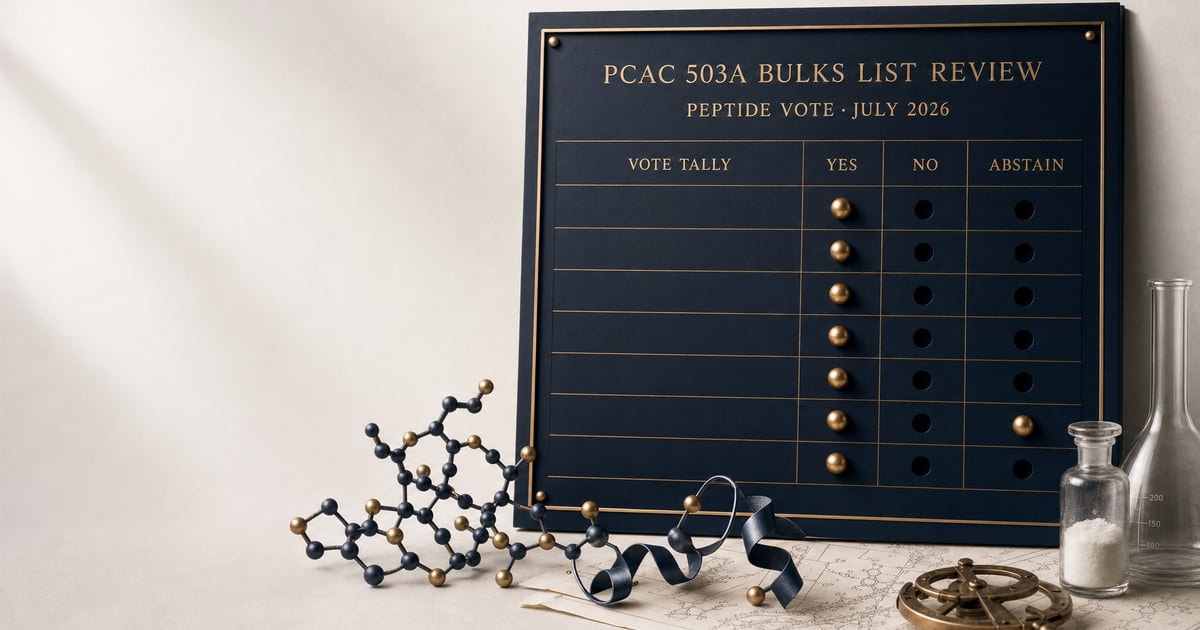
Six votes went one way. One went the other. Neither outcome changed what any of these substances is legally permitted to be used for.
On July 23 and 24, 2026, the FDA's Pharmacy Compounding Advisory Committee voted on whether seven peptides belong on the Section 503A Bulk Drug Substances List.[1] Six received favorable recommendations. Emideltide, better known as delta sleep-inducing peptide, did not. Coverage was careful to say that advisers, not the agency, had voted, but the verbs did the damage anyway: headlines describing a panel that "backed" peptides or moved to "loosen rules" read, to anyone not tracking the procedure, as a rule that loosened. No rule changed.
Research content. The article below reports a federal advisory-committee proceeding and explains the regulatory framework around it. It is not legal advice and is not medical advice. The compounds named are sold by Peerless Peptides for laboratory research use only and are not approved by the FDA for human or veterinary administration.
Last reviewed: July 26, 2026 by Peerless Research.
Summary
The Pharmacy Compounding Advisory Committee is an external body that advises the FDA on which bulk drug substances may be used by compounding pharmacies operating under Section 503A of the Federal Food, Drug, and Cosmetic Act. It met July 23 and 24, 2026 at FDA's White Oak Campus to review seven peptides that had been removed from the 503A Category 2 do-not-compound list on April 22, 2026 after their original nominators withdrew.
The Committee recommended six for inclusion: BPC-157, KPV, TB-500, MOTS-c, Semax, and Epitalon. It declined to recommend emideltide. Every vote was close, and every vote went against the position FDA's own review staff had taken in the briefing materials prepared for the meeting, which proposed that none of the seven be added.[2]
A recommendation from this Committee has no legal effect. Before any of the six could lawfully be compounded under Section 503A, the FDA would need to publish a notice of proposed rulemaking, take public comment, issue a final rule, and amend the regulation at 21 CFR 216.23. That sequence has historically run twelve to thirty-six months, and the agency is free to decline.
None of this reaches research-use-only research-chemical supply, which sits in a separate statutory channel governed by intended-use doctrine rather than by the compounding provisions.
Note: the vote counts below are corroborated across multiple independent publications. One outlet reported the Epitalon tally as 7-5 rather than 7-4; the figure used here is the one reported by the majority of sources. All counts will be reconciled against the official FDA meeting transcript when it is published, and this article will be revised if the transcript differs.
What the Committee Voted On
The Section 503A bulks list is a positive list. A state-licensed pharmacist compounding a patient-specific prescription may use a bulk drug substance only if that substance either has a USP or NF monograph and is the active ingredient of an FDA-approved drug, or has been affirmatively placed on the bulks list by regulation.[14] Substances that are merely absent from the do-not-compound category are not thereby eligible.
That distinction is what made the July docket meaningful. The twelve peptides removed from Category 2 on April 22, 2026 did not become compoundable when they were removed. They moved into a gap: no longer under active do-not-compound designation, and not on the positive list either. Seven of the twelve went to the Committee in July 2026; the remaining five, LL-37, DiHexa, injectable GHK-Cu, PEG-MGF, and melanotan II, are scheduled for a follow-up meeting before the end of February 2027.[3]
Each substance was voted in both free-base and acetate salt forms, and each was evaluated against a specific nominated indication rather than against general use. The framework governing all of this, including how Section 503A differs from Section 503B and why the Category 2 mechanism works the way it does, is set out in our 503A vs 503B regulatory primer.
The Results, Substance by Substance
| Substance | Day | Indication evaluated | Vote | FDA staff position |
|---|---|---|---|---|
| BPC-157 | July 23 | Ulcerative colitis | 8-6-1 favorable | Do not add |
| KPV | July 23 | Wound healing, inflammatory conditions | 8-6-1 favorable | Do not add |
| TB-500 | July 23 | Wound healing | 8-6-1 favorable | Do not add |
| MOTS-c | July 23 | Obesity, osteoporosis | 7-5-2 favorable | Do not add |
| Semax | July 24 | Cerebral ischemia, migraine, trigeminal neuralgia | 8-5-1 favorable | Do not add |
| Epitalon | July 24 | Insomnia | 7-4-1 favorable | Do not add |
| Emideltide (DSIP) | July 24 | Opioid withdrawal, chronic insomnia, narcolepsy | 6-7-1 rejected | Do not add |
No vote was decided by more than three members. The narrowest, emideltide, turned on a single vote.
The Vote Diverged From the Agency's Own Assessment
The vote counts travel further than the fact that gives them meaning. FDA's review staff prepared briefing materials for each of the seven substances, and those materials proposed the same conclusion in every case: do not add.[2] The Committee then voted the other way six times.
The agency's written assessments were direct about why. For KPV, TB-500, and MOTS-c, the staff review identified no human studies supporting the nominated indications, leaving evidence bases that were entirely preclinical. For BPC-157, the human record consisted of a conference abstract describing roughly 46 subjects using enema administration, with the remainder of the literature drawn from animal and laboratory work.
The two Day 2 substances that advanced fared no better on the agency's reading. For Semax, the staff pointed to a single uncontrolled 1996 study in which the compound did not resolve pain for most subjects with trigeminal neuralgia. For Epitalon, the review identified no patient-level studies for insomnia.
Those characterizations are consistent with the published literature. The BPC-157 corpus is dominated by rodent work and patent filings.[4][5] The KPV mechanistic literature centers on keratinocyte and immune-cell signalling rather than clinical endpoints.[6] The TB-500 fragment derives from a 43-residue parent protein whose own translational record is long and largely negative.[7] MOTS-c entered the literature in 2015 in a mouse and cell-culture study, and the osteoporosis indication rests on rodent models.[8][9] The Epitalon record is largely a Russian program with limited independent replication.[12]
Committee members voting in favor said on the record that they were weighing biological plausibility and clinical judgment rather than trial evidence. One spoke of BPC-157 in terms of promise for the gut lining; another pointed to the role of MOTS-c in muscle biology. Members voting against cited the absence of fundamental information. Both positions are visible in the record, and the split is roughly even.
Part of the explanation is who was in the room. Reporting on the meeting from STAT, Bloomberg Law, and Healio described a committee whose membership had drawn scrutiny before it convened, with several outlets characterizing a majority of the voting members as having ties to the peptide industry and noting that additional seats were filled shortly before the meeting.[18][19][20] Advisory-committee composition is a matter of public record and the appointments were made through the ordinary process, but the divergence between panel and staff is easier to read against that background than as a scientific disagreement.
This matters for what comes next. An advisory committee that agrees with agency staff makes rulemaking more likely. One that overrides staff on every substance, by margins of one to three votes, and whose composition is itself contested, does not.
The Evaluated Indications Are Narrower Than the Headlines
Each nomination named a specific clinical indication, and in several cases that indication has little overlap with what the substance is popularly associated with.
BPC-157 was evaluated for ulcerative colitis. Most of its preclinical literature sits instead in musculoskeletal and connective-tissue research, which is also where its popular reputation was built.[5] A favorable bulks-list vote on the colitis nomination would not extend to that body of work, because the bulks list is indication-anchored at the nomination stage and any resulting rule would follow the nominated scope.
Epitalon was evaluated for insomnia alone, not for the telomere and longevity framing that dominates its popular reputation. MOTS-c was evaluated for obesity and osteoporosis. Semax was evaluated for cerebral ischemia, migraine, and trigeminal neuralgia, reflecting the Russian stroke-trial literature behind it.[11]
The gap between nominated indication and popular use case is the single most reliable way to misread this vote. A recommendation is a recommendation about a specific substance for a specific proposed use, evaluated against the safety, effectiveness, and historical-use criteria the FDA applies under the 1997 statutory standard. It is not a general endorsement of the molecule.
Emideltide: The Only Rejection
The one substance the Committee declined to recommend had, by a reasonable reading, more human data behind it than several that passed.
Emideltide, or delta sleep-inducing peptide, has been studied in humans since the 1970s, including in double-blind designs, and carries a review literature that peptides such as KPV and MOTS-c do not.[10] FDA's assessment nonetheless found insufficient safety and efficacy data across all three nominated uses, and noted a route mismatch: the human studies used intravenous administration while the nomination proposed subcutaneous administration.
What panel members said on the record, though, turned less on the evidence base than on safety specifically. According to meeting coverage, an anesthesiologist on the panel said that as a clinician it was impossible not to take FDA's safety and efficacy recommendations to heart. Another member cited a significant lack of safety data. A third pointed to low-quality efficacy evidence and to the existence of approved alternatives for the proposed indications. Public testimony noted that the most recent study was roughly thirty years old.[18][19]
One member who had supported the earlier substances broke ranks here, describing concern about potentially dangerous downstream consequences, and members raised a mechanistic worry that endorphin release resembled the reward-pathway activity of addictive drugs.[19] The nominated indications included opioid withdrawal, which sharpened that concern.
That pattern is the more useful signal. This Committee was willing to override agency staff on thin efficacy evidence six times. It was not willing to do so on the one substance where members perceived an affirmative safety hazard rather than merely absent data. Volume of human evidence did not carry the vote in either direction.
What a Recommendation Actually Does
Nothing immediate. The Pharmacy Compounding Advisory Committee advises; it does not legislate and it does not issue regulations.
The path from a favorable recommendation to a lawful compounding pathway runs through the Administrative Procedure Act. The FDA evaluates the recommendation, and may decline it. If the agency proceeds, it publishes a notice of proposed rulemaking identifying the substances it intends to add. A public comment period follows. The agency then issues a final rule and amends 21 CFR 216.23 to reflect the addition.[15]
Historically that sequence has taken twelve to thirty-six months from recommendation to final rule, and the agency's own staff position going into this meeting was that none of the seven should be added. Until a final rule issues, the regulatory status of all seven substances is unchanged from what it was the day before the Committee met: removed from Category 2, absent from the bulks list, and not authorized for compounding under Section 503A.[13]
Three specific misreadings are already circulating and are worth naming. That the FDA approved these peptides: it did not, and bulks-list inclusion would not be drug approval in any case. That compounding pharmacies can now compound them: they cannot, and doing so would remain a violation. That a prescription makes any of it lawful today: it does not, because the underlying substance is not eligible.
Where Research-Use-Only Supply Sits
Section 503A governs compounding by state-licensed pharmacists in response to patient-specific prescriptions. Section 503B governs registered outsourcing facilities. Both are prescription-bound dispensing pathways defined at 21 U.S.C. §§ 353a and 353b.
Research-use-only research-chemical supply is a different regulatory category. It is governed by the drug-definition statute at 21 U.S.C. § 321(g)(1) and the objective-intent standard finalized at 21 CFR 201.128, under which a product's intended use is determined from the totality of circumstances surrounding its distribution.[16][17]
Peerless Peptides is a research-chemical supplier. It is not a compounding pharmacy under Section 503A and is not an outsourcing facility under Section 503B. The July 2026 vote concerned compounding eligibility and did not address research-chemical supply in either direction.
Literature reviews for five of the seven substances are published here: BPC-157, TB-500, KPV, Semax, and Epitalon.
The two Russian-origin substances on the docket came from different laboratories, a distinction vendor copy routinely erases. Epitalon originated in Vladimir Khavinson's St. Petersburg bioregulator program, surveyed in our Khavinson bioregulators review. Semax came from the Institute of Molecular Genetics in Moscow and is unrelated to that program despite sharing the July 24 docket.
What Happens Next
Three things are worth watching, in order of how soon they will resolve.
The FDA will publish an official meeting transcript and the final voting record. That is the document against which every reported vote count, including the Day 2 counts above, should be checked.
The agency will then decide whether to proceed to rulemaking, and there is no statutory deadline forcing that decision. Given that staff recommended against all seven, a decision not to proceed on some or all of the six is a live possibility rather than a remote one.
The remaining five peptides from the April 2026 reclassification go to a follow-up Committee meeting before the end of February 2027. That docket includes injectable GHK-Cu, which was absent from the July agenda despite sitting alongside BPC-157 and TB-500 in both the Category 2 designation and the April removal.
The July meeting is the furthest this set of substances has ever moved through the compounding process. Measured by what is now legally permitted, it was also two days on which nothing changed.
References
-
U.S. Food and Drug Administration. July 23-24, 2026 Meeting of the Pharmacy Compounding Advisory Committee. Available at https://www.fda.gov/advisory-committees/advisory-committee-calendar/july-23-24-2026-meeting-pharmacy-compounding-advisory-committee-07232026. Accessed July 25, 2026.
-
U.S. Food and Drug Administration. Pharmacy Compounding Advisory Committee Briefing Materials, July 23-24, 2026. Available at https://www.fda.gov/media/193711/download. Accessed July 25, 2026.
-
Federal Register. Pharmacy Compounding Advisory Committee; Notice of Meeting; Establishment of a Public Docket; Request for Comments. Document 2026-07361 (Docket FDA-2025-N-6895), April 16, 2026. Available at https://www.federalregister.gov/documents/2026/04/16/2026-07361/pharmacy-compounding-advisory-committee-notice-of-meeting-establishment-of-a-public-docket-request. Accessed July 25, 2026.
-
Józwiak M, et al. Multifunctionality and possible medical application of the BPC 157 peptide: literature and patent review. Pharmaceuticals (Basel). 2025;18(2). PMID: 40005999.
-
Gwyer D, Wragg NM, Wilson SL. Gastric pentadecapeptide body protection compound BPC 157 and its role in accelerating musculoskeletal soft tissue healing. Cell Tissue Res. 2019;377(2):153-159. PMID: 30915550.
-
Elliott RJ, et al. Alpha-melanocyte-stimulating hormone, MSH 11-13 KPV and adrenocorticotropic hormone signalling in human keratinocyte cells. J Invest Dermatol. 2004;122(4):1010-1019. PMID: 15102092.
-
Hannappel E. Beta-thymosins. Ann N Y Acad Sci. 2007;1112:21-37. PMID: 17468232.
- Lee C, et al. The mitochondrial-derived peptide MOTS-c promotes metabolic homeostasis and reduces obesity and insulin resistance. Cell Metab. 2015;21(3):443-454. PMID: 25738459.
-
Che N, et al. MOTS-c improves osteoporosis by promoting the synthesis of type I collagen in osteoblasts via TGF-β/SMAD signaling pathway. Eur Rev Med Pharmacol Sci. 2019;23(8):3183-3189. PMID: 31081069.
-
Pollard BJ, Pomfrett CJ. Delta sleep-inducing peptide. Eur J Anaesthesiol. 2001;18(7):419-422. PMID: 11437870.
-
Gusev EI, et al. Effectiveness of semax in acute period of hemispheric ischemic stroke: a clinical and electrophysiological study. Zh Nevrol Psikhiatr Im S S Korsakova. 1997;97(6):26-34. PMID: 11517472.
-
Araj SK, et al. Overview of epitalon: a highly bioactive pineal tetrapeptide with promising properties. Int J Mol Sci. 2025;26(6). PMID: 40141333.
-
U.S. Food and Drug Administration. Bulk Drug Substances Used in Compounding Under Section 503A of the FD&C Act, Category 2 list page. Quoted verbatim: "Removal from Category 2 does not render these bulk drug substances eligible for compounding under section 503A." Accessed July 25, 2026.
-
21 U.S.C. § 353a, Pharmacy compounding. Available at https://www.law.cornell.edu/uscode/text/21/353a. Accessed July 25, 2026.
-
21 CFR 216.23, Drug products that may be compounded under section 503A. Available at https://www.ecfr.gov/current/title-21/chapter-I/subchapter-D/part-216. Accessed July 25, 2026.
-
21 U.S.C. § 321(g)(1), Drug definition. Available at https://www.law.cornell.edu/uscode/text/21/321. Accessed July 25, 2026.
-
21 CFR 201.128, Meaning of "intended uses." Available at https://www.ecfr.gov/current/title-21/chapter-I/subchapter-C/part-201/subpart-D/section-201.128. Accessed July 25, 2026.
-
Regulatory Affairs Professionals Society. FDA advisory committee backs two more peptides, rejects one for compounding list. July 24, 2026. Available at https://www.raps.org/resource/fda-advisory-committee-backs-two-more-peptides-rejects-one-for-compounding-list.html. Accessed July 25, 2026.
-
STAT News. FDA advisory panel narrowly rejects compounding of one peptide, backs two others. July 24, 2026. Available at https://www.statnews.com/2026/07/24/fda-peptide-compounding-panel-backs-epitalon-rejects-emideltide/. Accessed July 25, 2026.
-
Healio. FDA committee recommends looser restrictions for several peptides. July 24, 2026. Available at https://www.healio.com/news/primary-care/20260724/fda-committee-recommends-looser-restrictions-for-several-peptides. Accessed July 25, 2026.
-
Bloomberg Law. FDA advisers back looser rules for six peptides, reject one. July 24, 2026. Available at https://news.bloomberglaw.com/health-law-and-business/fda-review-committee-rejects-first-peptide-in-second-day-hearing. Accessed July 25, 2026.
Frequently Asked Questions
- Is BPC-157 legal now after the July 2026 FDA vote?
- No. The Pharmacy Compounding Advisory Committee recommended on July 23, 2026 that BPC-157 be added to the Section 503A Bulk Drug Substances List, by a vote of 8 to 6 with one abstention. A Committee recommendation is advisory and carries no legal effect. The FDA would still need to publish a proposed rule, take public comment, issue a final rule, and amend 21 CFR 216.23 before any compounding pharmacy could lawfully compound from BPC-157. Historically that sequence has run twelve to thirty-six months. BPC-157 remains an unapproved new drug, is not on the 503A bulks list, and is not authorized for compounding as of July 26, 2026.
- Which peptides did the FDA advisory committee recommend in July 2026?
- Six of seven received favorable recommendations. On July 23 the Committee recommended BPC-157 (8-6-1), KPV (8-6-1), TB-500 (8-6-1), and MOTS-c (7-5-2). On July 24 it recommended Semax (8-5-1) and Epitalon (7-4-1). Emideltide, also called delta sleep-inducing peptide or DSIP, was the sole rejection at 6-7-1. Each substance was voted in both free-base and acetate salt forms. These tallies are drawn from contemporaneous reporting by multiple independent publications; one outlet reported Epitalon as 7-5 rather than 7-4. All counts are pending reconciliation against the official FDA meeting transcript.
- Did the FDA approve these peptides?
- No. The Pharmacy Compounding Advisory Committee is an external advisory body, not the FDA itself, and inclusion on the Section 503A Bulk Drug Substances List is not drug approval. The 503A bulks list identifies substances a state-licensed pharmacist may use as a starting material when compounding a patient-specific prescription. That is a distinct regulatory determination from the new drug application process at 21 U.S.C. 355(a). None of the seven substances is an FDA-approved drug, and a favorable bulks-list vote would not make one.
- What indications were the peptides evaluated for?
- Each substance was reviewed against a specific nominated indication, not against general use. BPC-157 was evaluated for ulcerative colitis. KPV for wound healing and inflammatory conditions. TB-500 for wound healing. MOTS-c for obesity and osteoporosis. Emideltide for opioid withdrawal, chronic insomnia, and narcolepsy. Epitalon for insomnia only. Semax for cerebral ischemia, migraine, and trigeminal neuralgia. The nominated indication in several cases is narrower than, or different from, the use the substance is popularly associated with.
- Does the PCAC vote change anything for research-use-only peptide suppliers?
- No. Section 503A governs prescription-bound compounding by state-licensed pharmacists and outsourcing facilities. Research-use-only research-chemical supply is a separate regulatory category governed by the drug-definition statute at 21 U.S.C. 321(g)(1) and the objective-intent standard at 21 CFR 201.128. The July 2026 vote concerned compounding eligibility. It did not address, authorize, or restrict research-chemical supply, and it did not change the status of any substance sold for laboratory research use.