Quality Standards
American Owned
Mixed, bottled, and tested in the USA
Third-Party Tested
Independently tested for purity and quality
>99% Purity
Exceptional purity you can trust
Also Screened For
Endotoxins + Heavy Metals
Beyond the identity, purity & sterility panel.
Epitalon
Synthetic Ala-Glu-Asp-Gly (AEDG) tetrapeptide, also written Epithalon. Khavinson short-peptide bioregulator family. more info
Available for laboratory research use only.
Quality Standards
American Owned
Mixed, bottled, and tested in the USA
Third-Party Tested
Independently tested for purity and quality
>99% Purity
Exceptional purity you can trust
Also Screened For
Endotoxins + Heavy Metals
Beyond the identity, purity & sterility panel.
Vial size
Choose your supply
3 vials· 30mg total
Save $6.00 (5% off)
Total
$114.00
Volume pricing applies to your total vials, not just this product. Mix or match any vials in your cart to reach the next tier.
Independent Lab Results
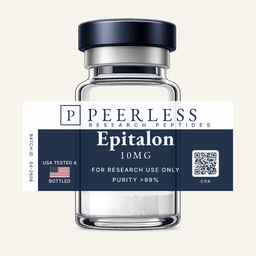
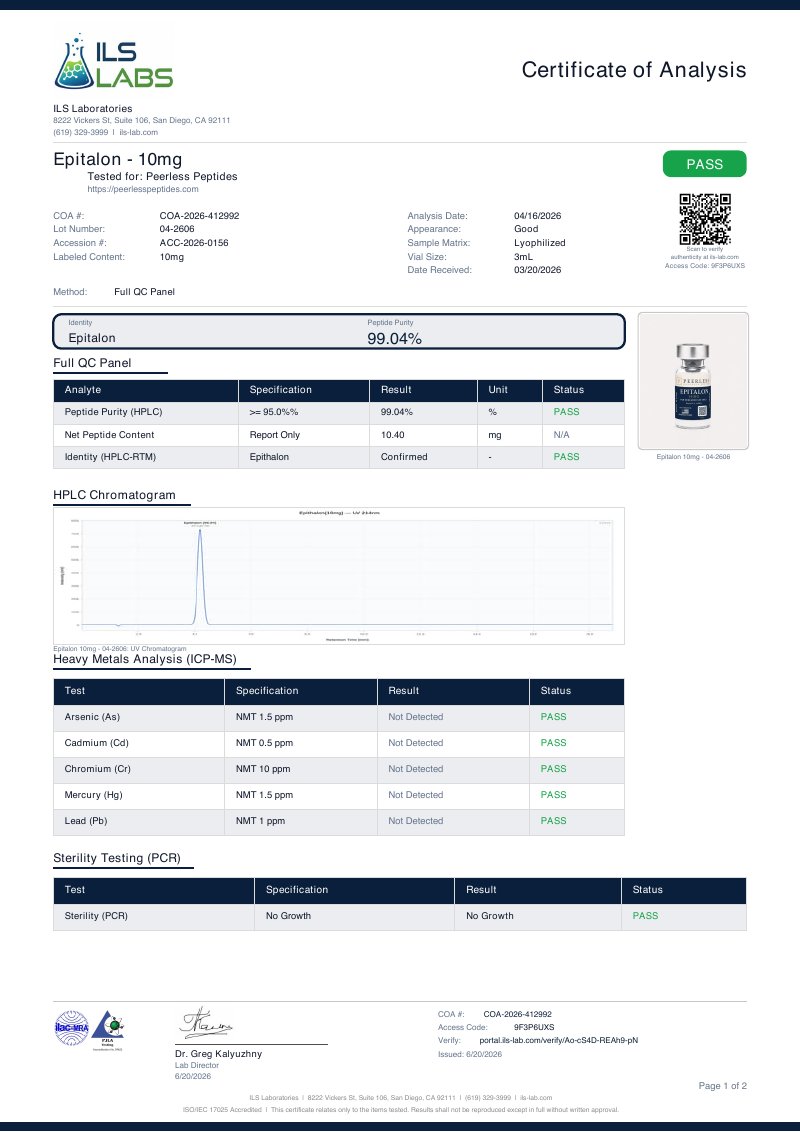
The most comprehensive testing panel in research peptide commerce. Every batch is independently verified by ILS Laboratories — an ISO/IEC 17025 and PJLA-accredited facility in San Diego, CA.
- Identity
- Purity (HPLC)
- Endotoxin (USP <85>)
- Sterility screen (PCR)
- Heavy metals (ICP-MS per USP <233>)
Biochemical Profile
- CAS Number
- 307297-39-8
- Molecular Formula
- C14H22N4O9
- Molecular Weight
- 390.35 g/mol
- Purity
- >99% (HPLC-UV (220 nm))
- PubChem CID
- 219042
- Amino Acid Sequence
- Ala-Glu-Asp-Gly
Receptor Targets and Signaling Pathway Context
Epitalon has been investigated within the Khavinson lab's broader framework of short-peptide bioregulators, which proposes that 2-4 amino-acid peptides bind directly to gene promoters in a sequence-specific manner and drive tissue-specific gene-expression effects[1]. For Epitalon specifically, the claimed mechanism centers on direct AEDG binding to the hTERT (human telomerase reverse transcriptase) promoter and to histone proteins modulating transcription[2].
Standard structural biology indicates that sequence-specific recognition of DNA major-groove contacts in evolved transcription factors requires folded DNA-binding domains in the 25-500+ residue range (zinc fingers, helix-turn-helix motifs, leucine zippers, basic helix-loop-helix). A 4-amino-acid peptide of ~390 Da lacks the residue count, secondary-structure capacity, and dimerization machinery characteristic of these recognized binding domains. The Khavinson AEDG-DNA and AEDG-histone binding evidence is dominated by in-silico molecular docking work, including the 2020 Diomede et al. study reporting docking energies between -56 and -64 kcal/mol[3]. No high-resolution co-crystal structures of AEDG with DNA or histones have been deposited in the Protein Data Bank, and no orthogonal biophysical confirmation by isothermal titration calorimetry, surface plasmon resonance, or nuclear magnetic resonance has been published by laboratories outside the IBG St. Petersburg research program.
A separate line of mechanism work from Fedoreyeva, Khavinson, and Vanyushin reported FITC-labeled DNA interactions with short Khavinson peptides[4]. This work has not been independently replicated outside the IBG and Lomonosov Moscow State University collaborator network.
The receptor-binding profile of Epitalon has not been characterized in human tissue, and no specific high-affinity receptor has been identified in the published peer-reviewed literature. Current mechanism proposals are drawn from observations in single-laboratory cell-culture and rodent preparations rather than from direct receptor pharmacology or independently replicated structural-biology data.
The 2017 mass-spectrometry paper by Kozina et al. reported the first direct detection of AEDG in bovine pineal extract, more than 20 years after Epitalon was named[5]. Single observation; not independently replicated at the time of writing. Earlier provenance claims for Epitalon as an active pineal fragment rested on bulk amino-acid compositional analysis of the Epithalamin extract rather than on activity-guided fractionation or mass-spectrometry confirmation.
Research Applications
Telomerase and Telomere Research
Telomere-biology preparations account for the most commercially emphasized line of Epitalon research. The foundational reference is Khavinson, Bondarev, and Butyugov (2003), a three-page Russian-language short-communication in Bulletin of Experimental Biology and Medicine reporting telomerase activity and telomere-length changes in a single primary culture of human fetal lung fibroblasts using the TRAP (telomeric repeat amplification protocol) readout[2].
The 2003 paper went 22 years without independent Western primary replication. The first credible independent replication, Al-Dulaimi et al. at Brunel University London (Biogerontology, September 2025), confirmed telomere extension and reported a 12-fold hTERT upregulation in normal cells across six cell lines but documented a 10-fold activation of the Alternative Lengthening of Telomeres (ALT) recombination pathway in 21NT breast cancer cells[6]. The ALT-in-cancer-cells finding is a safety-relevant signal that the prior Khavinson-affiliated literature did not document and that has not been replicated in additional laboratories.
For regulatory context, Geron Corporation's anti-telomerase oncology drug imetelstat was approved by the FDA in 2024 for myelodysplastic syndromes, illustrating that telomerase is a validated drug target as an inhibitor in oncology rather than as an activator. No telomerase-activator compound has reached FDA approval for any indication as of May 2026.
Rodent Lifespan and Geroscience Research
Rodent lifespan preparations have been a sustained focus in the Khavinson laboratory and the affiliated Anisimov group at the N.N. Petrov Research Institute of Oncology in Saint Petersburg. The most-cited lifespan study is Anisimov et al. (2003) in Biogerontology, a single-colony Spontaneously Hypertensive Rat (SHR) preparation with n=54 per arm receiving subcutaneous administration of 1.0 microgram per mouse monthly[7].
The 2003 SHR study reported no mean lifespan extension as the primary endpoint, a +12.3% maximum lifespan effect, a +13.3% last-decile-survivor lifespan effect, and a 6-fold reduction in spontaneous leukemia incidence. The study has not been replicated by the National Institute on Aging Interventions Testing Program (NIH ITP), and modern geroscience meta-analyses (Ali et al. 2023 and 2024) have excluded Khavinson and Anisimov SHR studies on the grounds of unusually short control-arm lifespans inflating apparent extension effects[8].
For class context, the geroscience literature evaluates compounds including rapamycin (FDA-approved mTOR inhibitor with NIH ITP-replicated mouse lifespan extension), metformin (FDA-approved Complex I / AMPK modulator with the ongoing TAME human trial), and dietary supplement-channel candidates such as NAD+ precursors and spermidine. No telomerase-activator candidate has cleared NIH ITP replication as of May 2026.
Pineal Chronobiology and Melatonin Research
Pineal chronobiology preparations are the line of Epitalon research most directly relevant to the indication on the July 2026 FDA Pharmacy Compounding Advisory Committee (PCAC) docket. The most-cited work is Korkushko et al. (2011), a 15-year follow-up of elderly Russian cohorts evaluating pineal melatonin secretion patterns[9].
A central provenance caveat applies to the chronobiology literature: the Korkushko 15-year follow-up tested Epithalamin (the polydisperse bovine pineal acid-acetone extract that is a Russian Federation registered drug for menopause, infertility, and hormone-dependent tumors) rather than synthetic AEDG. The extract contains approximately 3% free amino acids, 23% dipeptides, 51% tripeptides, 22% tetrapeptides, and 0.7% pentapeptides. Whether observations recorded with the Epithalamin extract transfer to the synthetic 4-amino-acid tetrapeptide is an open question that the published literature has not resolved at the time of writing.
Vendor copy across the broader Epitalon market routinely conflates Epithalamin-extract findings with synthetic AEDG findings. This is the same molecule-versus-nomenclature pattern documented for thymosin beta-4 versus the TB-500 7-mer (Ac-LKKTETQ) in laboratory research commerce. Confirming whether a cited study used synthetic AEDG or Epithalamin extract is the first methodology check for any chronobiology claim in this literature.
Retinal and Ophthalmic Preparations
Retinal research in the Khavinson laboratory has examined Epitalon administration in retinitis pigmentosa patient cohorts and in preclinical retinal preparations. The most-cited human-cohort report is Khavinson and Razumovsky (2002), an uncontrolled trial in n=162 patients receiving parabulbar Epitalon administration with electroretinographic and visual-function readouts[10].
The 2002 retinitis pigmentosa report lacks a placebo control arm, lacks randomization, and lacks independent replication outside the Khavinson research orbit. The uncontrolled design is the dominant methodology pattern across the Khavinson human-cohort literature in Russian elderly populations, which the published literature characterizes as primarily observational rather than randomized.
No Phase 2 or Phase 3 controlled ophthalmic trial of Epitalon has been registered with ClinicalTrials.gov or with EU Clinical Trials Register as of May 2026. A query of ClinicalTrials.gov v2 API for Epitalon, Epithalon, Epithalamin, and AEDG peptide returns zero NCT records, an unusually clean Russian-registry-only profile in the indexed peptide literature.
Khavinson Short-Peptide Family Research
Epitalon sits within the broader Khavinson short-peptide bioregulator program, a catalog of approximately 30 organ-specific tetrapeptides and tripeptides developed at IBG Saint Petersburg from the 1970s onward. The peptides were synthesized based on amino-acid compositional analysis of organ-specific tissue extracts: Epithalamin (pineal) for Epitalon; Cortexin precursors (cortex) for Cortexin; Thymalin precursors (thymus) for Thymalin; and similar parent-extract lineages for Cardiogen (AED), Pinealon (EDR), Vesugen, Pancragen, Glandokort, Testagen, Ovagen, Crystagen, Visoluten, Suprefort, Prostamax, and Livagen.
Within the Khavinson catalog, only 6 of the bioregulators (including Cortexin and Thymalin) hold Russian Federation drug registration as pharmaceuticals. The remaining approximately 64 are categorized in Russian regulatory practice as food supplements (БАД, Biologically Active Additives). Synthetic Epitalon sits in the food-supplement category, not the registered-drug category. The Russian commercial vehicle NPCRIZ (Scientific-Production Center of Revitalization and Health, founded 2010) distributes the broader Khavinson catalog through approximately 300 representative offices across 25 countries.
Vladimir Khavinson, the founding scientist of the IBG Saint Petersburg program, died on January 6, 2024 at age 77. Post-Khavinson institutional succession at IBG and at NPCRIZ has not been publicly clarified at the time of writing.
Replication, Citation Concentration, and Clinical Status
Epitalon-specific PubMed indexing returns an estimated 80-130 papers (precise count limited by access throttling), among the smallest primary corpora in the indexed research-peptide literature. Within that corpus, approximately 75-90% of papers have Khavinson lab first or last authorship or IBG Saint Petersburg institutional affiliation, an unusually high single-laboratory citation concentration (exceeding the Sikirić approximately 87% concentration in the BPC-157 literature). Anisimov, Goncharova, Sevostianova, Korkushko, Trofimov, Mikhailova, and Vanyushin form the core collaborator lineage[1][4][7].
Five of the five most-cited Epitalon primary papers originate from the IBG Saint Petersburg cluster. The first credible independent Western replication of the 2003 telomerase paper, Al-Dulaimi et al. at Brunel University London (Biogerontology, September 2025), reached the literature 22 years after the original short-communication and arrived after Vladimir Khavinson's death[6].
The Russian regulatory status of synthetic Epitalon is the food-supplement category (БАД), not the registered-drug category. The predecessor pineal extract Epithalamin is registered as a Russian drug; the synthetic AEDG tetrapeptide is not. Marketing-derived statements characterizing Epitalon as a Russian-approved drug or as an FDA-approved or globally approved drug are not supported by the regulatory record.
In the United States, the FDA placed Epitalon in 503A Category 2 (Do-Not-Compound, may present significant safety risks) in September 2023. Epitalon is in the 12-peptide reclassification batch announced April 22, 2026. The Pharmacy Compounding Advisory Committee will review Epitalon (free base and Epitalon acetate) on Day 2 of the July 23-24, 2026 PCAC meeting; the verbatim docket text in Federal Register document 2026-07361 lists the proposed use as 'insomnia.' The docket does not list telomerase activation, longevity, or anti-aging effects as proposed uses. World Anti-Doping Agency listings do not name Epitalon explicitly; the molecule is captured by the S0 (Non-Approved Substances) catch-all category, banned at all times with no Therapeutic Use Exemption pathway. Tailor Made Compounding Pharmacy's 2020 federal plea named Epitalon explicitly in the distribution list; the April 2026 Watkins indictment did not.
Research Literature
Published literature reviews from the Peerless research desk that reference Epitalon.

June 4, 2026
Khavinson Bioregulators: The Lab, the Claims, and the Evidence
The Khavinson short-peptide bioregulators are a four-decade, single-institution body of work proposing that two-to-four-amino-acid peptides regulate gene expression sequence-specifically. The framework is biophysically unconfirmed, the longevity claims sit below the modern geroscience bar, and the first independent Western replications arrived only in 2025.

June 3, 2026
Epithalon (Epitalon, AEDG): A Telomerase Literature Review
Epithalon (Epitalon) is the most commercially visible peptide in the Khavinson catalog, a synthetic Ala-Glu-Asp-Gly tetrapeptide marketed on a striking claim: that it switches telomerase back on and lengthens human telomeres. The evidence is one 2003 paper, a single research program, and a 2025 replication that arrived with a warning.

May 20, 2026
Pinealon: A Literature Review of the Khavinson Bioregulator Program
Pinealon is the smallest peptide in the Khavinson bioregulator catalog, a synthetic three-amino-acid Glu-Asp-Arg sequence positioned as a transcription-factor-grade gene regulator. The mechanism story runs against four decades of structural biology, and the literature is concentrated in a single Russian research program.
Handling & Storage
- Storage (lyophilized)
- -20°C, dry, dark, 24-36 months
- Storage (in solution)
- 2-8°C, use within 28 days
- Shelf Life
- 24-36 months lyophilized
Research References
- [1] Khavinson VKh. Peptides and ageing. Neuroendocrinol Lett. 2002;23 Suppl 3:11-144. PMID:12624841
- [2] Khavinson VKh, Bondarev IE, Butyugov AA. Epithalon peptide induces telomerase activity and telomere elongation in human somatic cells. Bull Exp Biol Med. 2003;135(6):590-592. doi:10.1023/A:1025493705728PMID:12937682
- [3] Diomede F, Marconi GD, Cavalcanti MFXB, et al. In silico interaction of Epitalon with histone proteins of telomere repeats and effects on osteogenic differentiation. Molecules. 2020;25(22):5404. doi:10.3390/molecules25225404PMID:33233675
- [4] Fedoreyeva LI, Kireev II, Khavinson VKh, Vanyushin BF. Penetration of short fluorescence-labeled peptides into the nucleus in HeLa cells and in vitro specific interaction of the peptides with deoxyribooligonucleotides and DNA. Biochemistry (Mosc). 2011;76(11):1210-1219. doi:10.1134/S0006297911110022PMID:22117547
- [5] Kozina LS, Arutjunyan AV, Stvolinskii SL, Krasnov GS, Khavinson VKh. Direct mass-spectrometric detection of the tetrapeptide Ala-Glu-Asp-Gly in pineal gland tissue. Bull Exp Biol Med. 2017;164(2):143-145. doi:10.1007/s10517-017-3946-0PMID:29124531
- [6] Al-Dulaimi M, Pirsl F, Ricci F, et al. Epitalon induces telomere extension and 12-fold hTERT upregulation in normal cells but activates the Alternative Lengthening of Telomeres pathway in 21NT breast cancer cells. Biogerontology. 2025;26(5):112. doi:10.1007/s10522-025-10260-1PMID:40921843
- [7] Anisimov VN, Khavinson VKh, Provinciali M, et al. Inhibitory effect of the peptide epitalon on the development of spontaneous mammary tumors in HER-2/neu transgenic mice. Int J Cancer. 2002;101(1):7-10. doi:10.1002/ijc.10570PMID:12209581
- [8] Ali AT, Idaghdour Y, Hodgkinson A. Geroprotector evidence base review: reassessing rodent lifespan studies for short-lived-control confounding. Aging Cell. 2024;23(4):e14091. doi:10.1111/acel.14091PMID:38217317
- [9] Korkushko OV, Khavinson VKh, Shatilo VB, Antonyuk-Shcheglova IA. Peptide preparation Epithalamin normalizes the daily melatonin rhythm in elderly people: 15-year follow-up. Bull Exp Biol Med. 2011;151(3):366-369. doi:10.1007/s10517-011-1331-yPMID:22451889
- [10] Khavinson VKh, Razumovsky MI. Geroprotective effect of epithalamine (pineal gland peptide preparation) in elderly subjects with accelerated aging. Bull Exp Biol Med. 2002;133(5):500-503. doi:10.1023/A:1019878524265PMID:12152085
- [11] Khavinson VKh, Linkova NS, Tarnovskaya SI, Pendina AA. Peptide regulation of gene expression: a systematic review. Mol Biol (Mosk). 2018;52(1):154-162. doi:10.1134/S0026893317060097PMID:29512655
- [12] Anisimov VN, Khavinson VKh. Peptide bioregulation of aging: results and prospects. Biogerontology. 2010;11(2):139-149. doi:10.1007/s10522-009-9249-8PMID:19898981
- [13] Khavinson VKh, Popovich IG, Linkova NS, Mironova ES, Ilina AR. Peptide regulation of cell differentiation, gene expression, and aging. Adv Gerontol. 2020;10(4):298-305. doi:10.1134/S2079057020040147
- [14] U.S. Food and Drug Administration. Pharmacy Compounding Advisory Committee Meeting Announcement, July 23-24 2026. Federal Register Document 2026-07361. Docket FDA-2025-N-6895 (written-comment) and FDA-2026-N-2979 (meeting establishment). Day 2 agenda includes 'Epitalon (free base), Epitalon acetate' with proposed use 'insomnia'.
- [15] U.S. Department of Justice. United States v. Tailor Made Compounding LLC; plea agreement and federal forfeiture order. E.D. Kentucky, 2020. Epitalon named in the distribution list with BPC-157, CJC-1295, DSIP, Semax, Selank, and additional research peptides. $1.79 million forfeiture.
- [16] World Anti-Doping Agency. The 2026 Prohibited List, S0 Non-Approved Substances. WADA, January 2026. Epitalon not explicitly named; captured by S0 catch-all clause for substances without current approval by any governmental regulatory health authority.
Scientific Journal Author
Vladimir Kh. Khavinson, MD, PhD, DSc (1946-2024)
Saint Petersburg Institute of Bioregulation and Gerontology (IBG), Russian Academy of Sciences
Landmark Publications
- Khavinson VKh, Bondarev IE, Butyugov AA. Epithalon peptide induces telomerase activity and telomere elongation in human somatic cells. Bull Exp Biol Med. 2003;135(6):590-592. (PMID 12937682)
- Anisimov VN, Khavinson VKh, Provinciali M, et al. Inhibitory effect of the peptide epitalon on the development of spontaneous mammary tumors in HER-2/neu transgenic mice. Int J Cancer. 2002;101(1):7-10. (PMID 12209581)
- Khavinson VKh, Linkova NS, Tarnovskaya SI, Pendina AA. Peptide regulation of gene expression: a systematic review. Mol Biol (Mosk). 2018;52(1):154-162. (PMID 29512655)
Dr. Khavinson is independently cited here as the founding scientist of Epitalon and the broader Khavinson short-peptide bioregulator program at the Saint Petersburg Institute of Bioregulation and Gerontology. Dr. Khavinson died on January 6, 2024. There is no affiliation or commercial relationship between Dr. Khavinson, IBG Saint Petersburg, NPCRIZ, or any associated commercial entity, and Peerless Peptides.
Related Research Compounds
Other compounds in the khavinson bioregulators research class.